


When we first found out we were moving to India for a couple of years back in 2004, we had all of three weeks to prepare - to figure out what to do with the house, the furniture, schooling in India for my son, how much stuff to take, what to leave behind, etc.
When the time came to head back to the US, we'd basically had all of the time we lived in India to prepare, but it was not enough, not by a long shot. When we left the US, we were coming to live close to family, close to our parents, brothers, sisters-in-law, aunts, uncles, cousins, and all our extended families who were minutes away rather than days away. We are heading back now to being our little unit again (although our number has increased by one more than we were when we came - my daughter who was born in Bangalore last year).
The house buzzed with activity for a week. Closets were emptied, clothes, shoes and toys given away, the pantry and refrigerator cleared. The pungent smell of reams and reams of packing cardboard and paper vied with the screeching noise of duct tape as it was torn off and plastered on everything from the tiniest spoon to the largest piece of furniture. The packers started off slowly and, fortified by many cups of tea made in the last saucepan remaining, became frenzied as the hours ticked away there were the pesky last few items still to be packed.
The whirlwind of packing and organizing the other aspects of the move had kept all our emotions under the lid. As was to be expected, there was a time crunch at the end. In the rush of taking care of the things on my list, there was, thankfully, no time for emotional, tearful goodbyes. My parents siezed the opportunity when it presented itself to make a quick get away (they had decided not to come to the airport) and my son and I waved them off in cheery tones and rushed right back into the house to finish packing the very last suitcase.
One final walk around the house and it was time to head to the airport. Just as we had finished checking in all our luggage is when the lid decided to come off. My son and my father, who had spent a lot of time together during our stay in Bangalore doing grandson-grandfather stuff, were the two people I was most concerned about. The finality of the move back sank in with my son at the airport check-in counter and with my parents on the long drive back from our house to theirs late at night. A single tear drop rolled down my son's cheek and landed on his watch followed in quick succession by many others and my own.
As is typical of children, he tried various permutations and combinations of living arrangements that would allow him to spend time with his grand-parents while allowing them to have their lives and family connections and him to continue on with his life in the US, negotiating right up to the point we got on the plane. Then, again, as is typical of children, the excitement of the journey caught up with him and the new TV/light/dinner table configuration on the plane took up all his attention.
There's a lot more adjustment to come, of course, once we are properly settled in at home in the US, but I am grateful for this opportunity we had after more than a decade to actually spend more than the three weeks we could scrape together during holidays in our hometown.
This, in brief, is the story of the change in dateline on the blog. There are a lot more posts on life in Bangalore coming up and about parenting and travel. I do hope you will continue reading.
Wednesday, May 23, 2007


Wednesday, May 16, 2007
Book Review: The Burden of Foreknowledge, Jawahara Saidullah
The river whispers maddening things to me in a slow, sinuous rhythm that wraps itself around me.... Her voice burrows within me, flowing inside me. 'Nadee...' she says, in a fluent, gentle cadence, 'there is only one way out of this trap....' Her words rush into each other, colliding and bursting like bubbles in the air before slithering into my ears, filling my mind until they crowd out every other thought, leaving me at her mercy. Others are oblivious to her insidious, hissing, sibilance and go about their business.Thus read the initial passages of Chapter Four in The Burden of Foreknowledge. Sensuous writing that transports you from the mundane to a plane where all your senses are on high alert is the hallmark of this fine first novel by Jawahara Saidullah.
Over the past few days, I've read this book in a few different settings - at home on the sofa, in bed, in airport lounges and hotel rooms. But each time I pulled my eyes away from the book, it was mildly shocking to come back to my surroundings and realize where I was.
The story is about a young girl we come to know as Nadee and the tragedies that befall her, starting with the loss of her entire family to a flood in the first chapter of the book. From then on, the novel arcs its way, with Nadee, to Kashi (where the raging Ganga dumps her, the sole survivor), Agra and Fathehpur Sikri where Nadee encounters the final twist of her fateful life. All through the book, glimpses of what is about to come flash on the pages as Nadee recounts the visions of the future that come to her, enticing you to read on. Nadee's suffering and her emotionally deadened state are made all the more poignant and stark by the sensory imagery that pervades the novel.
Set in the late 1500s in the time of Emperor Akbar, Burden is chock full of finely etched characters that the author has somehow acquired intimate, thorough knowledge of. Imagining the goings on in a time five hundred years ago is difficult enough, but to imagine them with the kind of detail that is on exhibit throughout the novel is quite something else.
I particularly liked the descriptions of life in the "house of culture", the "house of passion and longing" in Agra and its cast of characters - Nafasat Bai, Amma Jaan, the multitude of servants, the patrons and the rooms in the cavernous house which seem to have lives of their own. Some characters and events are familiar, from the history books of high school, but the novel casts them in a new light, enabling you to see them through Nadee eyes, feelings and individual circumstances. The assured advances of the plot through the familiar terrains of history are a delight.
If you are up for a great story, warmly told, one that transports you to other worlds and constantly leaves you surprised, breathless, feeling that tiny bit off-center and wanting more, then I highly recommend The Burden of Foreknowledge.
The Burden of Foreknowledge
Pages: 178
Price: Rs 295
Monday, May 14, 2007
Review: Lulu.com's Self-Published Children's Literature
Once upon a time, there was a baby polar bear who was a very picky eater; there were two girls, Orelda and Corelda, who went on a cruise aboard a ship called the S.S. Rottensteamer; there was Orangie the orange, who wanted, more than anything, to be back among his friends on the orange tree in the orange grove; and there was a boy who liked to play and not go to bed at the end of the day because the night monsters were waiting for him.
If these sound like stories you might have read to your children or might want to read to your children, you're right. These are children's stories. But what is unique about the books these four stories came out of is that they are all self-published books. The authors decided they had stories to tell and they were good enough to be published and they went ahead and did it themselves.
And the stories are good, very good. They are fun to read (even for me), very well told, they have excellent illustrations accompanying them and the books are slickly produced.
Potato Soup, written and illustrated by Phil Weinstein, is a heartwarming story about a baby polar bear who is a picky eater and how his parents got him to eat soup with a whole lot of different vegetables. This story reminded me of the time I used to read Green Eggs and Ham to my son and for months afterward we used to repeat the idea that although we think we might not like something at first, if we just tried it we might end up liking it after all.
I particularly liked the illustrations in this book. The polar bears look warm and cuddly and the picturization is appealing.
The Book of Monsters by Jamie Melani Marshall is a lovely story of how a young boy gets over his fear of monsters in his room at night. He decides to follow the monsters to their abode one night and discovers that there was nothing to fear after all.
The author has illustrated the story herself and the colorful drawings are a major attraction. They are stylized and it's fun to pore over the pictures trying to find small details relating to the story. The text is in simple rhyme and the language is easy on the early reader.
Orelda and Corelda's Ocean Voyage by George and Leslie Nazarian is, as the title suggests, a travel adventure book and coloring book in one. Any journey is fascinating and a cruise especially so. Children will love this story as much for the cool stuff the two girls and Oradillo, their friend, get to do on the ship as for the opportunity to color the pictures using their own imagination of how a cruise might feel. It's a great book to carry along on a trip.
Orangie, by Tempie Johnson, recounts the journey of Orangie the Orange from his tree in the orchard to the supermarket and back. It's a simple story, simply told, but is a life lesson for little children in kindness and humanity. It has the feel of a story that grandma would make up on the spot by your bedside - the best kind of story there is - and for this reason, children will find it attractive.
Perhaps because these are self-published books, I get the feeling that we, the readers, are privy to a little bit more of the authors' personalities. We find out, for example, that Tempie Johnson has been telling her story for ages, and that her son Stephens, finally got her story published. We read about the origins of Phil Weinstein's story at the back of the book in a personal note from the author that most parents will relate to immediately.
In Marshall's book, the usually boring bio and information about the book is replaced by,
If you are an author interested in publishing your book yourself, given the quality of the books I've described above, Lulu.com appears to be an valuable resource. The FAQ is useful to get to started in case you are interested in exploring their services.
They also have a handy catalogue that you can search by genre and popularity if you are interested in buying the books. The books have been rated by customers and the rating appears in the blurb related to each book on the web page.
If these sound like stories you might have read to your children or might want to read to your children, you're right. These are children's stories. But what is unique about the books these four stories came out of is that they are all self-published books. The authors decided they had stories to tell and they were good enough to be published and they went ahead and did it themselves.
And the stories are good, very good. They are fun to read (even for me), very well told, they have excellent illustrations accompanying them and the books are slickly produced.
Potato Soup, written and illustrated by Phil Weinstein, is a heartwarming story about a baby polar bear who is a picky eater and how his parents got him to eat soup with a whole lot of different vegetables. This story reminded me of the time I used to read Green Eggs and Ham to my son and for months afterward we used to repeat the idea that although we think we might not like something at first, if we just tried it we might end up liking it after all.
"We're gonna need some corn," the daddy polar bear said. "Corn?! I don't like corn!" the baby polar bear said. "I only like potatoes! Potatoes, potatoes, potatoes!"In this manner, the baby polar bear adds one vegetable after another into the soup and in the end ends up liking the soup and all the vegetables that went into the making of it.
"It's OK, it's OK," said the daddy polar bear. "We need corn to make potato soup." "All right, all right," said the baby polar bear. "I'll get some corn but I'm not gonna like it and I'm not gonna eat it!"
I particularly liked the illustrations in this book. The polar bears look warm and cuddly and the picturization is appealing.
The Book of Monsters by Jamie Melani Marshall is a lovely story of how a young boy gets over his fear of monsters in his room at night. He decides to follow the monsters to their abode one night and discovers that there was nothing to fear after all.
The author has illustrated the story herself and the colorful drawings are a major attraction. They are stylized and it's fun to pore over the pictures trying to find small details relating to the story. The text is in simple rhyme and the language is easy on the early reader.
Orelda and Corelda's Ocean Voyage by George and Leslie Nazarian is, as the title suggests, a travel adventure book and coloring book in one. Any journey is fascinating and a cruise especially so. Children will love this story as much for the cool stuff the two girls and Oradillo, their friend, get to do on the ship as for the opportunity to color the pictures using their own imagination of how a cruise might feel. It's a great book to carry along on a trip.
Orangie, by Tempie Johnson, recounts the journey of Orangie the Orange from his tree in the orchard to the supermarket and back. It's a simple story, simply told, but is a life lesson for little children in kindness and humanity. It has the feel of a story that grandma would make up on the spot by your bedside - the best kind of story there is - and for this reason, children will find it attractive.
Perhaps because these are self-published books, I get the feeling that we, the readers, are privy to a little bit more of the authors' personalities. We find out, for example, that Tempie Johnson has been telling her story for ages, and that her son Stephens, finally got her story published. We read about the origins of Phil Weinstein's story at the back of the book in a personal note from the author that most parents will relate to immediately.
In Marshall's book, the usually boring bio and information about the book is replaced by,
The Book of Monsters (a bedtime story) is author Jamie Melanie Marshall's first book. It's not that bad. Really. It's pretty good. You should probably buy it. Unless of course...There's a long list of such helpful suggestions and I have a feeling young children will love reading something of this nature addressed to them directly by the author.
You have no money with which to buy the book (this is sad. Perhaps if you wrote a letter to the author, she would take pity on you and send you a copy. If you can't write either, a simple handprint or droolmark will do.)
If you are an author interested in publishing your book yourself, given the quality of the books I've described above, Lulu.com appears to be an valuable resource. The FAQ is useful to get to started in case you are interested in exploring their services.
They also have a handy catalogue that you can search by genre and popularity if you are interested in buying the books. The books have been rated by customers and the rating appears in the blurb related to each book on the web page.
Friday, May 11, 2007
Diaper wipes are ...
great for cleaning monitor screens and keyboards.
If there is something horribly wrong with this, please don't tell me. I'm in squeaky clean heaven right now.
If there is something horribly wrong with this, please don't tell me. I'm in squeaky clean heaven right now.
Wednesday, May 09, 2007
Grasshopper Restaurant, Bangalore
I don't remember a single conversation from all the times I've been to the Grasshopper, but my memories are all of good times spent with good friends enjoying good food in a lovely ambience.
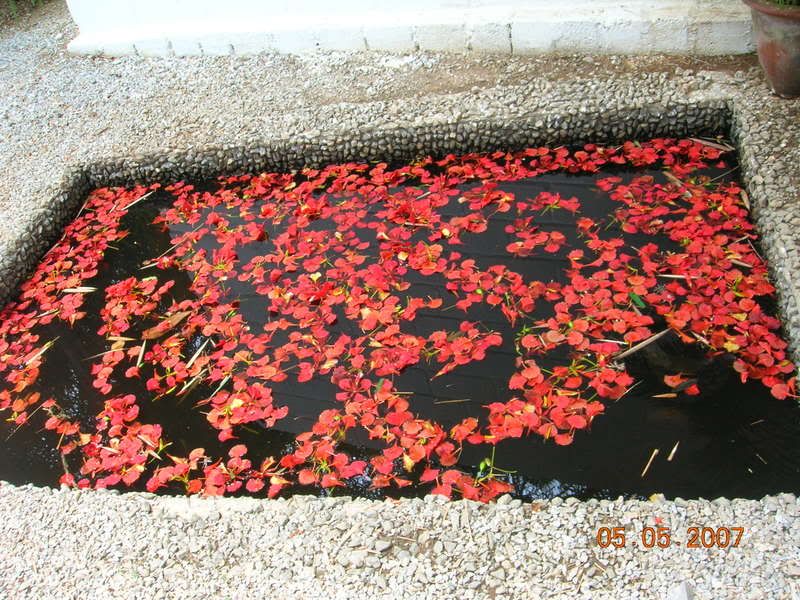
Grasshopper is housed in a farm on the outskirts of Bangalore off of Bannerghatta Road just past the Meenakshi temple (it's about a 30-minute drive from Jayanagar). The surroundings are beautiful with large, mature trees, some of them mango and sapota (chikoo), and a vegetable garden out in the front. A gravelled pathway laid with stones takes you past an industrial looking building on the right and a small pond on the left.
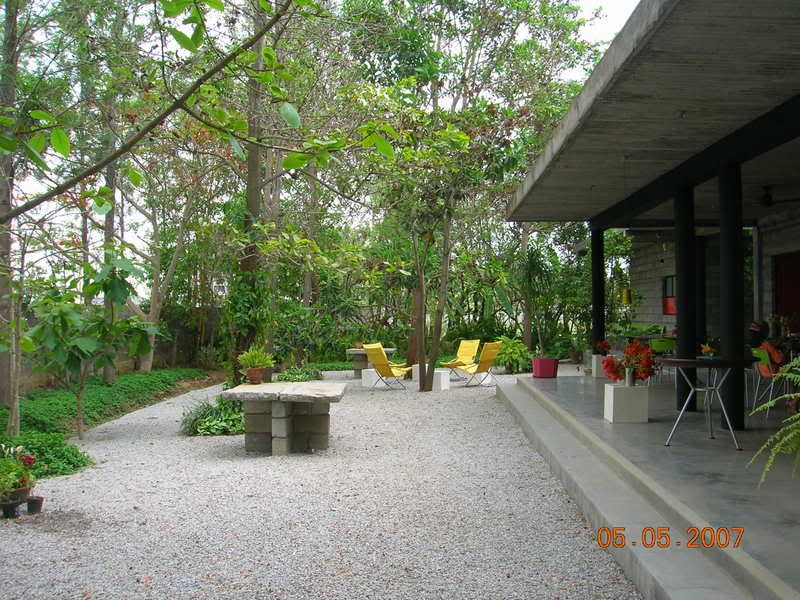
The path leads to a long, wide corridor on your right supported by beams and looking out on to a wide expanse of gravelly ground set with stone benches and more trees.
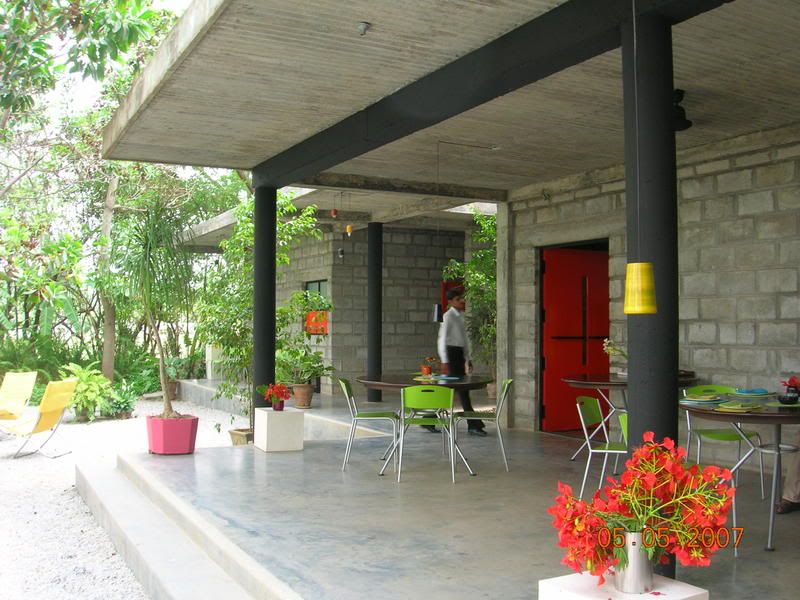
The corridor is the main seating space for the patrons with the gravelly yard serving as overflow space.
As you can imagine, space is tight and reservations are a must and at least a day before. The restaurant does not cater to walk-in patrons.
The first time we visited Grasshopper we did not know what to expect. One of our friends had heard about it, knew they served salads (after months of Indian food, one thing I positively crave is a salad fix) and that was good enough reason to go check it out.
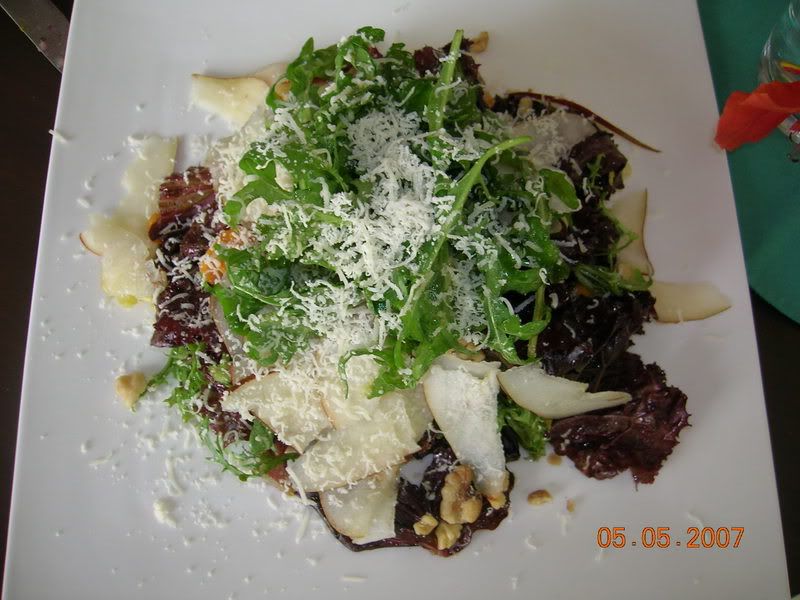
We called for reservations and the owner, Sonali, asked details about who would eat what - if there were vegetarians in the group, if everyone would eat sea food, whether there were any dietary restrictions and so on. What we found when we went there the next day is the equivalent of a gastronomic oasis of understated continental cuisine in a spice-mad country. The menu is set (eliminating the bother of the menu-perusing and dish-choosing ritual) and the dishes in the seven-course meal are brought out one by one at an unhurried pace.
Since then we've gone back a few times, some times with children, other times not. Children love the space to run around in and to explore the various nooks and crannies on the farm. There are a few beautiful dogs on the farm that become instant friends with the children.
The food is excellent. The combination of the fresh raw materials and the flavors brought together with the minimum of interference in the kitchen is truly a delight to savor. I suddenly realized the last time we were there that the warm breads served right at the beginning to get you started are the only carbohydrates you will get during the entire meal.
The combination of the unhurried service, the quiet surroundings, the uncrowded atmosphere (at the most you can expect one other group to be seated next to you during your entire stay there), the homely feel all combine to relax your senses and let loose. Conversation flows easily and a general feeling of bonhomie envelopes you by the time desert and coffee roll around at the end of about the three or four hours.
All this comes at a price, as you might have guessed. Lunch and dinner are priced at around Rs. 1,500 per person (drinks not included). I understand Grasshopper serves a shorter version during weekdays at lunchtime.
Grasshopper also houses a fashion boutique with designer clothes, sandals and jewellery for sale.
Reservations tel. no.: 98454 52646.
Grasshopper is housed in a farm on the outskirts of Bangalore off of Bannerghatta Road just past the Meenakshi temple (it's about a 30-minute drive from Jayanagar). The surroundings are beautiful with large, mature trees, some of them mango and sapota (chikoo), and a vegetable garden out in the front. A gravelled pathway laid with stones takes you past an industrial looking building on the right and a small pond on the left.
The path leads to a long, wide corridor on your right supported by beams and looking out on to a wide expanse of gravelly ground set with stone benches and more trees.
The corridor is the main seating space for the patrons with the gravelly yard serving as overflow space.
As you can imagine, space is tight and reservations are a must and at least a day before. The restaurant does not cater to walk-in patrons.
The first time we visited Grasshopper we did not know what to expect. One of our friends had heard about it, knew they served salads (after months of Indian food, one thing I positively crave is a salad fix) and that was good enough reason to go check it out.
We called for reservations and the owner, Sonali, asked details about who would eat what - if there were vegetarians in the group, if everyone would eat sea food, whether there were any dietary restrictions and so on. What we found when we went there the next day is the equivalent of a gastronomic oasis of understated continental cuisine in a spice-mad country. The menu is set (eliminating the bother of the menu-perusing and dish-choosing ritual) and the dishes in the seven-course meal are brought out one by one at an unhurried pace.
Since then we've gone back a few times, some times with children, other times not. Children love the space to run around in and to explore the various nooks and crannies on the farm. There are a few beautiful dogs on the farm that become instant friends with the children.
The food is excellent. The combination of the fresh raw materials and the flavors brought together with the minimum of interference in the kitchen is truly a delight to savor. I suddenly realized the last time we were there that the warm breads served right at the beginning to get you started are the only carbohydrates you will get during the entire meal.
The combination of the unhurried service, the quiet surroundings, the uncrowded atmosphere (at the most you can expect one other group to be seated next to you during your entire stay there), the homely feel all combine to relax your senses and let loose. Conversation flows easily and a general feeling of bonhomie envelopes you by the time desert and coffee roll around at the end of about the three or four hours.
All this comes at a price, as you might have guessed. Lunch and dinner are priced at around Rs. 1,500 per person (drinks not included). I understand Grasshopper serves a shorter version during weekdays at lunchtime.
Grasshopper also houses a fashion boutique with designer clothes, sandals and jewellery for sale.
Reservations tel. no.: 98454 52646.
Friday, May 04, 2007
Review Blogpourri at Guardian Abroad
If you are so inclined, please take a minute (or three) to review Blogpourri at Guardian Abroad. The Guardian has a bunch of blogs on various topics listed under "Your Blogs" and "Expat Life (the truth is out there)" is one of the topics.
Here's the link to the place where you can review this blog. There's also a link on the side bar on the right. Muchos gracias!
Here's the link to the place where you can review this blog. There's also a link on the side bar on the right. Muchos gracias!
Coming Back Home to Rice, Dal, Ghee and Pickle
We were away for five days in Bangkok and Hanoi. Let me just say it's wonderful to come back to dosas and spicy coconut chutney for breakfast and hot rice, leftover dal (six day-old dal was surprisingly good, or perhaps tomorrow I'll be singing a different tune, eh?), and ghee and pickle for lunch. Yum, yum.
Subscribe to:
Posts (Atom)