Showing posts with label Travel. Show all posts

Tuesday, April 28, 2015

Lincoln Cottage: Washington, D.C.'s Hidden Gem


A truly humbling aspect of living in a place like Washington, D.C. is that the city is a living, breathing shrine to history. Monuments, memorials and museums scattered throughout the city tell stories of mere mortals that built a nation from ground up and of their triumphs and tragedies that hold significance centuries later. The museums that line Constitution Avenue house artifacts that bring history alive, the cherry trees that line the Tidal Basin are a living testament to the strength of the relationship between nations.


Lincoln Cottage, from the front.
But every once in a while, no matter how long you’ve lived in the area, you come across a witness to history that somehow managed to remain off the beaten path.  The Lincoln Cottage, a home on the grounds of a residence for military veterans, a few miles from the White House and the Capitol, is one such gem.

During some the most intense periods of his presidency, in the summers of 1862, ’63 and ’64, this cottage served as the Lincoln family home, and an escape from oppressive Washington summers and from the stranglehold of DC politics and society.


The cottage itself is a simple home – especially when compared to the surrounding stone structures (one of which looks like a castle) of the Armed Forces Retirement Home – with the usual complement of rooms in the upper and lower floors, and a porch.


A sculpture of Lincoln and his horse.
What sets it apart from all those other monuments and memorials is that it is almost completely bare. Save for a few chairs and tables, the rooms are empty. And this, oddly enough, turns out to be Lincoln Cottage’s strength.


It allows your imagination to fill in the gaps and ease into the times Lincoln must have paced these rooms mulling over the war the gripped the country; or sat out on the porch with his breakfast looking on to the grassy expanse dotted with soldiers’ tents as his eyes settled on the horizon and on the Capitol that was being built; or received guests and favor-seekers who followed in his path when they found he’d left the White House for the cottage.


The field that held soldiers' tents. Beyond the trees is a
view of the Capitol
Much of the information about Lincoln’s time at the cottage is gleaned from the diaries of the soldiers who camped out in the field beyond the porch at the back of the house and from the personal notes of Lincoln’s visitors. The soldiers formed part of his security detail and wrote of what must have been mundane interactions for them then but now provide us with rich insights into daily life in the Lincoln household.

The knowledgeable tour guides at the cottage also paint a vivid picture of Lincoln’s thought process as he poured all his energies into the war and into the drafting and passage of the Emancipation Proclamation.


Those were tough times in the Lincoln White House and in the Lincoln household, as the family also struggled to come to grips with the loss of a son and brother.

The cottage, located as it was away from the center of all the action and at an elevation that provided succor from the muggy heat of the swampy area near the White House, was a welcome refuge.

Any history buff or Lincoln fan is fortunate indeed to have this portion of the President’s life preserved and restored to how it must have looked during his life there. Because of its size and non-official nature, the cottage seems to afford a much more personal connection to the man who just happened to be one of the most important thinkers and leaders of this country.


The back of the cottage.


Details:

Lincoln Cottage is located at the intersection of Upshur Street and Rock Creek Church Road in NW Washington, D.C., on the campus of the Armed Services Retirement Home. For visitors’ hours, tour information and tickets (required), visit their website.

Monday, February 20, 2012

In Honor of Mardi Gras, A Little Slice of New Orleans

In just a few hours, Mardi Gras will get underway in New Orleans, one of my favorite cities in all the world. Over Christmas break, with the Sugar Bowl, a Saints game and New Year's parties all happening around that time, the city was buzzing with excitement and energy.

But what's a good party without food, eh? Each meal was an event in itself, as we tried to get our fill of the delicious Creole cuisine. And one memory that will stick around for a long time is that of biting into a piping hot, sugary beignet.


Not really knowing what to expect, we ordered one plate for the table, for two adults and two kids. One bite in, the consensus was to order two more plates. The chicory-rich coffee made for a heavenly accompaniment. We peppered our 20 year-old waiter with questions about the restaurant and the hugely popular dish (the lines went out the door for at least a block on all the days we were there). He invited us to take a peek into the part of the kitchen where the beignets were being made.


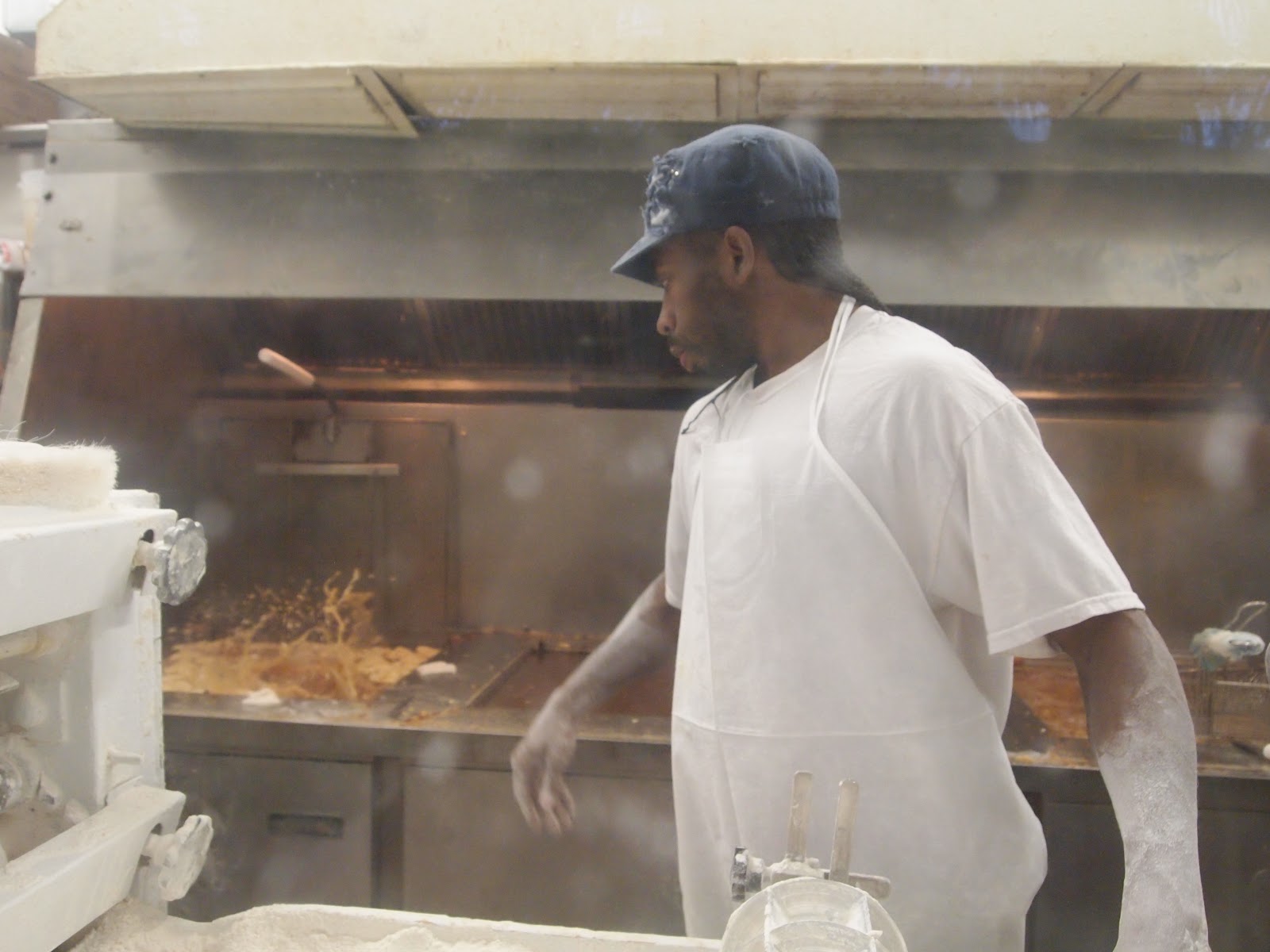
They must get the request a lot. Through huge glass windows that looked out onto a walkway at the back of the restaurant, we saw two men working silently and continuously, feeding the dough into a machine that sliced it and took it along a belt.


Starting from one end of the belt, the men would pick up the individual pieces, prime them in their hands and fling them across the air into the huge vats of boiling oil.


Each plate came with three or four beignets. Snowy mountains of powdered sugar rose precariously on top. Towards the end of the meal, that we had paid a visit to Cafe du Monde for the express purpose of devouring beignets was obvious. Our clothes, bags, and even parts of our hair bore the tell tale evidence.

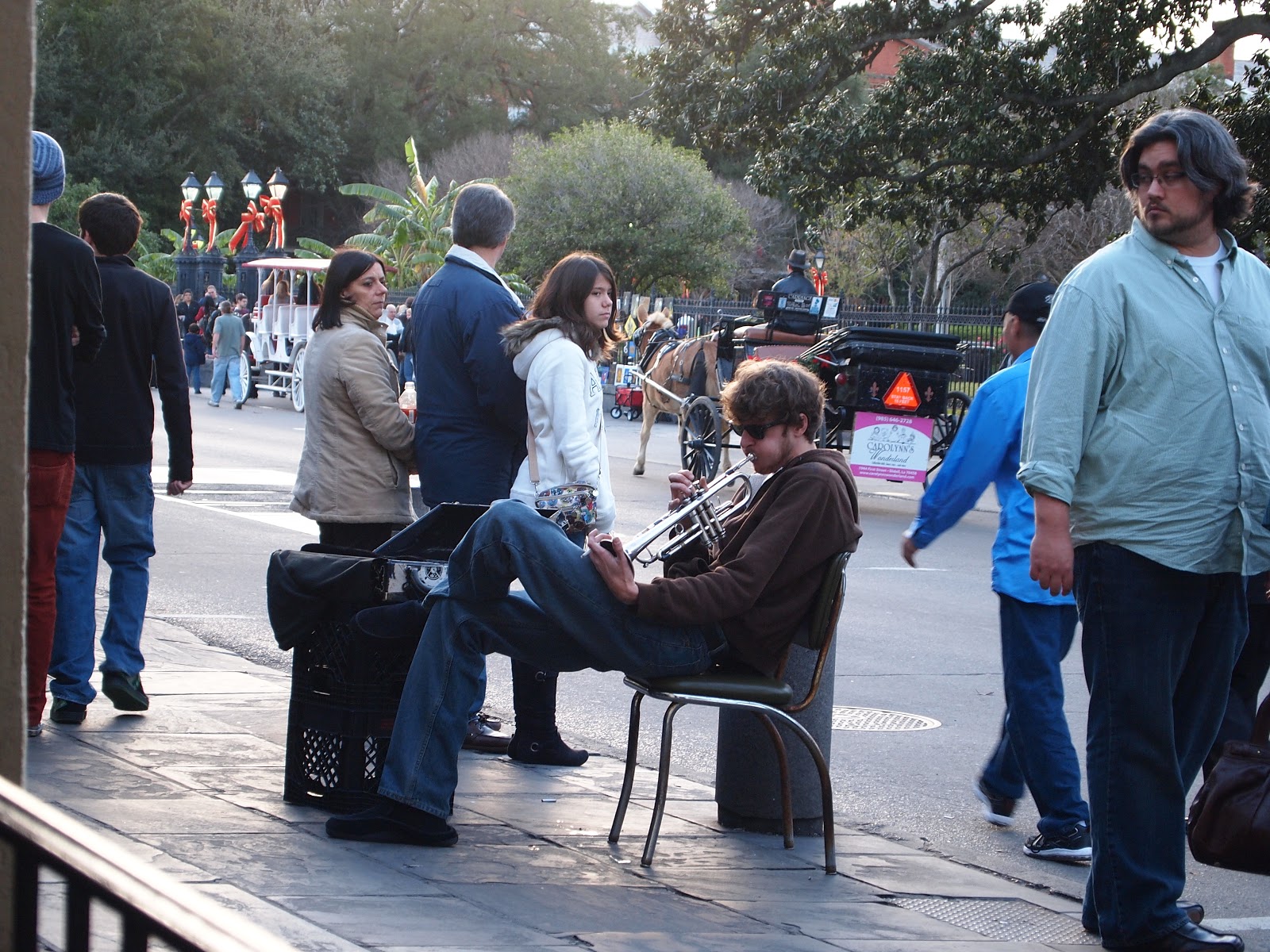
And as always in New Orleans, music was never far away. Just outside the railing the separated the eating area from the sidewalk, this young man played the trumpet.


Sunday, January 22, 2012

Forbes Article on D.C. Pedicabs


The nose wheel makes an acute turn and plants itself in the six-foot-wide gap between two cars idling at a traffic light on 14thStreet. Before we have time to analyse just how our driver would steer the rest of the 10-foot-long ‘pedicab’ into that space, we’re straddling another lane line a few feet down the road between a big, red tourist bus and a truck. A few more zigs and zags later, we are in front of a bank of vehicles at least 30 cars deep, clear of all the exhaust. Our driver looks back at us and declares triumphantly, “Like I said, this is not my first day on the job!”

For the past two years, Will Visbeck has been honing his skills as a driver of a pedicab – known to the rest of the world variously as cycle rickshaw, cyclo, becak or trishaw – on the streets of Washington, D.C. It has no roof, doors, seatbelts, airbags, rear-view mirrors or stereo systems (though headlight, taillight and turn signals are in evidence) but we do get to make leisurely circles around statues and monuments as our driver keeps up his commentary of the sights.

Originally published in ForbesLife India. A link to the pdf version is here.

Friday, March 11, 2011

Travel Essay: Budapest


Ajay Devgn. Aishwarya Rai Bachchan. His stark white suit. Her lusciously rich red sari. The earthy tones of the concrete and metal of Chain Bridge. A maudlin song wailing in the background. Their meeting on the deserted bridge. Her limpid eyes. His sad face. And…you know the rest.

The scene plays out in slow motion in my mind’s eye as we gaze at the majestic Chain Bridge from the low wall that separates a bustling promenade from the expanse of the Danube (known as the Duna in Hungary). The late afternoon breeze is soothing. We catch snippets of conversations in many tongues, familiar and unfamiliar. Buda’s Castle Hill rises on the left bank of the river on the far side. On the east bank where we stand, Pest sprawls as far as the eye can see.

The rest in last weekend's Mint Lounge.

Saturday, November 20, 2010

Travel Essay: Vienna

The drone of early morning traffic trickles in through the thick double-paned kitchen windows and into our apartment in the heart of Vienna. I hear buses, cars and a couple of motorbikes, usual fare for a modern city. Then, distinct from the mix, I hear a familiar sound from a long time ago—the clip-clop of a horse’s hooves. In an instant I’m transported to my grandmother’s house in Mysore, to the sounds of jataka gaadis packed with children going off to school.

The memory propels me to look outside. I leave the water for the tea to boil on the stove and open the windows wide.

A shopkeeper spruces up the display case
in a candy/pastry shop.
There are no bars or screens and I can lean out far enough to see the ends of the street on both sides. Crisp sunshine bathes the multi-storeyed building across from our window. The air is fresh and holds the promise of pleasant weather. Stylishly dressed women walk briskly on the pavement, jackets and sweaters swinging on one arm. The owner of the art store downstairs rolls up the shutters. A couple of taxi cabs roll by and then the horse carriage comes into view.

The driver, sitting straight on his perch, guides his two horses and the carriage between rows of parked cars on either side of the street. A bus and two cars follow slowly behind, their drivers seemingly patient, their pace forced but stately. Then, as the carriage slows for cross-traffic at the intersection to my right, one of the horses decides to answer nature’s call and deposits copious amounts of waste in the middle of the street.

The sight rings a discordant note in the otherwise harmonious tableau outside the window, only because the street is otherwise spanking clean. The carriage continues on out of sight, as do the cars and the bus, leaving a messy street and making me wonder how the street manages to stay as clean as it does.

Half an hour later, I get my answer. An enormous machine slowly rumbles up the street, spraying water, scrubbing the street clean and scooping the mess right up into its bowels.

The new has figured out a way to live with the old.

When the Viennale, Vienna’s highly anticipated annual film festival (first held in 1960, this year will see the 48th event), lights up movie screens from 21 October-3 November, judges and film buffs new to the city are likely—in addition to settling disagreements on their way to crowning the winners—to notice one or two or 10 such discordant notes. They are bound to discover, however, that in a city so comfortable in its skin, such dissonance merely forms happy interludes in the mellifluous magnum opus that is Vienna.

Nowhere is the push-and-pull of the old and the new more obvious than at St Stephen’s Square (Stephansplatz) in the old city. The jaw-drop inspiring 12th century church of the Gothic variety dominates the pedestrian-only city centre. Straight across the cobbled street stands Hasshaus, a modern edifice of the shiny glass variety, whose catoptric facade offers a resplendent mirror image of the church.

Vienna’s most visually striking (and popular) example of departure from the norm, however, is Hundertwasser-Krawinahaus, an apartment complex designed by Austrian architect Friedensreich Hundertwasser.


Nestled in a quiet street off Weissgerberstrasse, amid street upon street of identical, monochromatic, linear buildings, the apartments of Hundertwasser-Krawinahaus are a world apart. They appear to be stacked whimsically one on top of the other—we don’t detect straight lines other than in the window frames—the walls and pillars coloured in as if by a child. The interiors are closed to visitors (a note on the front door politely explains how discombobulating it is to have strangers traipsing through their homes), but a few blocks away, Kunst Haus Wien, a museum, is a visual and tactile journey into Hundertwasser’s philosophy. The floor is bumpy and uneven; the walls are wavy; colours seem to explode, rarely ending in straight lines.

Hundertwasser-Krawinahaus confirms what we have been feeling ever since our jaunt around the old city on the day of our arrival in Vienna—this city likes to have fun. And it doesn’t hesitate to call upon monuments and other historical landmarks in its pursuit of modern versions of entertainment.

So what if Vienna is not on the sea? Its denizens are not about to pass up a day at the beach. The 21km-long Danube Island, the by-product of Vienna’s elaborate flood protection system, is the go-to place for summer fun.

For year-round fun, the city boasts an expansive fairground for children and adults alike, the Prater. The century-old Giant Ferris Wheel which has come to symbolize Vienna dominates the Prater. Not only is it not cooped up in a museum, it still functions well enough to offer rides. More than 60m off the ground as you reach the highest point, it offers a bird’s-eye view of the tile-roofed, chimneyed, steeple-chased inner city, the glass and steel high-rises and the apartment buildings in the outer reaches.

At Schönbrunn Palace, the magnificent summer residence of the Hapsburgs—itself an ode to the good life—we find workmen constructing a massive stage with floodlights and speakers for a concert the next day. Inside, the private rooms, salons, galleries and reception rooms are a remarkably well-preserved window into the life of an empire that lasted six centuries. They offer a view of a monarchy appreciative and encouraging of the arts—Mozart performed for Maria Theresa in the Hall of Mirrors when he was six years old.


Schonbrunn Palace


The gardens and the expansive grounds of the palace

Perhaps one may find warm, welcoming cafés, lively city centres, rich museums and palaces or a prolific artistic legacy in other world cities. But to find them all, and to find a love of tradition, an enthusiasm for innovation and a hankering for fun, all in one neatly wrapped brown paper package tied up with strings, is a tall order indeed.

The essay was originally published in Mint. The trip planner (by Ahmed Raza Khan of Mint) is here.

Thursday, February 11, 2010

The Bangle Shop

Long, long ago, in villages and towns across India, the 'bangle man' roamed the streets. A cloth knapsack slung on his shoulders, he called out his wares - glass bangles in resplendent colors, some plain, some decorated with gold or silver paint - and made the rounds of his beat perhaps once a month, but more frequently during the marriage or festival seasons.

Inside the knapsack - fashioned out of a large cotton cloth whose four ends were knotted together - the bangles would be strung on long jute strings tied up at the ends to make a garland of the bangles. Many such colorful garlands nestled together in the knapsack.

The soles of his feet cracked from walking miles and miles on dry, dusty roads in worn out sandals or in bare feet, his head wrapped in a towel to ward off the heat of the sun, his teeth stained from years of chewing tobacco, the one-man, walking, talking bangle shop was a welcome sight nonetheless, his sing-song call a cause for great excitement especially if you'd been waiting for a delivery.

Women-folk (like my mom-in-law's mother, for example) hardly ever left the house, even to go to the market. They got their vegetables and grains from their farm and nearly everything else was home-delivered, including saris. Each family would have their favorite street hawker, one who knew the family's needs and would make special trips to his suppliers make sure he had what his customers needed. The same for bangles.

Most homes had a porch, screened with mesh or metal bars, where the bangle man and the women-folk would settle down to pore over the bangles, trying them on for size, flipping their wrists back and forth to check out the feel of the bangles, the clinking sounds providing a rhythm to their conversations. It was more than likely that neighbors would gather together on one porch, saving the bangle man from having to pack and unpack his knapsack over and over.

An old home with a screened porch

This little interlude was a welcome break for the women from their household chores and a welcome respite for the bangle man, a chance to rest his aching feet and take the load off his shoulders.

I wish I had a photo of one for myself and to show you because these days, the bangle man is a dead breed, especially in cities and the larger towns. Although street hawkers can still be found in the older residential neighborhoods, their wares are limited to vegetables in most cases.

The bangle shops have taken over. Even a small shop is able to carry a much larger variety than a hawker ever could. Street-side shops, such as the ones below, are quite popular in Bangalore.


And then there are ones like Bhavani Bangle Shop, which is a shop of the bone fida variety and is spread across four floors in Jayanagar, one of the busiest commercial areas of Bangalore. In all the years I lived in Bangalore, I dissed that shop. I grew up hating the thought of having to wear bangles or bracelets. Now it's a different story. Every time I've been back in the past few years, I've visited that shop, trying on and buying what a few years ago I thought was junk.

In the picture above, the owner receives boxes of new supplies for his shop.

The rows and rows of bangles and ear rings are mesmerizing. They are all costume jewellery, many of the designs (even those of the 'bindis' or the dots worn on the forehead) inspired by the heavily bejewelled heroines and vamps of the Indian soaps that rule the airwaves at all times of day and night.

Costume jewellery has caught on so well that this shop even offers to put together an entire set (bangles, necklaces, ear rings and other accessories) that will match your sari or other dress you might be planning to wear for a special event. I'd never heard of such a service before!


Most interesting of all, have you noticed something? The sales people are all men. A holdover from the bangle-man days, perhaps?

Sunday, December 06, 2009

Brief Quote in Article on Virtual Travel

Deccan Herald carried an article on virtual travel this weekend with a brief quote from yours truly.
There are other online resources, which can be used as educational tools. At mapmsg.com for instance, you can move blocks of countries around with the mouse. In that sense, are online resources such as wonderrotunda.com a great option for young learners?

Wonder Rotunda is an American website, which offers many virtual tour options. You could go on a climate change expedition if you so wish to, and there are simulations of Arctic ice on that particular tool.

However, Sujatha, a blogger and mother of two, says: "When we pick a destination, we pull out the atlas, check out the other places we can sensibly include in our plan and then move online to check out reviews and to make reservations. My son’s geography lessons still come from maps, board games, TV shows and the Nat Geo magazine."
Old fuddy duddies that we are, I had no clue that such a concept as 'virtual' travel existed, and that there are now websites dedicated to what used to be called 'armchair' travel back in the day.

Wednesday, December 02, 2009

Travel Ideas and Tips for Visiting Washington, D.C. with Children

The United States Capitol

A few days ago I did not know the first thing about Trekaroo, a travel website providing resources for families traveling with kids. When they were getting ready to launch their Washington, D.C. destination page, they tapped into local resources (D.C. moms and dads!) for tips and ideas on kid-friendly and must-visit places in and around the city. It was a delight to contribute to the effort and share our experiences. I also found a lot of useful ideas from other D.C.-based parents. So here it is, the entire post as it appeared on Trekaroo. I hope you too find some fun activities for your family if D.C. is on your to-do list.


The Lincoln Memorial as seen from the Arlington Memorial Bridge

~~~~~~~~~~~~


Trekaroo’s growing community of families from all across the country have pitched in with their votes for the most kid-friendly stops in Washington D.C. Here’s the line up for 2009!

Best Kid-friendly Hotels in Washington, D.C. – voted by parents
Best Activities for Kids in Washington, D.C. – voted by parents

Some of DC’s top blogging moms and dads have jumped on board the KidsMobile, playing the role of local tour guide. They are taking us into their fold by sharing with us their inside scoop about what’s fun for kids in their hometown.

Jennifer, a mom who loves the outdoors shares a fabulous list of The Best Kid-friendly Hiking Trails in DC. Jennifer’s passion as an environmental educator led her to start Hiking Along – a super cool educational program where she leads groups of children, preschool to high school, on hikes and allows them to participate in hands-on science activities to learn about their natural surroundings. She also keeps a blog about hiking with kids.

Dave, better known as SuburbanDaddy, knows that cold weather is just around the corner and any parent of a young child will be eager for his list of The Best Indoor Places for Toddlers Around Washington DC. He is the creator of Kidburst, an activities guide written by local parents about the Washington DC area with in-depth coverage of kids activities from summer camps to sporting facilities and classes.

Jennifer tells us about 8 Things (Under $5) to Do in Washington DC with Toddlers. She is an adventurous mom of a 2 and 4 year old who has not allowed having kids to slow her down. Although she’s based in Florida, Washington DC is one of her favorite vacation spots. She writes in depth about their family’s exciting adventures on Two Kids and A Map

Sujatha is mom to a 9 year old (boy) and 3 year old (girl) and brings us Fun Washington, D.C. Activities that get Kids Fired Up. This list has some great ideas of places beyond the usual tour of Capitol Hill that will really get kids to perk up. She writes candidly and casually about their travels as a family and about her adventures in parenting on her blog: Blogpourri

Amy is a mom who sees everything as a teaching moment and traveling is no exception. As a local DC mom, she’s got some her favorite Day Trips with Kids From Washington DC. As a literacy consultant and former high school teacher her blog – teachmama – is full of wonderful ideas about how to weave education into holiday traditions, travel, games and more.

Jill, brings us her list of Must See Attractions in DC with Preteens and Teens. She is the mom behind her prolific blog Musings From Me that covers a wide range of topics including parenting, travel and reviews of cool products. Jill has been on the go all her life, living in England, Italy, and America but currently calls Maryland home.

Ms Twixt, brings us a list of What to do with Tweens in Washington D.C. As a mom to 3 tweens girls and a toddler boy, she is an expert on everything Tween. Her Blog Twixt and Between provides helpful insights on topics that are current for tween girls and their parents. She even has a store in Georgetown Park with adorable age-appropriate clothing, shoes, gifts and accessories for Tween Girls.

Other Resources for Washington DC:

All 100 Activities for kids in the Washington DC Metro Area
Kid-friendly hotels in and around Washington DC

Next stop, Sunny San Diego, CA


The Trekaroo KidsMobile is a blog carnival with a twist. It’s designed to provide a unique opportunity for mom and dad bloggers to be featured on Trekaroo while:
1) expressing their unique point of view
2) getting a web of link exchanges.

Join us for one of our next stopovers.


~~~~~~~~~~~


Tuesday, October 13, 2009

Morning Prayer and Maine's Bounty

We finally figured out how to record music onto the computer! It was such a struggle to get the music from C's digital piano to the computer in any usable format (MIDI was not converting to WAV). Today I downloaded Audacity and recorded directly as C was playing - from the piano to the music editing program. We used the piece, Tchaikovsky's Morning Prayer, as background music for a movie of our Maine pictures and voilà! A video of some pictures from Maine with C playing Morning Prayer.


Wednesday, September 09, 2009

Maine-ly Delights!

If there is one thing that is all uniquely Maine that I adore, it's got to be lush lawns edged with natural stone containers brimming with colorful flowers.

The fact that I am besotted with this particular Maine feature must be all too obvious to you by now. So rather than go on and on about stone-walled flower containers, I will tell you about this tiny, heavenly patch on the east coast of Maine called Bar Harbor.

Rosalie's, a popular Pizza joint

About two and a half hours north of Portland, Bar Harbor is a long drive from Washington, D.C. - about 16 hours. But split over two days - with a layover in Boston on the way up and in New York on the way back - it's not too bad at all, even with and for the two kids in the back seat.

'2 Cats,' a restaurant and coffee house. Scrumptious doesn't begin to describe their breakfast spread.

Although the week we were there was sandwiched between two hurricanes, the weather was perfect. In the low 80s and high 70s during the day and in the 40s at night. The sun was bright but mild. Great weather to go biking, whale watching, driving around or just loitering the streets of Bar Harbor, all of which we did.

Bar Harbor is on Mt. Desert Island, the major portion of which is preserved as Acadia National Park, home to numerous lakes and the 1,500 ft. tall Cadillac Mountain. Thoughtfully laid out paths (thoughtful from the perspective of allowing visitors to extract maximum enjoyment out of their visits) for hiking and biking meander around crystal-clear lakes and through thick woods.


We rented three bikes for four hours. The lady at the counter looked us up and down and recommended that we bike the path of "intermediate" difficulty. I was skeptical. The next step was to choose the right bikes. Hope replaced the skepticism. Hope that had been springing eternal ever since I got to this country and faced my first non-Indian bike back in 1995.

I asked the man that was helping us for a bike with no gears. He looked at me like I was from another planet. Which I might as well have been given that what was driving my request was fond memories of riding bikes as a fifth-grader in Bangalore. Not-too-fond memories have managed to sneak in in the interim. Bikes with gears and I don't mix very well, you see. I just want to get on it and keep pedaling. I don't want to be bothered with figuring out what gear works on slopes or on hills. (But with cars I'm completely the opposite - I loved driving cars with gears.) Almost always, I find myself in the wrong gear.


My hopes dashed yet again, I resigned myself to a tussle with the bike for the next couple of hours and we started off. My husband and D on one bike, C on his own and me on mine. The very first hill almost had me turning back. The legs burned. The bike moved in spurts. It was incredibly hard to pedal in patches but I made good progress, and ridiculously easy in others but I had hardly moved. Argh! In the meantime the husband and C had shot off and were waiting for me atop the slope.


Thus the story went - I straggled, they waited, I walked alongside my bike, they waited, I flipped gears furiously, gently, cajolingly, they waited. Once in a while C would bike back looking for me and be my personal cheerleader, "You're doing great, mom! The last time you biked was five years ago. See, you're a natural!" Maternal pride and burning embarrassment jockeyed for real estate on my grimacing face.

The ride was well worth it, though. Not least because the path was punctuated with slopes going downhill as well. One spectacular slope lasted a good three or four minutes. The sweat we had worked up only amplified the coolness of the breeze floating in from the lakes. Plus it let us get closer to some beautiful parts of Acadia National Park than we would have been had we just stuck to the car.

But I must confess that driving around Mt. Desert Island was an infinitely more pleasurable activity. Drives on coastal roads are our favorite anyway, and Maine's rugged, scraggly coast was the perfect setting.


It took us to the top of Cadillac Mountain and gave us expansive, 360 degree views of the surrounding beauty.


It took us to the Somesville Footbridge. Somesville is the oldest village on the island and this footbridge is apparently very popular among photographers. I can just imagine the gently curve of the sparkling white bridge forming a delectable contrast to fall foliage.


It took us to the Bass Harbor lighthouse. It's not a great shot, and we apparently missed a better angle because we did not know there was another approach to the lighthouse. Oh well!


It took us to Thunder Hole. See how the rocks are angular and not rounded? They entice you to walk further and further out because they don't look slippery, because you feel like they are solid and they give you a good foothold.


But this is exactly what brought us to Maine. So I swallowed my trepidation and we walked out as far as we could and we just sat for a while, taking in the wilderness and the sounds and smells of the ocean.


The drive took us to Sand Beach, the one semi-proper beach on Mt. Desert Island.


As night fell, we took a long walk along the pier in Bar Harbor, the ocean on one side with the boats coming ashore for the night and beautiful, beautiful homes on the other side.

The highlight of the trip though, hands down, was the whale watching boat trip. A good one hour into the ocean and we came across a large pod of pilot head whales.


Pilot whales going about their business while we gawked

They were not shy at all and seemed content to swim circles around our boat. Nothing came close to delighting the children as much as happening on those whales did.

Monday, May 25, 2009

My World: Arlington National Cemetery

Arlington National Cemetery is one of the most visited tourist sites in the Washington, D.C. area, with around four million visitors every year. The evidence is all too clear as you stand at the information desk inside the bright, airy building at the entrance to the cemetery. A thousand people seem to be milling around you, buying tickets for guided tours, asking for information, perusing maps, getting oriented before heading out the doors and on to the grounds.

Barely a couple of hundred feet outside the entrance to the visitors' information office lies another world.
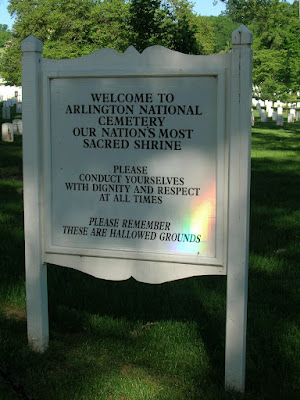
Perhaps it is this gentle reminder that sets the tone.

Perhaps it's the 600 acres of land sprawling outward and upward from under your feet. Perhaps it's the winding pathways on gently undulating hills, the lush trees, the grass drenched in a rich shade of green. Perhaps it's this oasis of silence just outside a bustling city.

Perhaps.

But at just a few more steps from that signpost the reason - hundreds of thousands of reasons, in fact - for the serenity and the awed hush that envelopes you becomes painfully obvious. Gravestones. On either side of you and ahead of you as far as the eye can see.


The neat rows appear to be in straight lines no matter the angle from which you view them, forming mesmerizing patterns.


If people talk at all, it's in quiet tones and in whispers. On the pedestrian only pathways, if a car drives by, pedestrians move away in respect, because only those who have loved ones buried at this cemetery are allowed to drive in.

Designated in 1864 as a military cemetery, the Arlington National Cemetery was initially used to bury the Civil War dead. Now more than 300,000 people, including soldiers who died in the wars since the Civil War, combat veterans, Presidents and Supreme Court Justices, are buried at the cemetery. The cemetery's website says that an average of 27 funerals take place every day. The funerals these days are for those soldiers who die on the battlefields of Iraq and Afghanistan and for World War II veterans.


The cemetery is divided into various numbered sections, each section designated for a particular conflict. In Section 27, for example, are buried former slaves who fought during the Civil War. Their tombstones designate their rank as "civilian" or "citizen". Section 60, pictured above, has been called the "saddest acre in America," and is the designated space for soldiers who die in combat in Iraq and Afghanistan.

At the end of the section bookended by two streets, lies another marker. From this end the empty space is foreboding.

In 1868, the military issued an order and set aside the last Monday in the month of May as a day of remembrance and as a day to honor those who serve in the military, now observed as Memorial Day. From the Memorial Day Order:

We are organized, Comrades, as our regulations tell us, for the purpose among other things, "of preserving and strengthening those kind and fraternal feelings which have bound together the soldiers sailors and Marines, who united to suppress the late rebellion." What can aid more to assure this result than by cherishing tenderly the memory of our heroic dead? We should guard their graves with sacred vigilance. All that the consecrated wealth and taste of the nation can add to their adornment and security, is but a fitting tribute to the memory of her slain defenders. Let pleasant paths invite the coming and going of reverent visitors and fond mourners. Let no neglect, no ravages of time, testify to the present or to the coming generations that we have forgotten as a people the cost of a free and undivided republic.

[...]

Let us, then, at the time appointed, gather around their sacred remains, and garland the passionless mounds above them with choicest flowers of springtime; let us raise above them the dear old flag they saved; let us in this solemn presence renew our pledge to aid and assist those whom they have left among us a sacred charge upon the Nation's gratitude—the soldier's and sailor's widow and orphan.

As you make your way up and around the winding paths at Arlington National Cemetery, it is not just the miles and miles of gravestones that remind you just exactly what it takes to preserve freedom. It is also the people that are walking all around you - aging parents who've come to say goodbye to their children, young soldiers, some of them barely 19, 20 years old; comrades who've come to remember; young women, with flowers in one hand, the other hand wrapped around a child's tiny palm who've come to say goodbye to their husbands; women, widowed now for years, who've come to plant flowers at their husband's graves; widowers who've come with a stool in tow, just to sit for a while near their wives' graves.

All kinds of people, in all shades of the human rainbow, of myriad nationalities, of all ages and abilities, in all stations in life - rich, poor, middle class. If a walk through the cemetery is a walk through American and world history, it is also a lesson in anthropology.

Families pay homage to a loved one.
There were three generations in that small group you see in the center.

The man came to pay a visit to his wife's gravestone, but searched in vain for that of a friend

Some come by walk, some come by metro, some come in cars, some come on buses, some come on thundering motorbikes.

Memorial Day Weekend in Washington means that the Rolling Thunder comes into town. From Wikipedia:

Starting in 1987 and continuing through May of 2008 Rolling Thunder has been conducting the “Rolling Thunder Run” in which all of its members attend. For 21 years the members of Rolling Thunder have converged on Washington, D.C to show their continued support for the efforts to find lost service men and women of past conflicts. In May of 2001 the estimated number of motorcycles involved in this rally was 200,000; by May 2008 that number had risen to more than 350,000.

It is humbling and thrilling to be anywhere close to where a large group of the vets on bikes have gathered. You only have an inkling of what they might have gone through in combat, but you can't help admiring their determination and perseverance in showing up every year and in large numbers for their fallen and missing comrades.

Two members of the Rolling Thunder arrive at Arlington Cemetery to pay homage


I took this picture last year as the bikers made their way to Constitution Avenue from the Lincoln Memorial

Memorial Day means many things to many people. It means the end of the school year - well, almost; the beginning of summer; the day the swimming pools open in the colder regions of the country; a day for blockbuster sales; a day when the smoke and aroma of barbecues fill backyards across the country. It also means, in cities and towns across the country, and in the capital, Washington, D.C., a day to remember those who fight on our behalf and give their lives so we may live ours in peace.

No matter which nook of the world we live in and no matter which corner of the world we came from, it's a fine day to tip our collective hat to all our soldiers.

P.S. HBO Documentary Films made a movie about Section 60. I couldn't bring myself to see it when it was first shown. For those who are interested, there's information about the movie online on HBO's website.

This is my world this week. For views from other corners of the world, visit My World.


Update: Adding a link to Lola's heartfelt post about the Sant'Anna massacre called 'Tiny Heroes':

I entered the church at my own risk. I had been warned by the sound engineer, my friend Maurizio. He had gone in minutes prior and exited sniffling. He's usually a big smile person, so a sad face on him stood out like a sore thumb. I wanted to go in nonetheless, to say a little prayer for those 560 people that died on a morning not unlike that one.

The entire east-facing wall of the tiny chapel was covered floor to ceiling with small plaques, faded photos, scribbled inscriptions and epitaphs. The age of the oldest victim honored on that wall was 16. The youngest was a 2-week old infant. That wall was the children's memorial section, and the images of those 110 innocent faces staring back at me was gripping my throat like a tight Nazi fist. The majority of the victims of the massacre that took place in Sant'Anna di Stazzema were children and young women. The men were either fighting, dead or hiding in the mountains surrounding the town. The few invalid elders in Sant'Anna died by the same two MG34 machine-guns that swept the church ground that day.

Please do read the entire post. It is available by clicking here.