Showing posts with label Personal. Show all posts

Monday, November 11, 2013

Working Out the Kinks in the Inter-Generational Recipe-Transfer Protocol


My new essay on The Aerogram:
So each time we sat down at my breakfast table I would bring out not only all our assorted notes, my computer, and pens and pe...ncils, but also my measuring cups and spoons. One day, even a golf ball ended up on the table. My mother-in-law held up her fingers for the nth time to indicate a piece of jaggery or tamarind, I forget now, and since we had decided that ‘lemon-sized’ as an indication of the required amount was just not going to cut it, we were casting about for something more standard.
Eventually, though, the golf ball too went out the window and we resorted to the cookbook mainstays — tablespoons and teaspoons — instead. We would eye-ball the amounts that seemed right, set it out on a plate and measure each ingredient with cups and spoons, and we were on our way.
 
The rest is here: http://theaerogram.com/food-tie-binds/

~~

Saturday, October 26, 2013

What Makes Food Comfort Food?

The Aerogram published my essay on why a bowl of rice and some pickle is my comfort food.
On any other day, late night infomercials would give me company through a bedtime snack, but that day, with the occasional swish of a car whizzing past the house for company, I stood barefoot in the kitchen and polished off the entire bowl.

Not for the first time, I wondered what it was that drove me to seek this particular combination of foods in times of distress. I didn’t bother then to press for an answer, just content in the knowledge that for the moment all was right with the world.
Read the full essay on The Aerogram.

~

Sunday, June 02, 2013

Even the Simplest of Things Come With Memories Attached

Seemebadhnekaayi curry with rasam rice was one of my favorite dishes as a long-braided teenager growing up in India. The squishy sweetness of the vegetable, a member of the squash family, gelled blissfully with the tangy spiciness of the rasam, a gravy-type dish usually eaten with rice.

[...]

 I turned my sights to the other vegetables on my list, left the coyote squash where I had found it after all those years and checked out of the store.

A recollection had waltzed in out of thin air, made space for itself and refused to let my mini-celebration be.

The rest is here.

Thursday, May 02, 2013

A Spoonful of Pickle Makes Life Go Down Easy


At 2am on a cold, damp weeknight, the highway that connects Washington, D.C. to its Virginia suburbs was nearly empty. I had the run of its deserted lanes as I hurtled through the darkness towards home with this single tantalizing thought on my mind – a bowl of hot rice, ghee and spicy mango pickle.

The past several days and nights had been one unending blur at work and the next few weeks didn’t promise any better. To add to my misery, none of the standard take-out places around my office in Washington, D.C. offered the one quality I sought in the dinners I was forced to eat at my desk – they were not comfort food. Not to me.
Once home, I headed straight into the kitchen to put a pot of rice on the stove – one cup of basmati rice rinsed clean and two cups of water in a small sauce pan. As soon as the water came to a boil, I turned the flame nearly all the way down and closed the pan with its tight-fitting lid. In the ten minutes it took the rice to cook, I washed up and changed, and got the pickle and ghee jars from the pantry.  

A gentle crackling from the base of the rice pot was the reassuring sound I’d been longing for, the signal that the rice was perfectly cooked, soft, plump and fluffy. I lifted the lid off, letting the steam escape and I caught a warm, moist, starchy cloud on my face.
As I breathed in, I felt the wrinkles on my forehead give way. The creases around my eyelids softened and my cheeks eased back to their original stations. I could try to describe its aroma in culinary terms, but in its swirls the steam held the rustle of mom’s sari, it held the twinkle in dad’s eye as he told us one of his jokes, it held my brother’s cackling laughter – all of which I’d left behind in India. At that moment, that aroma was home.

Too impatient to let the rice cool as it should, I scooped some up into a bowl with a wide, nearly flat spoon (known in literal translation from Kannada, my mother tongue, as the ‘rice hand’) I’d brought from India for that purpose.
Then, on top of the rice, a swirl of a teaspoon of ghee, its color and bouquet betraying its origin in butter.

Finally, my pickle of choice, the mango pickle. A couple of teaspoons did nicely for all of the rice in my bowl.
Chunks of raw mango nestled in a thick sauce of oil and pickling spices. The deep red of the chili powder (made from a special type of dried red chili prized for its intense color, called Byadgi, native to central India) combined with the rich yellow of the turmeric and powdered mustard seeds to form a tint and taste all their own.

Bright red with flecks of black. Tangy with the muted bitterness of roasted fenugreek and asafetida. Spicy with layers of heat from the chili and the mustard. Salty.
Unmistakably pickle.

I held the bowl in my left hand and – in true South Indian style – dug the fingertips of my right into the bowl, working the ghee and the pickle around and into the rice. There is a premium on serving and eating hot food in South India, and my fingers were proof of having lived up to that standard for years – they hardly felt the heat of the just-cooked rice.
That or the endorphins popping in my brain at the sight and smell of the ghee and pickle numbed my fingers.

Aided by the moistness of the ghee, rice and pickle came together in perfect union. The heat of the pickle, tempered somewhat by the ghee, and the now-warm rice blazed their way past my ravenous taste buds. Simple, starchy, buttery rice infused with the salty, spicy, sour, slightly bitter flavors of the pickle. The mango chunks, having marinated in the pickling spices for a good long time, provided sudden, crunchy bursts of intense flavor.
It was sublime.

On any other day, late night infomercials would give me company through a bedtime snack, but that day, with the occasional swish of a car whizzing past the house for company, I stood barefoot in the kitchen and polished off the entire bowl.
Not for the first time, I wondered what it was that drove me to seek this particular combination of foods in times of distress. I didn’t bother then to press for an answer, just content in the knowledge that for the moment all was right with the world.

It is only recently, when dad was irretrievably lost to me, that my mind made the connection.
Memories of dad flicker in and out these days, the rumble of his guffaws, the way he would fling his towel over his shoulder, his relentless haggling with the vegetable vendor, the games he would make up for our gang of cousins and friends, his voice when he called my name. I bounce around, in my mind, through the many homes we lived in at various points during my childhood.

Some recollections, however, refuse to leave, waiting patiently until I acknowledge and examine them. One of those is of our mealtimes when we were growing up.
Dinner was the one meal during the weekday when everyone sat together. We ate on steel plates, in the kitchen, on the floor. All of the plates had raised edges so they could contain the many dishes of South Indian cuisine that had the consistency of gravy. Mine was oval in shape, my brother and parents had circular plates. Even after all these years, when I go back to mom’s home I still reach for ‘my’ plate.

My brother or I would lay out the plates in a circle on the floor with enough space in the center for the containers of rice, Rasam (a soup-like lentil and tomato dish), a vegetable curry, assorted condiments such as pickles and spice powders, ghee, and curd (yogurt).
If dad was particularly hungry, he would get started as soon as he sat down. He could never resist the temptation of hot rice, ghee and pickle. He would mix them in his plate and feed us siblings first, then mom and then himself, repeating the cycle until mom, who would still be bustling about the kitchen trying to get all the dishes on to the floor, was done. She would protest that she was busy but it fell on deaf ears. Everyone would then settle down for the second course of rice with Rasam and curry (beans, cabbage or eggplant curries were staples), ending with rice and curd or buttermilk.

Juicy family and work gossip served as an ever-present accompaniment. Dinner was a raucous affair. 

It still was, every time I traveled back to India with my own children in tow. My brother and I would promptly revert to our roles as children and there would be at least one re-enactment of our dinner ritual from our childhoods, complete with dad feeding us. Over the years, the circle on the floor grew wider and noisier with more plates and more voices. Until the loudest link in the circle was no more.
In my own home, in my own kitchen so far away in time and space from the kitchens of my childhood, my bowl of rice and pickle is my ticket, the only way I know to transport myself, in an instant, back to that circle of my childhood.

It is magic.

Tuesday, April 03, 2012

An Easy Indian Recipe for Wheat Berries

A few days ago while on the hunt for some vegan dishes, I stopped at eatingwell.com, my new go-to site for healthy, delicious and novel recipes. A recipe for Zesty Wheat Berry-Black Bean Chili caught my eye. The ingredient list was chock-full of the good stuff and foretold of a hearty, flavorful meal. One ingredient, though, gave me pause - two cups cooked wheat berry. Wheat berry? I'd never come across it before this fruity sounding thing before. So off to Whole Foods I went in search of the wheat berry. The guy in the produce section helpfully walked me to the small silos of a variety of grains and pointed me to the red wheat berry.

By now you've probably guessed, right? The wheat berry was not some exotic hybrid fruit-grain from Latin America. It was good old whole wheat grain in all its pristine glory, the very same one I've seen all my life growing up in India, in its avatar before it got roasted and ground into wheat flour.

This episode recalled the time years ago when my brother and I decided we would make something out of a cookbook on our own. Firni it was. We sent my mom off to the bedroom to read a book and relax. And then called out to her every couple of minutes for this or that ingredient. At the end of a chaotic hour, what we had on our hands was....ganji! That self-same easily digestible gruel mom made every time one of us got sick. My mom had a good laugh at our expense and now, anytime we tell her we're making some quaint sounding dish, she tells us to make sure it's not ganji first.

But back to the wheat berry. I brought home some of the grain along with the other ingredients and made the chili. It was delicious to say the least! The blend of flavors complemented the crunchy bite of the wheat very well. The chili was a complete meal in itself. Most importantly, the friends for whom I made it enjoyed it immensely and were delighted to expand their vegan repertoire by one.

I was left with about two cups of wheat berry. So this morning, craving for something zesty and spicy for breakfast and having tired of the mainstays of Uppittu and avalakki dishes, I decided to make a Sundal (Usli in Kannada). Although Uslis are usually made with legumes, cooked wheat berry lends itself very well to this dish because it maintains its shape even when cooked. And it was everything I hoped for. Made for a fantastic breakfast.

Wheat Berry Usli:

Ingredients:
2 tbps oil;
1/2 tsp mustard seeds;
1/2 tsp turmeric;
1/2 tsp urad dal;
1/2 tsp channa dal;
1/2 tsp cumin;
A dash of asafetida;
4 green chillies, slit down the middle;
1 sprig curry leaves;
1 large onion coarsely chopped;
2 cups cooked wheat berry (http://www.eatingwell.com/recipes/cooked_wheat_berries.html);
Salt, to taste
Juice of one lemon;
A handful of cilantro, chopped.

Heat the oil in a medium sized pan until shimmering. Add the mustard seeds, urad dal and channa dal. Once the mustard seeds start crackling, add the turmeric, cumin and asafetida. After about 30 seconds add, the curry leaves and green chillies and roast for about a minute. Add the onions and let roast until translucent, stirring frequently. Take care not to burn the onions, lowering the flame if necessary. Add the wheat berries and salt, and stir to blend all the ingredients well. Lower the flame to the low setting, cover and let cook for about five minutes. Turn off the flame and add the lemon juice. Mix well, garnish with cilantro and serve.

The Usli is great even when cold. Serve with a dollop of plain yogurt.

~~~~~
Recipe for Zesty Wheat Berry-Black Bean Chili

Monday, February 20, 2012

In Honor of Mardi Gras, A Little Slice of New Orleans

In just a few hours, Mardi Gras will get underway in New Orleans, one of my favorite cities in all the world. Over Christmas break, with the Sugar Bowl, a Saints game and New Year's parties all happening around that time, the city was buzzing with excitement and energy.

But what's a good party without food, eh? Each meal was an event in itself, as we tried to get our fill of the delicious Creole cuisine. And one memory that will stick around for a long time is that of biting into a piping hot, sugary beignet.


Not really knowing what to expect, we ordered one plate for the table, for two adults and two kids. One bite in, the consensus was to order two more plates. The chicory-rich coffee made for a heavenly accompaniment. We peppered our 20 year-old waiter with questions about the restaurant and the hugely popular dish (the lines went out the door for at least a block on all the days we were there). He invited us to take a peek into the part of the kitchen where the beignets were being made.


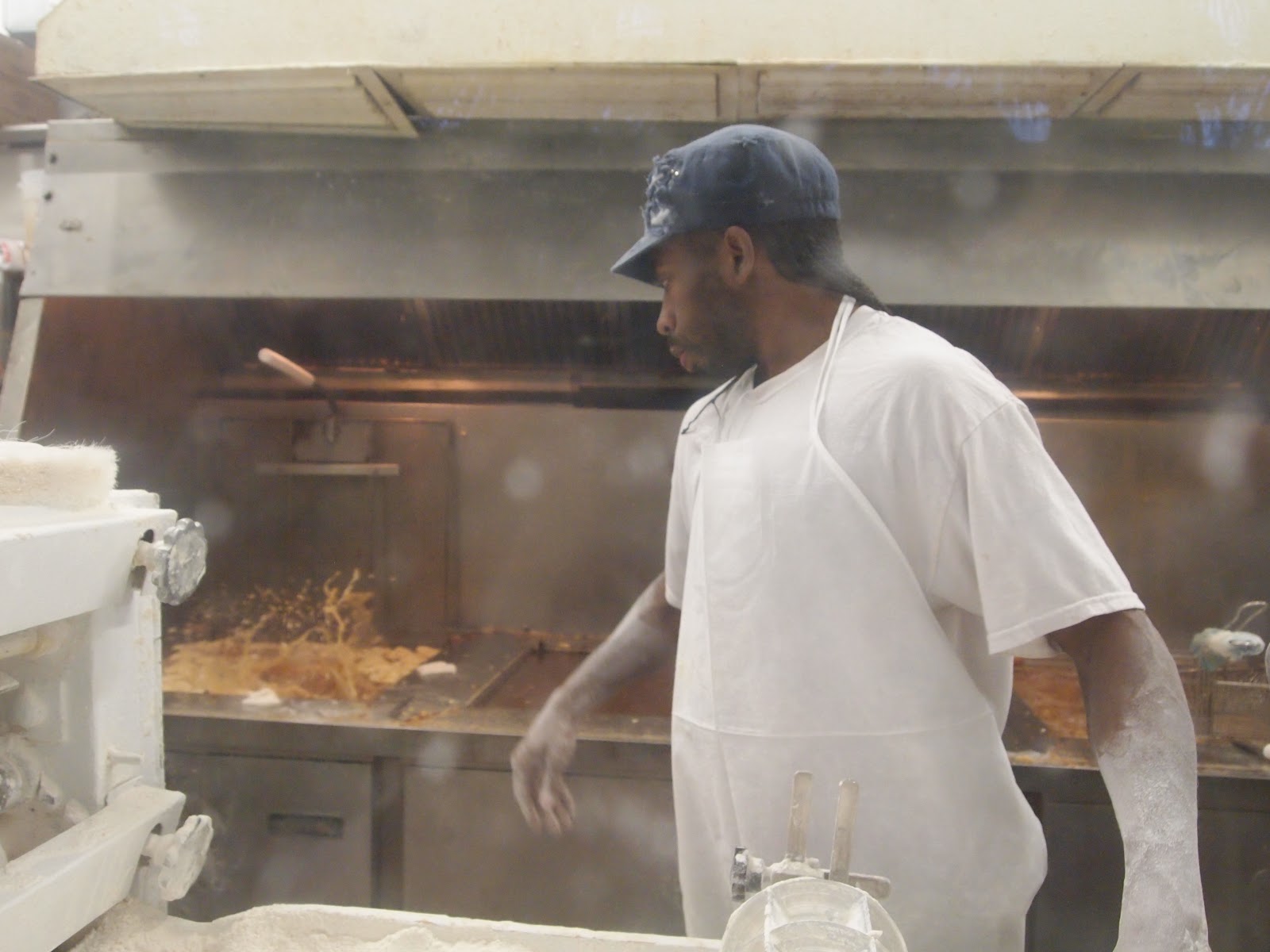
They must get the request a lot. Through huge glass windows that looked out onto a walkway at the back of the restaurant, we saw two men working silently and continuously, feeding the dough into a machine that sliced it and took it along a belt.


Starting from one end of the belt, the men would pick up the individual pieces, prime them in their hands and fling them across the air into the huge vats of boiling oil.


Each plate came with three or four beignets. Snowy mountains of powdered sugar rose precariously on top. Towards the end of the meal, that we had paid a visit to Cafe du Monde for the express purpose of devouring beignets was obvious. Our clothes, bags, and even parts of our hair bore the tell tale evidence.

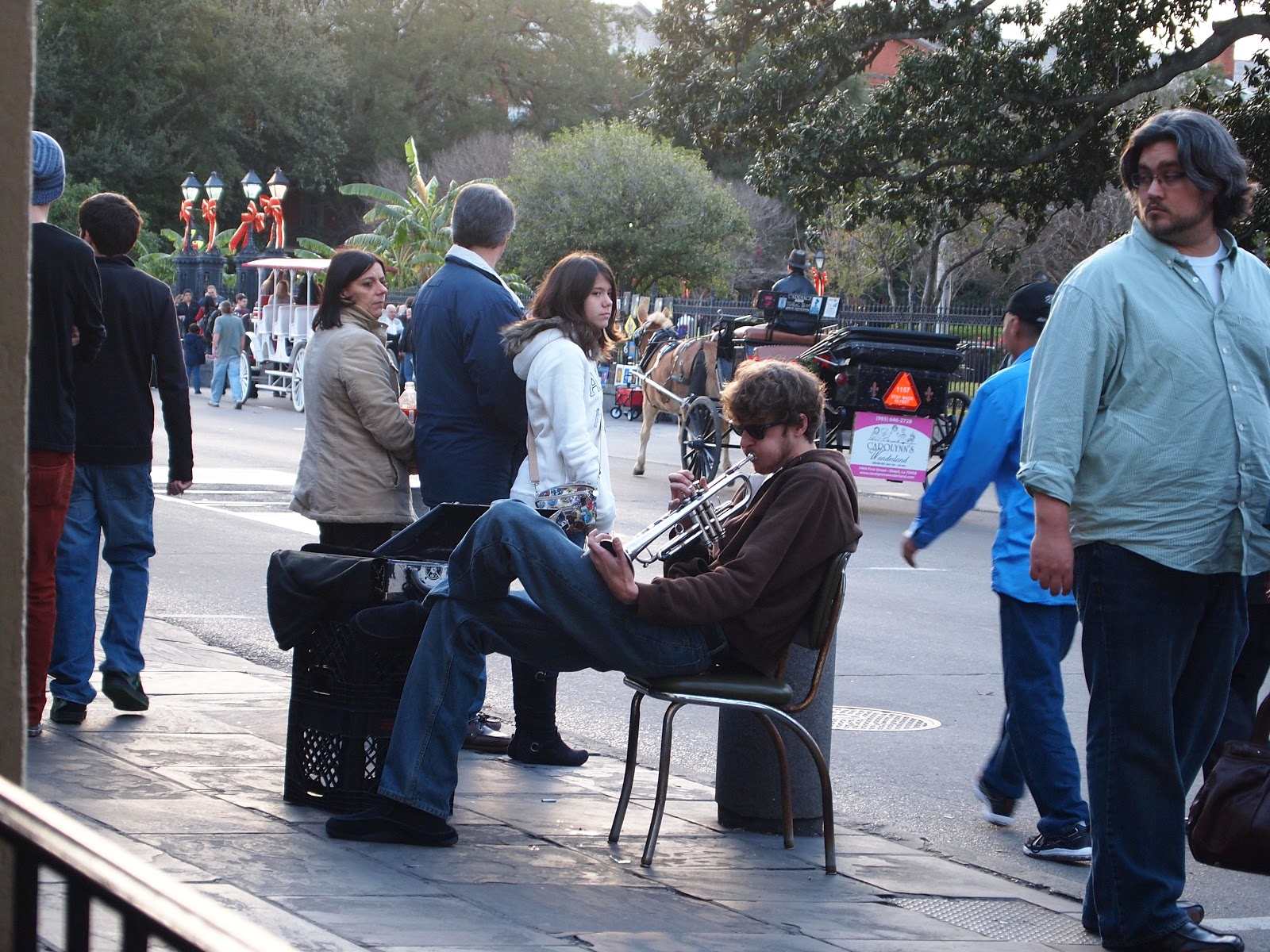
And as always in New Orleans, music was never far away. Just outside the railing the separated the eating area from the sidewalk, this young man played the trumpet.


Friday, January 15, 2010

Went Home and Came Back Home

I'm at my brother's desk at home in Bangalore, hogging his computer to check e-mails and check on what's going on in DC, making sure the house is still standing after that whopper of a snow storm (the house was still standing thanks to some truly fantastic neighbors). A dear friend comes online and as we begin chatting. At one point, I tell her I miss home. Radio silence for a few seconds as she digests that line.

"You're home and you're missing home? That's strange," she says.

Yes, I was home and I was missing home.

I was with my parents and my brother and my sis-in-law and nephew and loving every minute of it. A set of distinct memories that doesn't surface any other time made itself available. We laughed at all the jokes we've been laughing at for ... ahem... many, many years. We ate all the foods that we've grown up eating, feasted on the gossip that makes sense to no one else but us. But in the midst of it all, I missed my own kitchen and my bed and all the things my eyes can rest on when I'm in my own space.

So there - or here - I am. One foot there and one foot here. On the cusp.

But still, it's great to be back ... home. I hope you all had a good last few weeks and I wish the coming weeks and months treat you and your loved ones well.

Thursday, December 10, 2009

Life Can Change In An Instant

I slowly drove past a row of parked cars, on the lookout for a parking spot near where D goes to pre-school. The parking slots were unusually full for a weekday and for that time of day. I'd never had to drive so far up the street to find an empty slot before. Finally, after driving past about fifteen cars, I found an empty space.

I turned the steering wheel to the right, slowed down, pulled the car in and put my foot on the brake to stop the car. I have no idea what happened next, but my car jumped the curb, zoomed past a tree and over the grass and plants and crashed into the outside wall of a house. In an instant, the front of my car was crushed, the windows and the lower part of the wall of a house had buckled in. I still get shivers thinking about this and I still don't know how I got so lucky, but I was not hurt and the house I had crashed into was empty at that time.

I clambered out of the car and called emergency. A whole bunch of fire trucks came and repaired the house the best they could. One of the officers stayed with me the whole time, explaining to me what they were doing, making sure I was OK. One of the other firemen gingerly backed my car out on to the street. A few of the people who lived close by stood with me, got me to sit down and got me water and one of them even drove her car behind mine all the way to my house to make sure I got home OK. In the final analysis, no one was hurt, everything that was damaged could be put back together to its earlier state or even better.

A few weeks ago, a family we know through the kids' after-school activities was not so lucky. The children survived the accident, but the parents did not. The randomness, the suddenness and the finality of what had happened and the tragedy that had visited the lives of such young children (two of whom are the same ages as my own) left me breathless. When we saw one of the children a few days ago, I thought I detected her gaze lingering on a man who walked past her with his arm wrapped around his own little girl.

Children suffer all over the world. When I hear or read stories about such suffering, it leaves me angry and searching for ways to try to help. But with this incident, there was no anger, just sadness and an inability to understand and a deep sense of inadequacy at not being able to help or make things better in any way at all.

It is a cliche to say this, but the days and weeks have rolled on. We've seen at least one of the girls going about her activities (although haven't seen her the last few days). But every so often it gives me pause. We take so many things for granted and we behave as if life as we know it will continue long into the future. We plan for the changes we anticipate.

And really, that is the only way to live. No one can go on living expecting and preparing for dreadful things to happen every day.

But...

Thursday, October 15, 2009

Memories of Deepavalis (Diwalis) Past

My brand new clothes that I will wear tomorrow sit neatly in a box in front of the altar (the mantapa) in the prayer room, as do my brother's and my parents'. The heady aroma of our favorite sweets that mom has made, Mysore Pak, Coconut Barfi, Besan Unde, has been taunting us all day long. The prayer room has been cleaned, the idols washed and the pooja (ritual) items readied for prayers tomorrow. Fresh flowers, coconuts and betel leaves are arranged neatly in two or three plates for the prayers and to give away to guests that will arrive all day long the next day.

The night before Deepavali is a culmination of days of preparations for one of my favorite festivals of the year, and if you grew up in India, I suspect yours too. The bathroom has been washed down, the stone floors scrubbed clean with a heavy brush and every single utensil cleaned to a shine. A massive brass vat encased in stone and cement sits in one corner of the bathroom, with a medium-sized hole taking up one half of one of the two cement walls that has been cleared of all ash residue, wood pieces and coal. The brass vat is now filled with fresh bathwater and fresh firewood is at the ready to be lit the next morning for boiling it.

My brother and I and any of the assorted uncles, aunts, cousins and friends have already been to one of the massive outdoor fields that has been converted into a firecraker market. We have braved the crowds, shouted at the top of our lungs to make ourselves heard to the man or woman running a particular stall, hurried from one stall to the next to get our hands on the most popular firecrackers and come away with bags full of goodies for the next day.

When at last the last of the relatives have gone back home to finish up their own preparations and every little thing is in order in our home, we reluctantly get into bed, with the very firm resolve of waking up at 3 a.m. The goal, every year, is to be the very first in your neighborhood to burst a firecracker. Tradition demands that firecrakers be set off before sunrise so their light can chase away the darkness. Three a.m. is the goal so we have ample time to be properly oiled down, to have a bath and for a small ritual, where those sweets are the first thing we eat, before we are allowed out on to the street to light the firecrackers. We most certainly do not want a repeat of last year when someone else's firecrakers woke us up. Oh, the horror and the ignominy!

Groggy but excited we - all three of us, including dad - line up in front of the prayer room as mom pats some oil onto our heads and hands us our new clothes. It's a race to the bathroom to see who gets in first. In a matter of minutes, we are ready. It's barely even four. We tear into the firecraker boxes, pick the one that has the reputation for the loudest sound (aspiringly called the atom bomb), and head out into the street. Not a peep from anywhere else yet. Dad and mom walk out behind us with a matchbox and a box of incense sticks. We each hold the fuse of the atom bomb between two fingers and carefully snip off about an inch of the paper encasing the thread of the fuse. This, so that the fuse doesn't light as fast and gives us time to get away after lighting it.


A ten-thousand firecracker round


It unspooled to this length. At the far end, another family well into their celebrations.

Dad hands each of us one incense stick, we light them and with the firecracker in one hand and the incense stick in the other, both held far apart so they don't accidentally come together in our hands (that would not be funny), we approach the middle of the street. We stand a few feet apart from one another and light our respective fuses and run back towards our gate. We stand there, all four of us with our palms covering our ears. (We know it's loud, we chose the loudest firecraker, we want it to be loud. Pray, why then do we cover our ears? I look at photographs of Deepavali and the most I have are of a whole lot of us with palms, sometimes forearms because the palms are holding lit incense sticks, over our ears.)

Two loud booms and Deepavali has well and truly begun!

A few more varieties of firecrakers - a string of the longer ones, flower pots, sparklers - and we head back in. A couple of other early risers are already up and we hear sounds popping up from the homes around us, but content at being the first, we are ready to climb into bed again. The day has arrived but it's a long way to go before we'll allow ourselves any rest, so we might as well catch up on sleep before the house and the streets get too noisy.


Flower pots

A couple of hours later, it's breakfast time and then family starts arriving in drips and dribbles. By lunchtime we have a full complement of everyone in town. The more the merrier, especially at Deepavali. There's good-natured ribbing of the less brave among us, someone makes a loud noise just as your incense stick approaches the fuse making you jump, bravado and machismo are on full display as one or the other consistently picks the largest, loudest firecracker.

Soon this too gets tiring and it's on to a game of cards or carrom board. Bravado and machismo and teasing on full display here too. There is no space for everyone to sit down and eat together. But we've all been eating all day long and it continues well into the night when it's time for another session of firecrackers. This time around, the neighbors are also out in full force and somehow all the firecrackers get pooled and we're all into each other's stashes, laughing, running, hiding and covering our ears together.

Nighttime on Deepavali always has a different flavor. It's time for the more visually spectacular firecrakers to come out - the flower pots, the bhuchakras (they spin on the ground), the vishnu chakras (held in the hand), the rockets that shoot off into the sky (when they work as they're supposed to, or else they land on your neighbor's roof to be discovered months later). It's definitely time for the oohs and aaahs.

A rocket ready to be lit. It's in an empty bottle to coax it to shoot straight up.

Bhuchakra

The next two days of the festival are more religious, with the Lakshmi Puja (prayers to the goddess of prosperity) and Balipadyami. More visits from relatives and more visits to relatives' houses, but nothing compares to the pure fun of that one day.

~~~~~~~~~~~~

My family and I wish you and your families a very happy Deepavali, and whether you celebrate it or not, no matter which corner of the world you live in, we wish you a very prosperous and healthy year ahead.

Monday, October 12, 2009

Indian Rituals: A Hairy Tale

It's not that I'd never fiddled with my daughter's hairstyle before. I've had her hair up on both sides of her face in tiny pig-tails, turning her into the spitting image of Boo from Monster's, Inc (which, by the way, if you have not seen, you must. I will guarantee you will laugh more than the kids). I've pinned all manner of clips in her hair. I've tried to pull it all back into a severe pony tail only to have her silky strands escape the bondage a few at a time until there was not enough for the band to hold and it too fell away.

One fine day, however, I was seized with an urge to braid her hair. I sat her down on the bathroom counter top, partitioned her hair into two zones and proceeded to weave two plaits. She good-naturedly complied and held her head still while I tried to get the motions right.

Quietly, a feeling crept up on me. There was something surreal about the act, something about making three distinct strands on either side of her head, weaving each one by turn into a single plait. I was transported to another place, another time. I was on the floor in front of my mother, her hands working deftly on my hair to produce two long (and I mean long - they came down to my knees) plaits on either side of the back of my head. Every single day of my school life, she had braided my hair using the same motions I did with my own daughter.

My daughter's plaits turned out great, and for the first time since I became a mother, it occurred to me that hair - and all the things we do to it - is such an integral part of life in India, especially in the life of a child, especially during the time my brother and I were growing up. There are daily rituals, weekly rituals, rituals that take place perhaps once or twice in a lifetime.


Mom combing my hair when I was about three.

The daily rituals first. There was the oiling of hair. Every. Single. Morning. Coconut oil applied scalp to hair-ends and massaged in until not a strand was left uncovered, the constant movement of finger tips in your hair producing the kind of stupor that renders you putty in your mom's hands. Following the oiling, my brother got about five minutes of combing. Cow licks would be coaxed down towards the head with repeated patting, partitions drawn ramrod straight and cleared of hair trying to cross over the line.

I got about fifteen minutes. First came the combing. My head would be pulled back so my mom, sitting behind me, could see the hairline on my forehead and run the comb all the way through my hair to the tips. After about fifty strokes would come the braiding. My mom had a special trick - she would weave my plaits out of five separate strands, producing a stronger braid that did not loosen even a little bit during school. My hair was long enough that the plaits had to be folded up and secured at the top with ribbons according to the school dress code.

Weekly rituals took the form of the 'head bath' every Sunday. More oil, this time castor oil (no, not the kind you put in cars, thankfully, but equally sticky and heavy). We had to let it soak in for at least an hour before it would be washed away with seegekaayi, a brown-colored powder, and conditioned with a slimy concoction made of powdered leaves (chigaré pudi) mixed with water that left our hair shiny and silky. It really did, but it also managed to get in our eyes.

So Sunday afternoons were spent with blood-shot eyes and with hair banished of all traces of oil but smelling of leaves and nuts.

Summer holidays brought rituals of their own, although thankfully it was not every summer. One that I know nearly every South Indian Hindu family savors is the moggina jadé (literally braiding hair with flowers) tradition.

On the day I had mine made up, many summers ago in my ajji's (my maternal grandmother) house in Mysore, I remember her veranda being a beehive of activity. She had already been to the market that afternoon to get the freshest flowers she could lay her hands on - jasmine buds, jasmine blooms, jaaji flowers and the white insides of a banana plant. A couple of days before she'd already readied the colored threads, sticks of various lengths and thicknesses, hair pins, and the jewellery that she would use to decorate my hair.

A flower shop at the Gandhi Bazaar market in Bangalore. The orange flowers hung on the left are jaaji flowers. Swirls of white jasmine strung together lie in baskets on the right. The garlands are the kind that will be used in weddings for the bride and the groom to wear.

My grandmother's very capable fingers gently but firmly threaded the jasmine buds onto one semi-circular sheath of the banana shoot which she had cut to match the length of my hair. Slowly but surely the flowers filled the entire surface of the banana shoot. With the help of two girls who were learning art and craft from her, my grandmother strung the rest of the flowers into braids of their own with the help of some thread. When it was all done, the flowers formed a neat, colorful pattern. Then she weaved the colored threads around the now flower-covered banana shoot to add an interesting layer of color.

By then my mother had already braided my hair into a single plait falling down my back. They sat me down on a stool and went to work. With a whole lot of pins and black ribbons, they managed to get all of their art work onto my hair and this was the result.

We hot-footed it to a studio in the city before the flowers wilted. If you looked at that picture and noticed how the shoulders are hunched, you join a long line of very observant people. But in my defense, let me say that all the stuff on my hair was heavy. Very. My shoulders just sagged under the weight. So there.

These days, the moggine jadés are available ready made in flower shops in the markets, but watching it take shape right in front of my eyes was quite something else.

I asked my mom a couple of days ago why we did that - why we went through this elaborate process and took a photo at the end of it. She said it was a great way to keep the children occupied during the summer holidays and what better avenue for grandmothers to practice their craft than on their own grandchildren! Summer was also the time my grandmother worked on a lot of craft made of cotton and colorful foil paper. She conjured up beautiful garlands and other decorative items out of them and she would use them during the many festivals of the year. She employed us grand kids as gluers of all manner of shiny things on to the cotton.

The one other ritual most Hindu families follow is the shaving of the head. This has more of a religious flavor than cultural. According to custom, the child who has just turned two (i.e., during the third year) is taken to the temple of the family deity (this is one temple that the family tries to visit at least once a year, no matter how far it is from their hometowns) and the hair is shaved off as an offering to god and as a token of gratitude for the birth of a child. In most families, this custom is followed only for the boys, but some families get it done for the girls as well.

And so, finally, we come to this photo. Because the hair is not cut at all before it is shaved off at the temple, by the time the boys turn three it is very likely they'll have grown curly, shiny locks that would put any girl's to shame. Once the hair is shaved off and it grows back, regular haircuts become the norm. So mothers and the other women folk in the family see a golden window of opportunity - the one chance to properly dress up their darling boys as girls and acquire photographic evidence of their madness and the boys' utter helplessness.

Here it is, one such photograph of a boy that, alas, shall remain unnamed in this post. I have been threatened with the most dire consequences if I told you who he was.

I agree. Very, very cute! I'll be sure to tell him you said so.

~~~~~~~~~~~~~~~~~~~~~~~
Related Post: Grandmother Stories.

Updated (Oct 13, 09) to add a link to my post about traditional baby baths in India.

Friday, October 02, 2009

Bangalore Life: A Bus Ride and a Lingering Memory

In my memory the thick stone walls rise to the level of four floors. The walls are covered with ivy and punctuated neatly with brown-colored windows. A sprawling stage backs to about a third of the back wall of the school. A little distance away is another imposing building, one that houses the convent of the Sisters of Charity. Still beyond that, a massive playground with a basketball court and another concrete stage.

A large open space behind the building is filled with girls in light-blue pinafores, white shirts, blue ties, white socks and black Mary Jane shoes. Girls with long hair have braids neatly folded in half and kept in place with blue ribbons. They are chatting in groups, headed somewhere in groups, eating lunch out of their lunch boxes in groups. Loners are few and far between. There is lots of chatter, shrieking, laughter.

From Sankey Road, a busy thoroughfare at somewhat of a higher elevation than the school (you looked down at the school from the road), it looks positively idyllic, straight out of my rendering of Nancy Drew or Hardy Boys and so different from any other school I've seen so far. This is where I want to go to high school, I tell my parents.

Our home is at least two bus rides away and then a long walk from the last bus stop to the school. In terms of time, that's at least an hour door to door with a heavy back pack on my shoulders. In India, there is no school districting. You pick whatever school you want to go to, but you figure out how you're going to get there. Some private schools provide buses, but it's not always an option. We have no car. All we have is a scooter that my father rides to work in the opposite direction from the school. There is no one else that goes to the same school from my neighborhood.

There is no dissuading me, however. So off to Stella Maris High School I go. On all my note books and text books, I write my name, my grade and the name of my school - Stella Maris High. Note the missing 'School.' That's because Nancy Drew went to Riverdale High and Joe and Frank to Bayport High.

One day after school, I walk the 20-minute walk from the school to the bus terminus (many bus routes begin and end at this one bus stop) at 18th Cross in Malleswaram. Most of you will know how crowded the buses get in India. Bangalore is no exception. Riders will make the extra effort to trek to a terminus because there is at least half a chance that they might get to sit, rather than stand in the aisles (perfectly normal in India) or even on the steps leading into the bus (yours truly has ridden many times on the steps of a bus).

Once you get on the bus, you must purchase a ticket from the conductor (unlike in the US, the conductor is not the driver of the bus - this caused a whole lot of confusion when I first arrived in the US, I tell you). When every passenger purchases a ticket, the conductor blows a whistle strung around his neck and signals the driver to start driving.

This particular day, the bus is so crowded there is absolutely no space. The conductor is trying to finish up selling the tickets as fast as he can, but people are still arriving and trying to squeeze in. The exasperated conductor and driver hold a mini-conference. The situation is untenable, they concur, and agree they should execute a plan they've come up with for conditions such as this. They decide to start driving and stop about half a mile away but before the next scheduled bus stop on their route. That way the passengers already on the bus can finish buying the tickets but the driver and conductor wouldn't have to deal with new passengers constantly trying to get in.

A few seconds later, the driver hears the whistle and we're off! The bus stops at the agreed-upon place and we all wait for the conductor to make his rounds. It is stifling, to say the least, in the confines of the bus. The press of people, the still air and an immobile bus are not helping. Soon people start craning their necks to see how far the conductor has to go before the bus can move again. The people in the front crane their necks toward the back and the people in the back look toward the front of the bus.

The conductor is nowhere in sight.

Now the driver is impatient too. He has a schedule to keep if he wants to be home on time. He hollers, "ಎಲ್ಲಪ್ಪ ಇದ್ದೀಯ ನೀನು?" (where are you man?).

Silence. Then groans and clicking of the tongues.

Just as it dawns on everyone that we've managed to leave the conductor behind, an autorickshaw whizzes past and comes to a screeching halt in front of the bus. Out comes the conductor, shaking his fist at the driver in mock anger, unable to control his laughter at the turn of events.

Then a routine that would put the Three Stooges to shame: "I heard the whistle." "But I didn't blow the whistle." "But I heard the whistle. I thought you blew the whistle." "I'm telling you I didn't blow the whistle."

At every stop that day, the driver and the conductor proceed to enact an elaborate skit to make sure the conductor is safely on the bus before it starts to move again.

Thursday, September 17, 2009

The manifold advantages of a big brother

Last weekend both the kids had appointments for flu shots.

I was not worried about C (my nine-year-old son) at all. From the time he was three years old, I have been very upfront with him about the need for shots and how making a fuss would only make it more uncomfortable for him. I really had not expected the message to go over so well so quickly, and was heart broken that this little three year-old had let go of my hand, had walked up to the chair, lifted his sleeve and presented his arm to a skeptical nurse. The only one that cried that day was me.

With D, my daughter, who's now three herself, it's a completely different story. When we returned to the US from India two years ago she went through a spate of tests that involved drawing blood. The repeated visits at that age (she was barely one) and having needles stuck in her arm each time cemented a dreadful connection in her mind - a visit to the doctor meant injections. That association is starting to fray a bit, but we're nowhere close to me talking to her about not fussing for shots.

When our turn came at the doctor's office, C raised his hand when the nurse asked who was going first. He went through the drill with minimal talking. Then it was D's turn. Fully expecting her to bawl, C stood at the door and covered his ears. I scooped D in my arms and sat down on the chair with her on my lap. D, who had been watching C get his shot eyed the syringe warily. As the nurse lifted D's sleeve, inspiration struck C. He called D, told her to look at him and proceeded to dance a crazy little jig. She turned to me and giggled with an expression that said, "Look mom, C is being silly again." By the time she felt the sharp prick of the needle, she was too engrossed in her brother's antics to spare more than a glance at her arm. The colorful kiddie band-aid had already made an appearance.

As far as D is concerned, C is a major source of fun - he's great for horse rides, to watch movies with, to make puzzles with, to bounce on the bed with, to play tag with, to raid the freezer for ice cream with, to read books with, to tussle with. I hope it's not long before she wraps her mind around all the tiny ways in which he makes her life a little less hurtful.

Thursday, September 10, 2009

Memories of 9/11

We have two pictures* of the Twin Towers around the house. One was taken from a boat as it sped away from the city toward the Statue of Liberty. The other from the ground as I lay on my back at the foot of the towers and snapped a photograph from a quirky angle. In that shot the towers seem to be leaning toward each other.

I don't go to New York that often, but when I do these days, my eyes scan the fast-approaching skyline. The Twin Towers were hard to miss when they were there. Their absence is hard not to miss now that they no longer straddle the horizon.

In Washington, D.C., I have driven by the Pentagon countless times since 9/11. Every single time, I turn and look over to where the third plane ploughed into what I thought was a fortress. New concrete, new glass, new paint and a brand new memorial have more than managed to smooth over the terrible scars inflicted on the building that day. Whether the scars inflicted in the human beings have smoothed over is quite another matter.

The minutes may have merged into one another, no longer distinct, clear; the day itself making its presence felt, and not just on anniversaries, as a vague, anxious feeling, amorphous, floating in the air. It makes its presence felt every time a loved one gets on a plane and I refresh news pages on my computer until I know the plane has landed; when I get into a large building in a large city and look around trying to ... I don't know what; when tunnels and bridges don't seem as enjoyable anymore.

This year, particularly, I've noticed that small flags are lining lawn edges and plant borders in the homes around me. The memorial tree in my neighborhood in remembrance of my neighbors who died in the Pentagon on 9/11 is lined with flags.

Every year there is a new way of remembering. But there is remembering. It is difficult not to remember.

Some of you may have noticed a link to a post in the side bar to the right - 9/11 Remembered. What appears below is that essay I wrote four years ago.

~~~~~~~~~~~~~~~~~~~~~~~~~~

A generation ago, the question was, "Where were you when President Kennedy was shot?"

For my generation, there are too many questions. Tragedies and calamities abound in our collective memories, but one question that will be asked again and again is, "Where were you on 9/11?"

At this time of year, that question doesn't even have to be asked.

I was at home in northern Virginia with a cup of tea and a newspaper in my hand, standing in the breakfast room and looking out into the backyard through the bay windows. N** was already at the baby sitter's and V was on his way to work.

Three days ago, N and I had returned home from a six-week trip to India.

I savored all the little things I had taken for granted, but had missed sorely when I was away from home.

Outside, the sky was blue, cloudless, bright with that early fall sunshine that was not too hot on the skin. A slight breeze ruffled only the tops of the tall trees in the backyard. Everything looked fresh, clean.

Inside, Diane Sawyer and Charlie Gibson's easy, morning talk show banter filled the silence in an otherwise quiet house.

Then, confusion.

In Diane Sawyer's voice. In Charlie Gibson's voice. The banter was gone. Replaced by broken sentences, words that were coming out staccato. Too many pauses in between. They were searching for words, for understanding, for any information that would explain what has just happened. I turned to look at the TV screen.

There were no video shots yet. Just two lines repeated over and over - the Vice-President of CNN had seen a plane crashing into the Twin Towers. His office had a direct view of the World Trade Center.

I flipped furiously to the other channels - NBC, CBS, CNN.

The first images that replaced the Good Morning America studio scene were shots of the Twin Towers, smoke billowing out of a gaping hole near the top of one of them.

None of the TV channels had any confirmation of the news that a plane had crashed into one of the towers, yet. The discussion focused on whether there was an explosion in the building. Or speculation that may be it was a helicopter or one of those chartered planes. They are known to fly low, staying just above the Manhattan skyline, sometimes even seeming to dip in between the buildings. At this point, there was no thought (at least none that was voiced) that it was anything but an accident.

I called V, who was still on the road, on his way to his office about eight miles away.

I watched the TV screen, describing the scene to him. Then I saw a plane entering the screen from the center-right side. My first reaction was, "God, how stupid is he? He's too close to the buildings!"

Within a few seconds the plane rammed into the other tower. A ball of fire followed by an inferno, black smoke.

The TV anchors were just repeating what I had said to V when describing the second plane. The theory of the pilot's stupidity now duelling with the theory that may be, it was not an accident. Compounded by the shock that this was happening twice within the space of a few minutes.

There was no other way of reporting it. They had no more information than I did. The pictures were there for all to see.

There were no background file photos. No fillers. There was no script.

This was not pre-meditated war. This was not a natural disaster. This was not a multi-car pile-up on some icy interstate.

This was the story of two planes that came out of the clear blue skies that sunny September morning and crashed into the Twin Towers, those pillars of American achievement.

This was as real as TV could get.

I wanted all three of us to be home. Right away.

There was a deep sense of foreboding. Something was not right. I could not explain what I was seeing on TV. The people that were supposed to be able to explain could not, did not, explain what I was seeing on TV.

I wanted V to turn around wherever he was and come right back. I wanted to get N back from the baby sitter.

I could not. I was stuck at home. One of the cars was in the garage for maintenance. V had taken the other. He told me not to worry, that he would be back home as soon as he could and pick up N on the way back.

I'd been standing all this time. As I sat down on the sofa, remote in hand, I heard a loud thud. The windows rattled, the house trembled. Blasting at a construction site, I thought.

Without warning, the the television screens switched to Washington, DC. Claire Shipman was on TV, mike in hand, her back to the Vice-President's office, plumes of smoke rising from a building behind her.

From one angle, the building behind the Vice-President's office is the White House. No one was certain what this meant. May be a fire in one of the buildings? At this point, no one, least of all me, was connecting the loud thud with the smoke.

A few minutes later, the connection was clear. A plane's tail was sticking out of the side of the Pentagon that faces Arlington.

I called V. The cell phone circuits were jammed. I called all of my family that's in the US, made sure everyone was fine. I called India, told my parents and in-laws we were all fine. Everyone was trying to call everyone else. It took us all a few minutes to reach each other.

I still could not reach V. He managed to call me.

Washington, D.C. was being evacuated. He was turning back. But there was no place to turn. By this time, the morning rush hour had mushroomed into a monster. Two-way roads were switched to one ways, vehicles were going around in circles. Rush hour that was usually uni-directional was becoming bi-directional. All the bridges coming out of Washington, DC into Virginia were choking with the overload.

As V would say later, the evacuees were sitting ducks for anyone wanting to target huge numbers of people with nowhere to go. That evacuation was anything but orderly. It was an unmitigated disaster. It took V three hours to cover the distance that would normally take 30 minutes, to get home.

Still no information on what was happening. I don't know, may be because of the movies, or may be it is what I was getting used to, may be getting spoiled even - what with all the news channels, all that information, the idea that the nation should know what is going on, the images of Presidents addressing the nation - but I kept thinking, ok, the President will be on any minute. There will be something someone at the White House will say that I want to listen to.

Everyone had their two cents in. Everyone except the people I wanted to hear from. I was waiting for an answer to a simple question, "What is going on?"

The thing is these thoughts rolled through my mind right then. They were not the result of some post-mortem of the events that transpired that day. That day, I realized for the first time that I was looking for something from the government, something other than services or social security programs or budgets, or low interest rates.

The image of David Bloom - with ash, debris on his hair, his voice hoarse, his face gaunt, his eyes red from the dust, from hours of standing on his feet, his back to the falling towers - is the strongest in my mind from all the hours of TV coverage we watched, compulsively.

Then news of Flight 93 crashing in Pennsylvania. By this time, the shock was gone. There was the dull realization that whatever this thing was, it was relentless.

Hours, days, later, the stories.

Of bodies flying out of the windows of the towers, a desperate attempt to escape the fire and heat inside. Of policemen and firemen and dogs risking their lives to save others'. Of Todd Beamer and Lisa, the telephone operator who connected him to his pregnant wife, also Lisa, for a final few words before going to meet his death.

Of people trudging home on foot for hours. Of firms losing all their employees in a span of minutes. Of a six-month old baby waiting for her mother to come home and wailing every time the door opened but the mother did not come. Of rows and rows of cars waiting in vain at metro stations in New Jersey for their owners to come drive them home. Of my own neighbors who work at the Pentagon (two of whom died in that attack), coming home shaken, unable to eat for days.

Of depression among the people living around the World Trade Center because they are no longer in the shadow of the Twin Towers.

Their view outside their windows and our view of the world inexorably altered.

~~~~~~
* I will try to scan the pictures and put them up.
** C was known as N then on my blog. D wasn't born yet.

Wednesday, June 10, 2009

One Family, Three (or Four) Languages, One Fine Legacy

Summer holidays back when we were growing up meant family get-togethers. The four of us - my parents, my brother and I - would drive down to Tamil Nadu from wherever we happened to be living to visit my father's side of the family or we would drive to Mysore where my mother's parents lived. Alternatively, family came to visit us. We moved every two years to a new town or city and visiting us was, therefore, always an adventure. And then there were the weddings and upanayanams* that had seasons of their own. Auspicious days occurring during a few months of the year meant wedding dates and dates for other rituals were crammed into those few months.

While the summer holidays, weddings and other occasions had a charm all their own and were eagerly anticipated, they were by no means the only times the families converged. Whenever we lived in the same town as my mother's or father's siblings, Sunday afternoons meant everyone would gather in one house for a massive lunch. I could never figure out how it happened, who planned it or who called everyone else, but there we were in the midst of a gaggle of aunts, uncles and cousins, chowing down food until we could eat no more, my father's deep laughter resonating around the house, my uncles backing him up with cackles of their own, my aunts picking an argument with my father just because, and whoever the host was packing dinner for the guests in steel tiffin boxes to be hauled away at the end of the visit in buttis (plastic baskets with handles).

Amidst the laughter and fake arguments and the heady aromas and family rituals and gossip that enveloped us children like a warm blanket, one curious fact at these gatherings was (and is) a great source of delight to me. At any point in time we were liable to hear any one of four languages** - English, Kannada, Telugu or Tamil - floating in the air. It was, as far as I knew, unique to our family.

Since the pieces of this puzzle were in place way before I was born, I have never known anything other than my parents speaking to each other and with us children in one language (Telugu) and with their siblings and in-laws in two separate languages (Kannada and Tamil), all generously interspersed with English. It was only when I got older and visited my friends' homes that I realized that it was not normal at all.

The explanation for how this came about is innocuous enough - my father grew up in Tamil Nadu, my mother in Karnataka. One day my mother's aunt came with a marriage proposal for my mother. That aunt and one of my father's sisters were somehow related through an earlier marriage. It has been explained to me a hundred times, but I still don't get it (the next time around, I'm sitting down with a pencil and paper when I talk to my parents about this). But because they grew up in different states speaking different languages - Kannada in my mother's case and Tamil in my father's - how would my parents speak to each other? The elders talked about it a little and came up with a solution, a lingua franca - a third different language, Telugu - one that my maternal grandmother and mother knew how to speak and one that my dad spoke with his sisters-in-law and his sisters. Although each of their versions of the language was corrupted from being secondary to their main tongues, they could manage. And so they got married.

In time, my father became fluent in Kannada and my mother learned to speak and read Tamil, but they stuck to the original plan of speaking in Telugu to each other. So family events in which both sides of the family were present looked somewhat like this:

My parents spoke to each other and to us in Telugu; my father spoke to his brothers and brothers-in-law in Tamil, to his sisters-in-law and sisters in Telugu, to my mother's siblings in Kannada, to my maternal grandmother in Telugu and to my maternal grandfather in Kannada; my mother spoke to her parents, brothers and sisters and associated in-laws in Kannada, to all of my father's family in Telugu; my maternal grandmother spoke to my mother in Telugu (but my mother unfailingly responded in Kannada), and she spoke in Kannada to the rest of her children; my maternal uncles and aunts spoke to each other in Kannada; my paternal uncles and aunts spoke to each other in Tamil, but they spoke to the sisters-in-law in Telugu; my mother's nieces and nephews spoke to her in Kannada and the ones on my father's side spoke to her in Telugu; my brother and I spoke to cousins from my father's side in Telugu and to the ones from my mother's side in Kannada.

Depending on the participants, the same conversation would be had in all three languages, with everyone following and not missing a beat, and any exclamatory statements and pronouncements would be made in English. As in, "But that is preposterous!" to sum up someone's less than desirable stance on an issue. And sermons about bad behavior or life lessons were almost always in English.

As I tried to lay out and trace this bowl-of-spaghetti lingual connections to someone I worked for years ago when I moved to the US, he wondered if all this meant my brain was wired differently from his. It is quite possible that it is, but the one abiding lesson my parents tried to drill into us was respect for languages, and by extension, cultures. My father does not hesitate to express immediate and visceral disgust for anyone who puts down a language or culture. He maintains a small pocket dairy in which he notes down unfamiliar turns of phrases or new words he comes across in magazines or newspapers (he finds a boatload of them in The Atlantic Monthly magazine every time he comes here) and takes great pleasure in using them.

And if you thought I'd had my fill of languages to last me a lifetime, my husband speaks an entirely different dialect of Kannada than I do - the North Karnataka dialect. So when I first got to know his family, I, who had grown up speaking the language and studying it in school, stared at them a few times with a blank face trying to piece together what they said and trying to make sense of it in the context.

Over the years, our different languages and dialects have been a source of fun, too. My mother-in-law or my husband try to say something in Telugu with rather hilarious results, and they look at my face in anticipation when they use a particularly obscure word in the North Karnataka dialect.

Now all I need to figure out is how we're going to pass on this treasure to our children. My son picked up Kannada during our three-year stay in Bangalore and my daughter, who thought anything that did not sound like English was, by default, Spanish (courtesy Dora), now can identify Kannada words when she hears them. I have a strong feeling that the iron is hot and this summer is the time to strike it. The kids and I have planned to set aside an hour a day to speak exclusively in Kannada during the summer. I want them to be able to converse in the languages of our families without inhibitions, and am not really particular about them being able to write or read in those languages. Although if that does happen, no one will be more delighted than me.


Notes:
* I wrote about my son's Upanayanam, a thread ceremony marking the passage from boyhood to the life of a student, here.

** The Government of India recognizes 22 official Indian languages. There are hundreds of dialects of each of these languages.

Monday, May 18, 2009

What's to love about being a mom?

It was during one of those innumerable calls I made to my mother and my mother-in-law when I was pregnant that I distinctly remember noticing a difference - I now related to them as a woman. I was not yet a mother, but neither was I merely a daughter or daughter-in-law. I was a woman on a journey to motherhood, a journey they'd already been on and therefore were repositories of rich experience I was grateful to tap into.

They guided me through the aches and pains, through the heartburn, the strange goings-on in the pit of my stomach, amazed that I had no cravings while regaling me with stories of their own. Between the two of them, they had raised six children (well, first of all they had delivered six children without pain killers), stay at home mothers while their husbands worked and took them around from town to town, moving every two or so years. They created homes for us out of strangers' houses in big cities, small towns and villages, they were our anchors in alien ports. They did all the things mothers are supposed to do and then much more. What's not to love about being in their company?

Then C was born. And so a mother and a father. When we first got married, my husband and I got busy finishing up school, starting out on our careers, and finding our feet in a brand new country. Having babies and growing our family was way down on the list of priorities. When we did get around to it, it was a good eight years after we got married. By then we were ready to be parents (as much as anyone could be without having had a child). Nine years after C was born, I no longer remember what I thought being a parent would mean, but it is so many things I did not even have the bandwidth to imagine at the time. The way in which the children relate to their father has been an unexpected source of delight and fascination for me. My becoming a mother had made a father out of my husband. His children reduce him to a puddle of tears, produce antics that have him helplessly laughing until he doubles over in pain, have him looking at the world and wishing it were a gentler, kinder place for children his own and unknown, have shown him his unbounded capacity for love. What's not to love about that?


And the two little human beings that bind us together have also strengthened the bonds between two families. My parents and my in-laws revel in recounting to each other the antics of their grand-children. Never mind that it's a story that's been told and retold a hundred times. The laughter is as genuine as it was the first time anyone heard the stories. And each set of grand-parents sees reflections of their own child in their grand-children and there is great joy in calling out the similarities. As a result, my parents know much more about my husband as a little boy and my in-laws know a little bit more about me as I was when I was a little girl. The same is true of my uncles and aunts - they take delight in catching glimpses of me in D and shades of my brother in C. During the eight years before C was born, I had no inkling that becoming a mother would set off all these ripples that would echo through so many lives. All our lives are richer because my husband and I became parents. What's not to love about that?

And then there is the awesomeness of being handed ring-side seats to witness the journey of two beings - from helpless babies to already now proper little people, with their own ideas; with the tools to express them and act on them; their own quirks and sense of humor; with the curiosity to ask the questions, oh the questions, that drag the imponderables down to the realm of the here and now; with the capacity to feel empathy and sadness for another person; with the wisdom to make the decisions that seem tiny but have enormous impact on their lives; with the hearts to love and to make friendships and to give the softest, sweetest hugs at just the right times; with the ability to understand certain things without receiving an explanation that is at times humbling as it is awe inspiring. What's not to love about that?

Finally, this is the most unexpected of all. Being a mother has made me a lot less judgemental of other people's actions and choices. Having a child puts in front of you a human being that you brought into this world, but is still so different from you. I only have to look at C and D and realize that people cannot react in the same way to the world around them. They are shaped by a different set of genes, by different upbringings, by different environments, by different experiences. Being a mother has made me more understanding. It has made it a little easier to know that most mothers have their children's best interests at heart and are really doing everything they can within their particular set of circumstances to be the best mother they can be.

What's not to love about being a mom?

Sands and Cantaloupe'sAmma both tagged me to write five things I love about being a mother. Apologies, but I'm going to break the rules. I won't tag any of you. If you're interested, however, please do take up the tag.

Update: Sorry about the errors. Fixed the ones I noticed.

Thursday, May 07, 2009

Growing up, growing old and things in between

A few weeks ago C, my 9 year-old, wrote in his weekend journal that his grandfather was not his usual self, not being able to go on long walks with him or talk to him for hours on end. "It's all right," he wrote. "He is growing old after all."

For a couple of months before we were able to go to India to visit with my parents, C had known that my father was not keeping well. So when we finally got there C was prepared to see him in bed, tired. For two people who revelled in each other's voices and words, whose days were planned around myriad activities undertaken together, the comfort came this time by just being in each other's presence, some times in the same room, at other times being in the same house was comfort enough.

I fully expected C's adjustment to his grandfather's newly muted abilities to be less smooth and less understanding than it actually was. I know I had a difficult time processing my father's weakness and his passage from a strong, active man to an exhausted soul. Test after test, hospital visit after hospital visit had taken their toll on him physically and emotionally. My father had always been strong. The only time I remember him crying as long as I lived with him was when his oldest brother passed away when I was about five or six and when I had to be hospitalized for some minor illness when I was about thirteen. He was always a no-nonsense person, never shrinking from having to face anything, although in recent years, he has been quicker to show his emotions.

So there I was, worried about what C would be feeling, prepared to hold him up, to tell him that his grandfather would bounce back, to tell him not to worry, that he would be back to his old self in short order, and not at all prepared to have to cajole and berate my father into agreeing to just that one more test and one more doctor's visit and to that one more morsel of food or to just smile a little bit more. I did not have to do any of the former and had to do all of the latter.

C's birthday was coming up a few days after we were to leave India to come back home, but "let's not have a birthday party this year," he said. It has been three weeks since we got back and whenever C's been around when I talk to my husband about my father or talk to my brother or mother about how my dad is doing (with the inevitable tearing up), C quietly sidles in, listens and is there to give me a hug and say, "I love you, Mom" at the end.

I am a mother and a daughter. But the roles, at least with respect to this one aspect in our lives at this time, seem to have undergone a subtle shift.

P.S. Thank you for your comments and your e-mails. My father is doing much better now and the doctors have given him a good prognosis.

Thursday, April 30, 2009

Why is it that...

... you hold up so well under stress, you deal with sadness, you manage to suppress your emotions and swallow your tears, but at the merest hint of sympathy and kindness the dam breaks?


... dentists try to carry on a conversation with you, when you are lying there with your jaw propped open, a latex sheet stretched across the chasm and the drill bit is going full speed? When try as you might, you cannot bring the necessary parts of your mouth together to reply, to agree or disagree?

... when you have typed the wrong word but the correct word is almost exactly the same as the wrong word but only that the last two letters are different, your fingers backspace over the entire wrong word and retype almost exactly the same letters again? Why are you not satisfied with only fixing the last two letters?

Wednesday, April 29, 2009

Walk away from me

In the throes of a heated argument, when the object of your ire starts to walk away from you, the words easily spring to your lips, "Don't you dare walk away from me!" When two people are engaged with each other, the need to see the other's countenance, gauge their expressions, be able to read their minds, look for clues as to their feelings or their state of mind is present and real.

Add a camera to the mix and the dynamic undergoes a dramatic shift. There is something incredibly romantic about people walking away from the camera. The instrument lets you see things your eyes cannot. It freezes, for all eternity, the space between the foot and the ground, the turn of the head, the flick of the hair, the hunch of the shoulder, the carefree swinging of the arm. Aspects of a person you don't - or cannot - notice because the actions before and the actions after blend together with that one moment and the parts are lost in the whole.

The first time I felt compelled to capture someone walking away was years ago, when my in-laws first came to visit us here. My husband and my father-in-law were deep in some conversation and they broke off from the rest of us and headed down the path toward the White House.

It's not a great photograph clarity-wise or composition-wise, but I cherish it for the intangible, perhaps for the glimpse it offers into the future, perhaps for the intimation of camaraderie between the generations.

Then a few weeks ago, during our trip to the Tidal Basin, Altoid took this photo of myself and my son. Alty seemed to be busy with the cherry blossoms and the trees and the water, so my son and I walked on a little ahead of her, not wanting to cramp her style. A few minutes later she called out to us and showed us this. I'd found another fan of the 'subject-walking-away-from-the-camera' shot!

Image credit: Altoid

Needless to say, I love this picture and will cherish it for a long, long time, even (or especially?) when I'm well into my eighties, doddering along with a walking stick, wondering just where all the time went.

And then still later, when I went to India to visit family a couple of weeks ago, my brother showed me pictures he'd taken of his friend's wedding on a beach in Goa. The images and the setting and the composition, they were all awesome. And even more so the bride and groom. I fell in love with the pictures, with the three he had remaining after he'd given away the rest. And then I saw the fourth. I haven't stopped wanting to look at it.

Image credit: Sukku, my brother

Can you blame me?

The camera imparts its longing for a peek into the other side of the image. There's romance, there's mystery, there's a gentleness in the way the hands come together to hold one another (and to save the clothes from the water!), a determination and a promise in the way the feet are poised to march into the future, together.

Saturday, March 07, 2009

The first time I walked down this road...

Yes, my very firm resolution was that I would not do tags. But this one, tagged by Tharini, I'd already done before on FB for Deej, so it was just a matter of copying and pasting! Is that a valid excuse?

1. WAS YOUR FIRST PREGNANCY PLANNED?
Yes.

2. WERE YOU MARRIED AT THE TIME?
Yes.

3. WHAT WERE YOUR REACTIONS?
Delight and relief!

4. WAS ABORTION AN OPTION FOR YOU?
Nope.

5. HOW OLD WERE YOU?
29+.

6. HOW DID YOU FIND OUT YOU WERE PREGNANT?
I had a very strong inkling at work. Even though we'd been disappointed many times before, I left work early to get home and do the test.

7. WHO DID YOU TELL FIRST?
The husband, my partner in crime.

8. DUE DATE?
April 24.

9. DID YOU HAVE MORNING SICKNESS?
Nope.

10. WHAT DID YOU CRAVE?
No cravings.

11. WHO/WHAT IRRITATED YOU THE MOST?
Nothing, really. Except may be for the heartburn towards the end when the baby was pushing up into my lungs.

12. WHAT WAS YOUR FIRST CHILD'S SEX?
Male.

13. DID YOU WISH YOU HAD THE OPPOSITE SEX OF WHAT YOU WERE GETTING?
The first time it really did not matter. All we wanted was a healthy baby.

14. HOW MANY POUNDS DID YOU GAIN THROUGHOUT THE PREGNANCY?
37.

15. DID YOU HAVE A BABY SHOWER?
Yes! It was a delightful affair. We had so much fun with all sorts of games my friends had planned.

16. WAS IT A SURPRISE OR DID YOU KNOW?
I knew. I went armed with idlis and chutney for a friend who wanted some.

17. DID YOU HAVE ANY COMPLICATIONS DURING YOUR PREGNANCY?
No.

18. WHERE DID YOU GIVE BIRTH?
At a hospital. I loved the birthing room. It was spacious and did not at all feel like a hospital.

19. HOW MANY HOURS WERE YOU IN LABOR?
13.

20. WHO DROVE YOU TO THE HOSPITAL/BIRTH CENTER?
The husband. My mom came along, but she went back home after a couple of hours.

21. WHO WATCHED YOU GIVE BIRTH?
The husband, the doc and a nurse. We went back a few weeks later to give the nurse a box of chocolates, but unfortunately she'd left the hospital. Her presence was very soothing. I held on to her hand for dear life, my nails bearing down and gashing her skin. But she never told me to let go.

22. WAS IT NATURAL OR C-SECTION?
Natural.

23. DID YOU TAKE MEDICINE TO EASE THE PAIN?
No.

24. HOW MUCH DID YOUR CHILD WEIGH?
8 lbs 4 oz.

25. WHEN WAS YOUR CHILD ACTUALLY BORN?
A few days after his due date.

26. WHAT WAS YOUR REACTION WHEN THE DOCTOR ANNOUNCED THE SEX OF THE BABY?
We already knew it would be a boy.

27. WHAT WAS YOUR FIRST REACTION ON SEEING THE BABY?
Couldn't wait to meet this ...thing... that had been inside me for 9 months! I knew everything - the shape of his head, nose, mouth, the poke of his knees, his elbows, his tush, the sugar rush he got every time I ate cake. But I really didn't know him at all.

28. DID YOU CRY?
Nope. The husband did, as he cut the umbilical cord.

29. WHAT DID YOU NAME HIM?
Big N!

30. HOW OLD IS YOUR FIRST BORN TODAY
8 going on 9.

Updating to change the title to the one in the tag.

Updating to add a link to a relevant post: Labor of Love.

Thursday, March 05, 2009

A known memory

We heard the cow mooing angrily and galloping down the dusty path long before we saw it. A hysterical female voice shrieked at us to get out of the way. We flung our heads around wildly, trying to locate where the cow was coming from and ran helter-skelter away from the dust cloud.

We were a gaggle of seven-year-olds on the way back home from school and for a few minutes the connoisseurs of pure, unadulterated panic. We regrouped in the middle of the path in the wake of the errant cow and her frantic owner. Still shaking, we looked around uncertainly, mutely debating whether to continue on or wait for evidence of the all-clear.

The rest of the details are lost in the recesses of my memory, but suffice to say we all made it back home safely that evening.

The two years we spent in Kuppam, in Andhra's Chitoor district, could well belong to someone else. It all seems so far away in distance and time. Except that while large patches are missing from my memory bank, certain memories still clamor for attention. They just come and wait until I deal with them. There is no pattern or time table. But it is also the distance of time and space, and conscious effort, that makes the memories malleable, amenable to being organized.

During our time in Kuppam, I was six and seven, my brother was two and three, my dad was a bank manager and my mother was the underpinning that held our itinerant life together. We moved every two years, following my dad wherever his job postings took him.

For the first time and really the only time in all the years we moved from town to town, our home was right on top of my father's office. The entire ground floor was the bank and the entire top floor was our home. As you can imagine the house was massive. Certainly larger than anything we had lived in up to that point. Huge bedrooms, a large living room, a separate dining room, a fantastic kitchen and sprawling terraces in the front and in the back. There were two problems as far as I can remember. One, the fact that we were right on top of my father's workplace and two, the monkeys.

First, the house. In those days there were no mixer-grinders. My mom ground batter and made masala powders the old-fashioned way - with stone grinders by hand. The first few times she tried it, an office boy from the bank would come bounding up the stairs, quaking in his bare feet, probably cursing his fate at having to convey an angry message from his boss, the "Saar", to the boss' wife. The grinding made a godawful noise downstairs. Plus my dad could not have relished the thought of everyone knowing what was cooking upstairs.

Second, the monkeys. They were everywhere. They were bold. Sometimes they were aggressive. It was a delight to watch them go about their life - taking care of the babies, grooming each other (although it was slightly gross when they ate the lice. Ugh!), fighting, playing. But you could never tell when they would get aggressive. So when the monkeys came out, we stayed in.

And for the only time ever in all my academic life, I went to school for two years in the servants' quarters, stables and barns of one of the lesser known palaces of India.

To my seven-year-old eyes, the front of the palace was an awesome sight although years of neglect had rendered the edifice a mere shadow of a palace - with pock-marked walls, broken doors, crumbling steps - whose former glories could only be imagined. Countless small arches in the deep yellow exterior walls offered a peep into mystifying darkness. It was made very attractive by the fact that we were forbidden from setting foot in the palace. It was still occupied by a lone man, a descendant of royalty we were told, and he hated having the kids mess up his space with food crumbs. So we reluctantly stuck to the back of the palace, which I must say was pretty memorable on its own.

The Yvonne Douglas Primary English School (which we pronounced as Why One Douglas...) was started in the memory of the wife of Mr. Douglas (I cannot remember his first name). The only English-medium school in town, it was run by Mr. Douglas' two children. As far as I knew, all Mr. Douglas did was walk around the school with a fly swatter in his hand, swinging it wildly at insects big and small, real and imagined.

Ms. Douglas spent ten minutes every day during assembly teaching us the difference in pronunciation between words starting with 'v' and 'w'. She taught us to bite our lower lip for the 'v' and pucker our lips into a circle for the 'w'.

One day, she noticed a boy wearing all black. The boys were supposed to wear khaki colored shirts and shorts. So she called him out and asked him why he was wearing black. The boy looked confused and said, "I am wearing khaki colored clothes." Back and forth they went, she asking why and he repeating his assertion. Then it finally dawned on one of the Indian teachers - 'khaki' means 'crow' in Telugu. So the boy's family thought they had to get him black colored clothes.

During the first Christmas I was there, the school decided to put up a play about the birth of Jesus. Someone had the bright idea of including live goats in the play. During one of the rehearsals, the goats got so scared they pooped on stage. As you can imagine, that idea was scrapped in a hurry.

The most excruciating part about school was having to learn a new language from scratch. I had studied English and Kannada before, but now I had to learn to read and write Telugu. And because we moved in the middle of the school year, I had to get all my subject notes up to date, which meant pages and pages of writing. I remember just putting my heard down in my arms at the dining table and having a good bawl, with all my notes spread around me, my mother holding me and trying to comfort a tired soul.

Also for the first time I remember lying to and manipulating my parents.

The town had one big cinema tent. The entire town - rich or poor - congregated under that one tent for movies big, small, super hits, also-rans and everything in between. One day a friend asked if I wanted to go with her to watch a movie the whole town was buzzing about. To a seven-year-old it was mighty tempting. I ran up to ask my mother. She said no. So the friend suggested I ask my dad. My dad, who never involved himself in any of these sorts of decisions, absent-mindedly nodded his head and I was off. I wish I could tell you that I was influenced, nay corrupted, by my friend, but that would not be the entire story. All I could see at that moment was me in that movie tent. I did not think about obedience or consequences.

When I returned home later that evening, my parents were waiting for me. Their eyes brimmed with disappointment and sadness. I remember very clearly being stood there in the living room and handed down THE RULE. If one of them said no, I was not to go running to the other. I was to simply assume that the other would say no too. And they stuck to it. They never played one against the other. As far as the children were concerned they were one.

Most of all, those two years are memorable for that idyllic small-town life that is the stuff of sepia-toned novels - the weekly village fair ("santha") was a big to-do when farmers and traders from the near-by villages congregated in town; when my brother became ill, we had to get him on a train and take him to Bangalore because there was no one in Kuppam who could tell why his fever wasn't going down; a carpenter who lived and worked across the street from our house just took it upon himself to make a toy bullock cart for my brother; summer nights were spent under the stars on the terrace or whatever open space you had around your house; festivals were a communal affair - everyone had their little rituals at home, but mostly everyone congregated in a central place to celebrate them together; bicycles and mopeds were popular, four-wheelers rare - everyone just walked wherever they needed to get to.

We moved to a lot of other cities and towns after Kuppam and each comes packaged with its own memories. But for me our time in that town signifies the beginning of the memories of me as a being separate from my parents, as someone who experienced a set of events distinct from anyone else in my family, and was able to recall them years later.