Showing posts with label Photographs. Show all posts

Monday, November 09, 2015

FotoWeek DC 2015

For folks in DC, MD and VA, a week-long photography festival and exhibition is currently on at  various locations in DC and Virginia. If you're in town, more than a few look like they could be worth your time.

A complete list of events is at this link: http://www.fotodc.org/fotoweekdc/ 

Starting today: "In a special nighttime display from November 9-12, the United States Holocaust Memorial Museum will project images onto its exterior walls that feature religious and ethnic minorities persecuted in Iraq. These stunning photos were taken as part of a bearing witness trip to raise awareness about attacks on civilians in the region. The exhibition will begin with an opening program the evening of Monday, November 9, featuring a discussion with experts who will explore what is driving the conflict and what can be done to end it." More at: http://www.fotodc.org/events/2015/11/9/exhibitions-nighttime-projections


I was at the main photography exhibition space at what used to be the official residence of the Spanish Ambassadors to the US (now a Spanish Cultural Center) in DC. The photographs are everything from cute to stunning to gut wrenching.

There is one particular section on the fight for LGBT rights in Russia (part of the Pulitzer Center exhibit) and this alone is worth going out to see. There will be a panel discussion during this week that will include one of the activists who is currently in the US seeking asylum.

And then there are the delightful ones, such as the series on dogs who freestyle dance with their humans - yes, that is apparently a thing. Titled 'Everyone Likes to Cha Cha Cha,' the photographer of the exhibit, Bogo Anton, explained that she was exploring the contradictory relationships we humans have with animals ("we eat some, hate some and love the rest") and stumbled upon this dog-human freestyle dance community. She spent three months traveling across the US, photographing and documenting the pairs and their performances.


As part of FotoWeek, there are movies, panel discussions, photo exhibits (including those of contest winners), photojournalism exhibits (images from Afghanistan, Iraq), and a documentary about Dorothea Lange made by her grand-daughter.


Monday, February 20, 2012

In Honor of Mardi Gras, A Little Slice of New Orleans

In just a few hours, Mardi Gras will get underway in New Orleans, one of my favorite cities in all the world. Over Christmas break, with the Sugar Bowl, a Saints game and New Year's parties all happening around that time, the city was buzzing with excitement and energy.

But what's a good party without food, eh? Each meal was an event in itself, as we tried to get our fill of the delicious Creole cuisine. And one memory that will stick around for a long time is that of biting into a piping hot, sugary beignet.


Not really knowing what to expect, we ordered one plate for the table, for two adults and two kids. One bite in, the consensus was to order two more plates. The chicory-rich coffee made for a heavenly accompaniment. We peppered our 20 year-old waiter with questions about the restaurant and the hugely popular dish (the lines went out the door for at least a block on all the days we were there). He invited us to take a peek into the part of the kitchen where the beignets were being made.


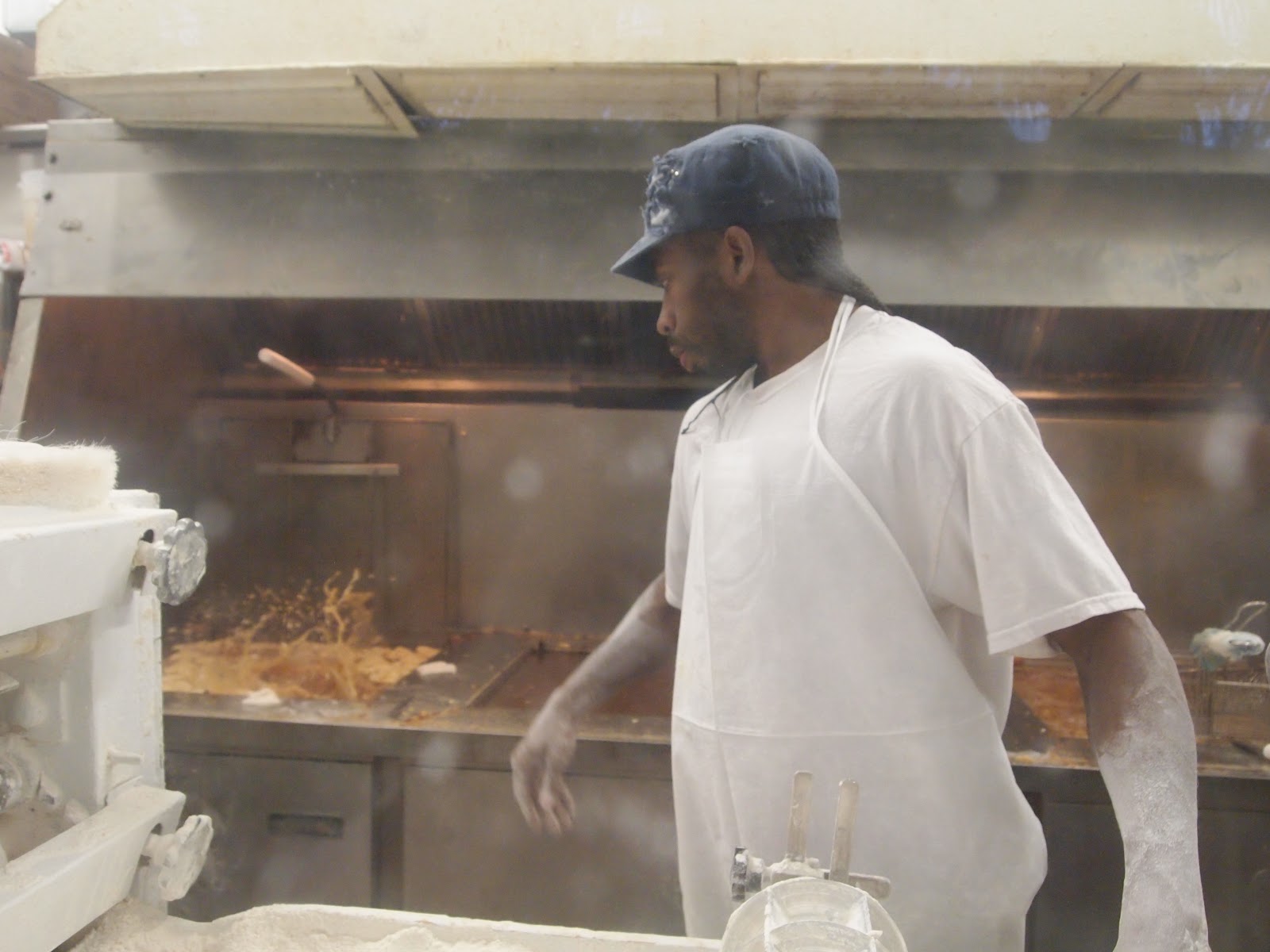
They must get the request a lot. Through huge glass windows that looked out onto a walkway at the back of the restaurant, we saw two men working silently and continuously, feeding the dough into a machine that sliced it and took it along a belt.


Starting from one end of the belt, the men would pick up the individual pieces, prime them in their hands and fling them across the air into the huge vats of boiling oil.


Each plate came with three or four beignets. Snowy mountains of powdered sugar rose precariously on top. Towards the end of the meal, that we had paid a visit to Cafe du Monde for the express purpose of devouring beignets was obvious. Our clothes, bags, and even parts of our hair bore the tell tale evidence.

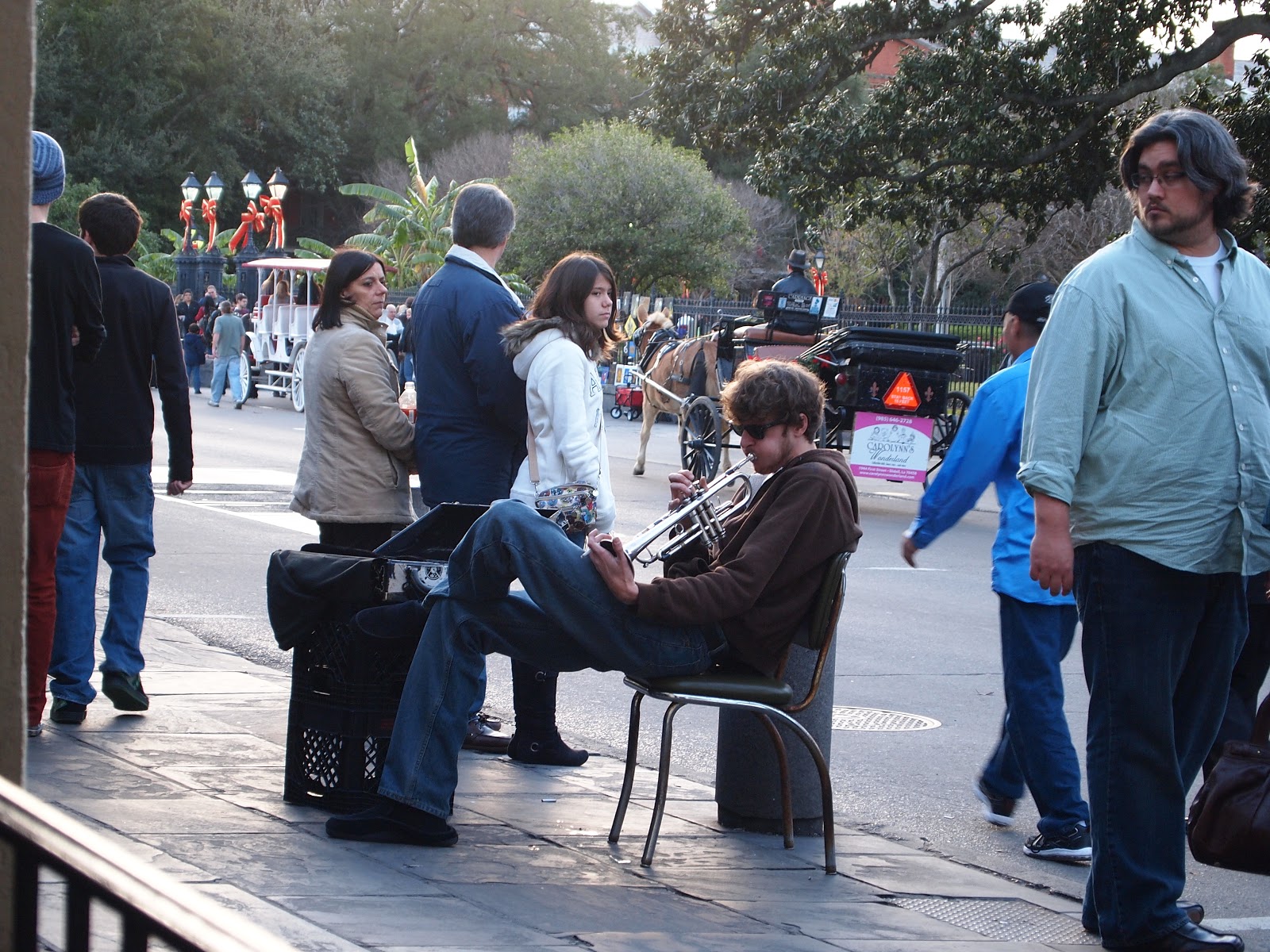
And as always in New Orleans, music was never far away. Just outside the railing the separated the eating area from the sidewalk, this young man played the trumpet.


Sunday, January 22, 2012

Forbes Article on D.C. Pedicabs


The nose wheel makes an acute turn and plants itself in the six-foot-wide gap between two cars idling at a traffic light on 14thStreet. Before we have time to analyse just how our driver would steer the rest of the 10-foot-long ‘pedicab’ into that space, we’re straddling another lane line a few feet down the road between a big, red tourist bus and a truck. A few more zigs and zags later, we are in front of a bank of vehicles at least 30 cars deep, clear of all the exhaust. Our driver looks back at us and declares triumphantly, “Like I said, this is not my first day on the job!”

For the past two years, Will Visbeck has been honing his skills as a driver of a pedicab – known to the rest of the world variously as cycle rickshaw, cyclo, becak or trishaw – on the streets of Washington, D.C. It has no roof, doors, seatbelts, airbags, rear-view mirrors or stereo systems (though headlight, taillight and turn signals are in evidence) but we do get to make leisurely circles around statues and monuments as our driver keeps up his commentary of the sights.

Originally published in ForbesLife India. A link to the pdf version is here.

Thursday, February 11, 2010

The Bangle Shop

Long, long ago, in villages and towns across India, the 'bangle man' roamed the streets. A cloth knapsack slung on his shoulders, he called out his wares - glass bangles in resplendent colors, some plain, some decorated with gold or silver paint - and made the rounds of his beat perhaps once a month, but more frequently during the marriage or festival seasons.

Inside the knapsack - fashioned out of a large cotton cloth whose four ends were knotted together - the bangles would be strung on long jute strings tied up at the ends to make a garland of the bangles. Many such colorful garlands nestled together in the knapsack.

The soles of his feet cracked from walking miles and miles on dry, dusty roads in worn out sandals or in bare feet, his head wrapped in a towel to ward off the heat of the sun, his teeth stained from years of chewing tobacco, the one-man, walking, talking bangle shop was a welcome sight nonetheless, his sing-song call a cause for great excitement especially if you'd been waiting for a delivery.

Women-folk (like my mom-in-law's mother, for example) hardly ever left the house, even to go to the market. They got their vegetables and grains from their farm and nearly everything else was home-delivered, including saris. Each family would have their favorite street hawker, one who knew the family's needs and would make special trips to his suppliers make sure he had what his customers needed. The same for bangles.

Most homes had a porch, screened with mesh or metal bars, where the bangle man and the women-folk would settle down to pore over the bangles, trying them on for size, flipping their wrists back and forth to check out the feel of the bangles, the clinking sounds providing a rhythm to their conversations. It was more than likely that neighbors would gather together on one porch, saving the bangle man from having to pack and unpack his knapsack over and over.

An old home with a screened porch

This little interlude was a welcome break for the women from their household chores and a welcome respite for the bangle man, a chance to rest his aching feet and take the load off his shoulders.

I wish I had a photo of one for myself and to show you because these days, the bangle man is a dead breed, especially in cities and the larger towns. Although street hawkers can still be found in the older residential neighborhoods, their wares are limited to vegetables in most cases.

The bangle shops have taken over. Even a small shop is able to carry a much larger variety than a hawker ever could. Street-side shops, such as the ones below, are quite popular in Bangalore.


And then there are ones like Bhavani Bangle Shop, which is a shop of the bone fida variety and is spread across four floors in Jayanagar, one of the busiest commercial areas of Bangalore. In all the years I lived in Bangalore, I dissed that shop. I grew up hating the thought of having to wear bangles or bracelets. Now it's a different story. Every time I've been back in the past few years, I've visited that shop, trying on and buying what a few years ago I thought was junk.

In the picture above, the owner receives boxes of new supplies for his shop.

The rows and rows of bangles and ear rings are mesmerizing. They are all costume jewellery, many of the designs (even those of the 'bindis' or the dots worn on the forehead) inspired by the heavily bejewelled heroines and vamps of the Indian soaps that rule the airwaves at all times of day and night.

Costume jewellery has caught on so well that this shop even offers to put together an entire set (bangles, necklaces, ear rings and other accessories) that will match your sari or other dress you might be planning to wear for a special event. I'd never heard of such a service before!


Most interesting of all, have you noticed something? The sales people are all men. A holdover from the bangle-man days, perhaps?

Wednesday, February 10, 2010

The Collapse of the World Trade Center Towers as Seen From the Air

ABC News has obtained aerial photographs of the collapse of the Twin Towers taken in the immediate aftermath of the attacks. They were taken by Det. Greg Semendinger of the NY Police Aviation Unit, the only photographer allowed in the airspace around that time, according to the NY Times.

They make for stunning visuals. All of my visual memory of that day seems to contain images of the towers seen from the bottom up, of debris falling all around the people fleeing the carnage of building parts falling, of ash falling.

These pictures offer an entirely new perspective, especially when grouped together as aerial pictures - the ash looks like it's spreading sideways and up, not falling.

Monday, February 08, 2010

Seen on the street: Snow art

Gotta love the wicked sense of humor that produced this! Can you make out the tiny flush handle on the left?


"Building a snow man is so boring," the man said. Yup! When you can build something like this, why settle for a snow man?

Sunday, February 07, 2010

The Blizzard of 2010 aka Snowmageddon

The snow came down thick and fast and wet. If you didn't keep up with it, it got heavy as the minutes ticked by. Fluffy and light on top, watery (later icy) at the bottom.


Just beyond the windows, the kitchen was warm and inviting.


We shoveled and shoveled. And shoveled. At least five times on the deck in the back and four times out front.

This morning, the sun was out!

Our fence grew a few inches overnight.

Winter is here, but spring seems so far away.


Icicles cling on to the roof edge for dear life.

A jet zooms across a nearly cloudless, blue sky this morning.


The sidewalk looks like a tunnel.

We lost the top of our holly tree to the weight of the snow.

I have a feeling we'll remember this for a long time.

Friday, February 05, 2010