Showing posts with label Food and Drink. Show all posts

Wednesday, November 25, 2015

South Indian Vegetarian Recipes for Your Holiday Feast


A road map for a vegetarian Thanksgiving. The entire essay is up at The Aerogram, including a recipe for Cranberry Pickle. 


One of the best memories of all our years celebrating Thanksgiving is the year we realized that the holiday had less to do with exactly what form the dinner took and more with getting to spend time with family and friends. It seems like a simple idea, but it was counter-intuitive to imagine Thanksgiving without turkey or beans or cranberry sauce. The menu at our house that year read like one for an Indian festival with a vegetarian spread, complete with an array of condiments.

If you’re contemplating vegetarian dishes for upcoming holiday feasts and love South Indian food, this roundup of recipes offers suggestions for dishes to include in your plans. Go forth and try your hand at one or two! Or if you’re feeling adventurous, supplement every section of your holiday feast with the help of these dishes. While some Indian recipes can be complicated and take hours to make, that’s not the story with most Indian home cooking, particularly vegetarian cooking.

Friday, April 17, 2015

South Indian Vegetarian Homestyle Cooking: A Guide to Essential Spices


My new essay on the basic spices used in South Indian vegetarian cuisine includes a recipe for Potato and Onion Curry. An excerpt is below. The entire essay is on The Aerogram.


Indian cuisine is vastly diverse, not only in terms of ingredients, traditions, and techniques, but also in terms of levels of complexity — ranging from simple curries and chutneys to the biryanis that demand multiple discrete steps and hours to cook.

Most Indian home cooking, however, particularly vegetarian home cooking, boasts of a repertoire of recipes that allow one to achieve sophisticated flavors with a few basic fresh and dry spices and herbs. Those recipes and a few slightly higher on the complexity spectrum — from the South Indian kitchens of my childhood and now my own — will be the focus of this essay and the ones that follow.


Friday, February 13, 2015

Semolina Porridge: How to Make Your Upma and Eat It Too


On AntiSerious, my essay on a childhood dish I learned to hate and then learned to love as an adult. The entire essay is here: The Pagan's Progress: How To Make Your Upma and Eat It Too

Then on one of my trips back to my parents’ home, I stumbled upon the problem with my Uppittu. Or the answer to the problem. As my mom stood over her stove, her die-hard cast-iron wok held firmly in one hand with tongs and the other gripping a steel ladle trying to scrape the roasted-on bottom layer of Uppittu, a flashback occurred in an instant. That used to be my favorite part of a not-so-favorite dish. Mom carefully transferred the crisp bits onto a plate and wordlessly handed it to me. She’d remembered.


Wednesday, November 26, 2014

New Recipes for Dips and Appetizers Inspired by Indian Condiments


My new food essay is up on The Aerogram with two recipes.


In my quest for dips that are a delicious departure from the ordinary, I decided to re-purpose a couple of types of condiments that play supporting roles in South Indian cooking — chutneys and bharthas. Bharthas are somewhat of an unknown quantity outside of desi circles, and while various types of chutneys are popular items on grocery store shelves, the many different South Indian cuisines boast of so many varieties that are still only found in home cooking.

The entire essay is here: Dips With a Twist: New Ideas for an Old Party Standby

Tuesday, November 25, 2014

The Evolution of an Immigrant's Thanksgiving


My essay on Thanksgivings past. 
We had left behind a culture that boasts of many festivals and rituals that bring families together. With extended families still living in close proximity, impromptu family gatherings are still the norm in our hometowns. Once we moved here we got busy with school and work calendars and we regularly lost track of those festivals (and still do), only a call from home prompting us to remember when it was too late.
The rest is at The Medium.

Friday, November 15, 2013

Easy Tomato Pickle Recipe


The recipe that accompanies the 'Food is the Tie That Binds' essay on preserving family recipes for future generations is also up on The Aerogram.
Pickling is usually a process that takes days if not weeks, but in less than a couple of hours, you could have on your hands this tomato pickle designed to delight your taste buds and impress your guests.
The entire recipe, with detailed notes, is here: http://theaerogram.com/tomato-pickle-recipe-food-tie-binds/

I hope you take a shot at it!

~~

Monday, November 11, 2013

Working Out the Kinks in the Inter-Generational Recipe-Transfer Protocol


My new essay on The Aerogram:
So each time we sat down at my breakfast table I would bring out not only all our assorted notes, my computer, and pens and pe...ncils, but also my measuring cups and spoons. One day, even a golf ball ended up on the table. My mother-in-law held up her fingers for the nth time to indicate a piece of jaggery or tamarind, I forget now, and since we had decided that ‘lemon-sized’ as an indication of the required amount was just not going to cut it, we were casting about for something more standard.
Eventually, though, the golf ball too went out the window and we resorted to the cookbook mainstays — tablespoons and teaspoons — instead. We would eye-ball the amounts that seemed right, set it out on a plate and measure each ingredient with cups and spoons, and we were on our way.
 
The rest is here: http://theaerogram.com/food-tie-binds/

~~

Saturday, October 26, 2013

What Makes Food Comfort Food?

The Aerogram published my essay on why a bowl of rice and some pickle is my comfort food.
On any other day, late night infomercials would give me company through a bedtime snack, but that day, with the occasional swish of a car whizzing past the house for company, I stood barefoot in the kitchen and polished off the entire bowl.

Not for the first time, I wondered what it was that drove me to seek this particular combination of foods in times of distress. I didn’t bother then to press for an answer, just content in the knowledge that for the moment all was right with the world.
Read the full essay on The Aerogram.

~

Wednesday, June 12, 2013

Let Children Have a Say in What They Eat

A clap of thunder, a bolt of lightning and it hit me that this was it. The answer to my prayers to help me steer clear of the trap that many parents around me seemed to be unable to extricate themselves from — one in which feeding their children healthy food turned into wars of attrition.
My post on why it's important to involve children in the kitchen and tips on how to do it appears here.
 

Tuesday, April 03, 2012

An Easy Indian Recipe for Wheat Berries

A few days ago while on the hunt for some vegan dishes, I stopped at eatingwell.com, my new go-to site for healthy, delicious and novel recipes. A recipe for Zesty Wheat Berry-Black Bean Chili caught my eye. The ingredient list was chock-full of the good stuff and foretold of a hearty, flavorful meal. One ingredient, though, gave me pause - two cups cooked wheat berry. Wheat berry? I'd never come across it before this fruity sounding thing before. So off to Whole Foods I went in search of the wheat berry. The guy in the produce section helpfully walked me to the small silos of a variety of grains and pointed me to the red wheat berry.

By now you've probably guessed, right? The wheat berry was not some exotic hybrid fruit-grain from Latin America. It was good old whole wheat grain in all its pristine glory, the very same one I've seen all my life growing up in India, in its avatar before it got roasted and ground into wheat flour.

This episode recalled the time years ago when my brother and I decided we would make something out of a cookbook on our own. Firni it was. We sent my mom off to the bedroom to read a book and relax. And then called out to her every couple of minutes for this or that ingredient. At the end of a chaotic hour, what we had on our hands was....ganji! That self-same easily digestible gruel mom made every time one of us got sick. My mom had a good laugh at our expense and now, anytime we tell her we're making some quaint sounding dish, she tells us to make sure it's not ganji first.

But back to the wheat berry. I brought home some of the grain along with the other ingredients and made the chili. It was delicious to say the least! The blend of flavors complemented the crunchy bite of the wheat very well. The chili was a complete meal in itself. Most importantly, the friends for whom I made it enjoyed it immensely and were delighted to expand their vegan repertoire by one.

I was left with about two cups of wheat berry. So this morning, craving for something zesty and spicy for breakfast and having tired of the mainstays of Uppittu and avalakki dishes, I decided to make a Sundal (Usli in Kannada). Although Uslis are usually made with legumes, cooked wheat berry lends itself very well to this dish because it maintains its shape even when cooked. And it was everything I hoped for. Made for a fantastic breakfast.

Wheat Berry Usli:

Ingredients:
2 tbps oil;
1/2 tsp mustard seeds;
1/2 tsp turmeric;
1/2 tsp urad dal;
1/2 tsp channa dal;
1/2 tsp cumin;
A dash of asafetida;
4 green chillies, slit down the middle;
1 sprig curry leaves;
1 large onion coarsely chopped;
2 cups cooked wheat berry (http://www.eatingwell.com/recipes/cooked_wheat_berries.html);
Salt, to taste
Juice of one lemon;
A handful of cilantro, chopped.

Heat the oil in a medium sized pan until shimmering. Add the mustard seeds, urad dal and channa dal. Once the mustard seeds start crackling, add the turmeric, cumin and asafetida. After about 30 seconds add, the curry leaves and green chillies and roast for about a minute. Add the onions and let roast until translucent, stirring frequently. Take care not to burn the onions, lowering the flame if necessary. Add the wheat berries and salt, and stir to blend all the ingredients well. Lower the flame to the low setting, cover and let cook for about five minutes. Turn off the flame and add the lemon juice. Mix well, garnish with cilantro and serve.

The Usli is great even when cold. Serve with a dollop of plain yogurt.

~~~~~
Recipe for Zesty Wheat Berry-Black Bean Chili

Monday, February 20, 2012

In Honor of Mardi Gras, A Little Slice of New Orleans

In just a few hours, Mardi Gras will get underway in New Orleans, one of my favorite cities in all the world. Over Christmas break, with the Sugar Bowl, a Saints game and New Year's parties all happening around that time, the city was buzzing with excitement and energy.

But what's a good party without food, eh? Each meal was an event in itself, as we tried to get our fill of the delicious Creole cuisine. And one memory that will stick around for a long time is that of biting into a piping hot, sugary beignet.


Not really knowing what to expect, we ordered one plate for the table, for two adults and two kids. One bite in, the consensus was to order two more plates. The chicory-rich coffee made for a heavenly accompaniment. We peppered our 20 year-old waiter with questions about the restaurant and the hugely popular dish (the lines went out the door for at least a block on all the days we were there). He invited us to take a peek into the part of the kitchen where the beignets were being made.


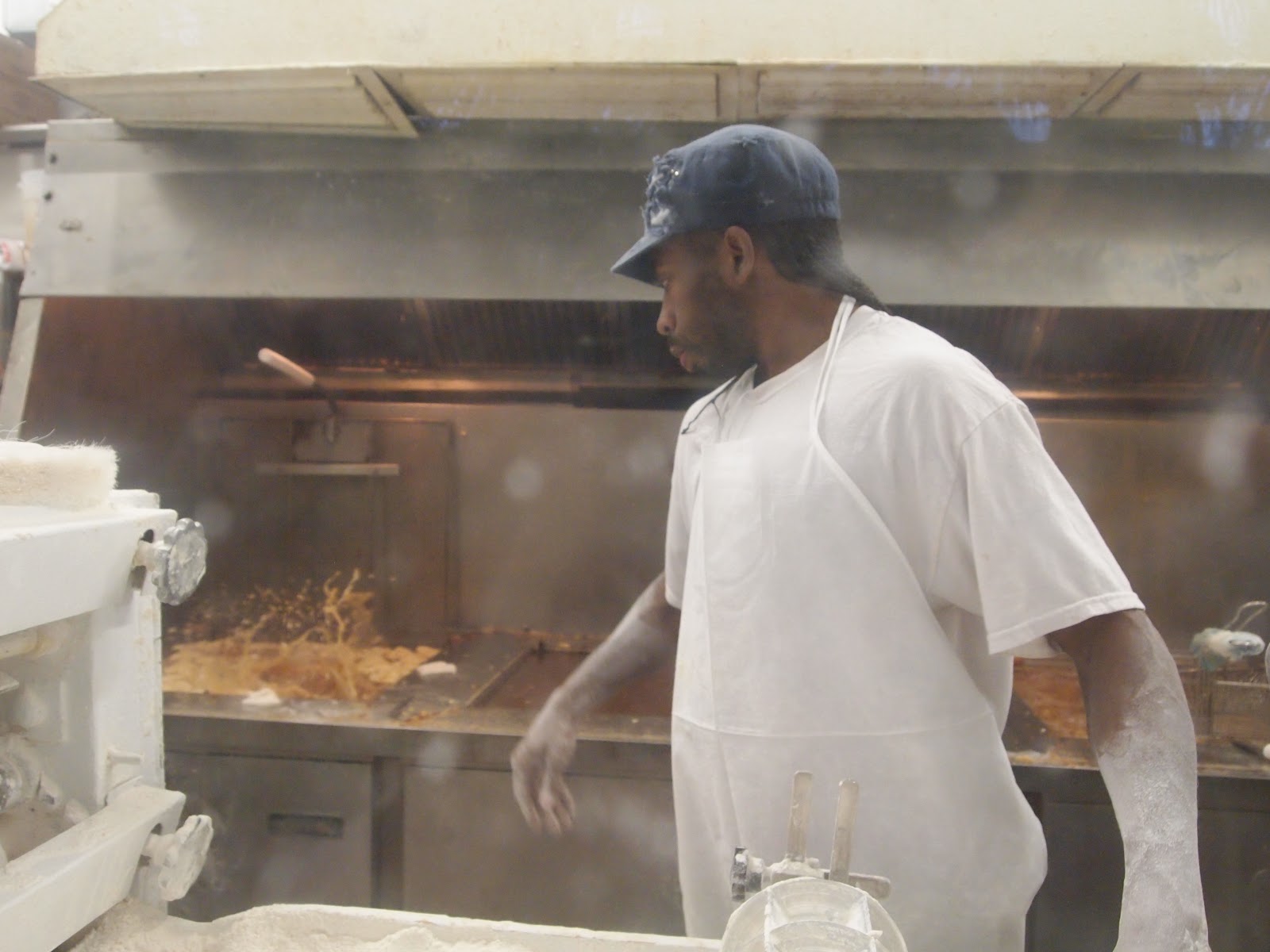
They must get the request a lot. Through huge glass windows that looked out onto a walkway at the back of the restaurant, we saw two men working silently and continuously, feeding the dough into a machine that sliced it and took it along a belt.


Starting from one end of the belt, the men would pick up the individual pieces, prime them in their hands and fling them across the air into the huge vats of boiling oil.


Each plate came with three or four beignets. Snowy mountains of powdered sugar rose precariously on top. Towards the end of the meal, that we had paid a visit to Cafe du Monde for the express purpose of devouring beignets was obvious. Our clothes, bags, and even parts of our hair bore the tell tale evidence.

And as always in New Orleans, music was never far away. Just outside the railing the separated the eating area from the sidewalk, this young man played the trumpet.


Tuesday, September 14, 2010

Advertisements and Parenting: A Little Bit of Help From an Unlikely Source

I am not a big fan of blaming television or video games for kids gone wild. Nor do I expect sports stars to be role models for my children. I don't believe that schools are solely responsible for making sure our children are well-educated. I don't blame advertisers or broadcast companies for airing enticing ads for sugary junk in the middle of what are touted to be educational programs.

What I believe is that parents have a big role to play in the lives of their children. Parents do have the responsibility, and, if they choose to use them, the resources and ability to guide their children in a way that does not let all those extraneous factors have more influence than the parents themselves do.

But I will be the first to say that it sure does not hurt to have some help from the inside. A couple of months ago, Businessweek carried an article about Alex Bogusky, an adversiting mogul whose biggest client was Burger King and who had a change of heart:
By June it was clear Bogusky wasn't just leaving the industry, he was turning on it. While most of his peers were at the annual Cannes Lions International Advertising Festival, he was advocating on his blog for a ban on advertising to kids. He named names, citing McDonald's (MCD) and Burger King, still a CP+B client. Then he sent the post by e-mail to Porter in Cannes. Porter has spoken about Bogusky and the piece just once, to Advertising Age: "I told him it was well written and made some great points, but I also said he needs to make a choice because [it's not compatible with the business we're in]. And the next morning he sent me a note saying, 'I resigned like you recommended.' "

[...]
In mid-July he interviewed Robyn O'Brien, author of The Unhealthy Truth: How Our Food Is Making Us Sick—and What We Can Do About It, and focused on genetically modified soybeans. "God created all these seeds but never got around to monetizing that s—t. God's a bad capitalist. So we said, let us show you how it's done," he said, to the bemusement of his guest. "We have a right to critique a food system created by a corporation....What if things don't turn out well and your kids come to you and ask: 'What did you do to try to stop this?' "

Sunday, December 13, 2009

Masala Art: New Indian Restaurant in Washington, D.C.

We're not great fans of eating out at Indian restaurants in the US. No matter how laudatory the reviews, we end up being disappointed - the flavors seem boring and bland, many of the dishes insipid versions of those made at home. But hope springs eternal. So when we saw a review on the Washington Post for a new North-Indian restaurant in DC called Masala Art, we decided to give it a try.


The restaurant, located on Wisconsin Avenue, has a pleasing ambiance - plenty of Indian art and other decorative items, but not so much as to overwhelm the senses. When we walked in on a Sunday afternoon, there were not many patrons to begin with, but people trickled in slowly in twosomes and in groups. Soon the place was buzzing.

We ordered the standard fare - mango lassis, samosas, pani puri, dahi papri, butter chicken, baingan bartha and a paneer dish. We ordered the naans with the interesting twist - baked with cilantro and rock salt.


Thrillist has this to say about the restaurant and its owner:
Preaching the philosophy that cooking is an “art form to be savored along with music and painting” and that particular dishes have their own “perfect moment”, the owner of the green-walled, trinket-lined, 45-seat Masala is a 20-year vet who spent the last decade exploring subcontinental cuisine at Dupont's Heritage India, after spending the first half of his career in India, exploring his heritage.
The food was actually flavorful, served hot and in the right portion sizes. Someone had put some thought into the presentation. The kids enjoyed the food as much as we did. The menu presents a nice variety of dishes and is not too pricey. The wait-staff was attentive (and talkative, which was OK as we were not there for a business lunch). One of them said that the restaurant serves brunches during the week, but is still gauging interest in weekend brunches.

Perhaps because it was the cozy space or because the restaurant was not overflowing, allowing us to linger, or because it was just the four of us out on a jaunt into DC on a bright, sunny Sunday afternoon, but we had an awesome time. I have a feeling we might be making our way back there again with a bunch of friends the next time around.

The restaurant is located at 4441-B Wisconsin Ave. NW, Washington, DC 20016, ph: 202-362-4441. The closest metro is Tenleytown-AU. According to the wait-staff, Thursday to Saturday nights tend to be crowded and reservations, therefore, would be prudent.

Tuesday, May 12, 2009

Mind-boggling Marketing by McDonald's

We opened the (snail) mailbox a couple of days ago and found a flyer from McDonald's, addressed to us specifically, advertising their new McCafe coffee line. It caught my eye because we'd just listened to a segment on the launch of McCafe on NPR's Marketplace in the car on the way back from C's swim session. I flipped it over and saw this:


A line of Hindi in English script - "Taste ki baat hai", meaning "It's a matter of taste". It was just so totally unexpected that I needed a moment to figure out I wasn't in India. This is not the first time I've had this "clash of the worlds' experience, but it never fails to get me.

P.S. The original "Clash of the Worlds" post is below. We lived in India then and were visiting the US for a "home visit" (and C was known as N on the blog).
N and I were at the DMV (Department of Motor Vehicles) a couple of days after we got to the US to get our car license tags reissued. We took a number to get in line, I filled out the application form and we sat in the row of chairs facing the 17-odd customer service counters. Christmas decorations were everywhere - green imitation pine streamers hung from the doors, windows and ceiling, red bows punctuating them every two feet or so, and red stockings hung from every counter with the name of each employee written in shiny colorful markers across the white furry borders.

As we sat waiting, we read the names on each of the stockings. When we came to the one with lettering in gold-colored marker, I blinked. The name looked like it had been written in Kannada. I blinked again, but it wouldn't go away.

I asked N to go up closer to the stocking and see if it was written in Kannada. He looked at me like I was nuts ("You've got to be kidding, mom"), but he went to the stocking and looked. It said Safiana. In English, of course.

Snippets of conversations I could not catch in crowded places seemed like they were spoken in Kannada. I looked around and there was not a single Indian face to be seen. It's not just me. On this trip, N sometimes thought he heard Kannada too.

This was not the first time my two worlds have clashed in my head. When we're driving around in the US on a stretch of road empty of other vehicles, with relatives or our Indian friends in the car, listening to a Hindi CD, it comes as a complete shock to me when we come to a traffic signal and there are cars with non-Indian faces in them.

We're not in Kansas anymore, Toto.

And my brain doesn't just transplant India into the US. The reverse works very well too.

A few months ago I was at my uncle's house in Bangalore for a pre-wedding family get-together (my cousin was getting married). I was dressed up in Indian clothes, of course, with bindis going a mile up on my forehead and bangles clanging on my wrists. On the way back home I needed to stop at the grocery store for something.

As I was leaving my uncle's house, an image flitted across my head. I was going to show up at the grocery store in all my Indian finery. Just a thought. And an awareness that I would get a lot of stares and smiles and perhaps some questions. A second later it struck me.

Duh! I'm in India! I'm not going to the local Safeway, I'm going to Monday to Sunday!

Monday, February 02, 2009

Recipe: Sakkaré Achchu (Sugar Figurines)

By popular demand, here it is, from our family to yours!

Sakkaré Achchu

Ingredients:
1kg sugar (the white colored, large-grained variety);
Water as necessary;
1 cup milk; and
4 tsp sour curds.

Equipment:
Wooden sugar figurine moulds;
Rubber bands;
A large saucepan;
A fine muslin cloth for straining;
A round-bottomed steel vessel;
A round-bottomed ladle; and
A set of tongs.

Method:
1. Before you start out, soak the moulds in water for 15 minutes. Remove them from the water and dry them completely. They should be moist but not wet.

2. In a large saucepan, pour the sugar and then pour enough water to cover the sugar. Then pour some of the milk.

3. Bring to a boil and stir until the sugar melts completely.

4. Strain the syrup into another saucepan through the muslin cloth. The cloth will have trapped some of the impurities from the sugar.

5. Repeat this process until you use up all the milk and all you're left with is a white paste.

6. Now add the 4 tsp of the sour curd and boil once more. You will see the remaining impurities of the sugar collect to one side at the top of the syrup.

7. Filter the syrup once more and you should be left with a transparent liquid.

8. Put the mould pieces together, bind them tightly with rubber bands and have them ready next to you on the counter top.

9. Take one cup of this syrup in a round-bottomed vessel. On the lowest setting of your stove, heat the syrup, stirring constantly from the bottom with a round-bottomed ladle. When the syrup starts bubbling, hold the vessel with a pair of tongs and rub the syrup with some pressure at the bottom of the vessel. When you hear a crackling sound and the syrup is just starting to turn opaque, then it's ready to be transferred to the moulds.

10. Pour the syrup into the ready moulds. Tap gently on the counter top to let the syrup trickle down into all the corners of the mould. See if you need to top off with some more syrup.

11. Let sit for about 5 minutes. Peel open the moulds carefully. Once you take the sugar figurines out, put the moulds back in cold water for 2 to 3 minutes at a time. Dry them out and use as before. They should not be warm when you pour the syrup into them. The figures will not set in warm moulds.

12. Repeat the process with 1 cup of syrup at a time.

13. Enjoy!

Note: If there are any changes to any of the above, I will post it up here.

May the syrup be a brilliant white, and sweet with that tiniest hint of tang; may the figurines hold together beautifully (or not, if there are hopeful young children hovering around the kitchen for fat crumbs; sorry, must side with the kids); may they brighten many a festival and family gathering.

My earlier post on Sakkaré Achchus appears in its entirety below, along with the photographs, so it's all in one place. If you try out this recipe please do let me know how they turned out.

And just one more thing. When I told my aunt that there was an interest in the recipe and I wanted to put it up on the blog, she willingly and happily agreed and reeled off the instructions. In that spirit, I would like to make a request - please do not copy these instructions or photographs elsewhere, whether for commercial purposes or otherwise without permission or attribution. Thank you.

~~~~~~~~~~~~~~~~~~~~~~

Sakkaré Achchu (in Kannada for "sugar moulds") is the mainstay of many a South Karnataka festival. Celebrations of Sankaranthi and Dussera, and family rituals such as weddings and housewarmings are incomplete without the sugar figurines.

Beautiful to look at, the figurines are used to embellish puja displays, are part of the gifts to the guests and are, most importantly, simply delicious to eat.

The ingredients are few and the process is painstaking, but pretty straightforward. The first step is to purify the sugar so that there are no impurities and the figurines turn out white instead of a dull shadow of white. The sugar syrup is boiled with curd and stirred constantly to separate impurities from the sugar. After two or three iterations of this, the resulting sugar syrup is simmered on a slow flame in a round-bottomed steel vessel until the syrup develops a thick consistency.


Photo Sharing and Video Hosting at Photobucket
Simmering sugar syrup


The moulds need to be soaked in water and must be damp so that the figurines loosen up easily when they are ready to be removed. Moulds are two wooden slabs with various shapes carved into them, each half a mirror reflection of the other.


Photo Sharing and Video Hosting at Photobucket
A banana-bunch shaped mould


Photo Sharing and Video Hosting at Photobucket
A bird-shaped mould


Just before the sugar syrup reaches the right consistency, moulds are readied by tightly tying together the matching pairs with rubber bands.


Photo Sharing and Video Hosting at Photobucket
Various moulds ready for the syrup


Photo Sharing and Video Hosting at Photobucket
Syrup being poured into the moulds


In a couple of minutes, the moulds are ready to be opened.


Photo Sharing and Video Hosting at Photobucket
Half-open moulds


And this is when you hope and pray that the figurine is weak in some spot and breaks apart so you get to eat the broken one hot off the mould. If you're desperate enough, you try to jinx it by rubbing your index finger the floor, counter-top or your grandma's hand. Trust me (and my gut), it works.


Photo Sharing and Video Hosting at Photobucket
Fresh and still warm figurines. Yummmm


Photo Sharing and Video Hosting at Photobucket


Homemade sugar figurines (with my grandma's and now my aunt's recipe) are the best. The purification process imparts a slightly tangy flavor and balances out the sweetness of the sugar and the constant stirring of the syrup turns out soft figurines that literally melt in your mouth.

No matter how delicious the end result is, the best part of the whole process is the family getting together to make them. Usually one member of the family takes on the onus of making the figurines for the entire family. My grandmother made it for all her daughters and shipped them off to wherever they lived in the years they were not with her to make them. Now, my aunt, my mother's younger sister is the family sugar goddess. She uses the same moulds that my grandmother did (some of them are losing the sharp outlines and so we have figurines that look like elephant shapes, only sort of).

Yesterday, as we made the figurines for a family function this weekend, much of the talk revolved round my grandmother and how she used to make them and how we used to pester her for the broken pieces (ever the frugal lady, she used to put the broken pieces back in the simmering syrup when we kids weren't looking). I'd asked my aunt to come over to my house to make them so my son could see how they are made. Every Sankaranthi I remember the sakkaré achchus and am glad that my son has some idea of what they are all about.

Saturday, January 17, 2009

Guilty Pleasure


Thursday, January 08, 2009

It's 10 pm on a cold, dark night

C finishes all his work, has dinner, wrangles a Wii game out of his grandfather, reads, and, finally, straggles into bed.

C: Mom, what am I having for breakfast tomorrow? Let's discuss it right now.

Me: I don't know. What do you want to eat?

C: Well, I can't eat pancakes. The syrup we have is not good. It's too sweet.

Me: I bought new syrup today.

C: Which one? Aunt enema?

Me: ROTFL

Thursday, December 18, 2008

Monster in the grocery aisle

Went to the grocery store to pick up some stuff last night and found this in the fresh vegetable section.


My first reaction was "Ewwwwww!" before I whipped out the cell phone and snapped a couple of pictures. It had the texture and color of a lemon. A label slapped on the thing told me it was Buddha Hand.

Wikipedia offers more pics and some very interesting tid-bits:
The fruit may be given as a religious offering in Buddhist temples. According to tradition, Buddha prefers the "fingers" of the fruit to be in a position where they resemble a closed rather than open hand, as closed hands symbolize to Buddha the act of prayer.

The origin of Buddha's Hand is traced back to Northeastern India and is believed to be the first citrus fruit known in Europe. It is speculated that the Greeks and Romans brought them back from Asia.

Tuesday, December 16, 2008

Darth Vader and Veggie Tacos

It's 8:40 already and I'm scrambling to make lunch for C. I've cut up the veggies, roasted them and have the rest of the fillings ready for his soft tacos. In the usual last-minute rush of the morning - C can't find his socks, D wants milk - I leave one of the tortillas in the pan for a little longer than I should have. It turns out crisp and flaky.

As I try to roll up the tortilla around the stuffing I show C what's happening. I tell him to be careful at lunch time so the insides don't all spill out. He says he has an idea. Why don't I wrap aluminum foil around the taco so it doesn't fall apart, he suggests, just like Darth Vader's suit kept his insides together.

I could do without the visual but I follow his suggestion.

Later in the afternoon, I find a clean lunch box with no evidence of the mess I had feared.

Wednesday, November 14, 2007

Recipe: Cranberry Pickle

The Thanksgiving holidays are just around the corner, and if you're like us, you'll probably have quite a few Indian dishes on the menu along with some traditional ones (here's a menu from a Thanksgiving past - and the New York style cheesecake was homemade, just so you know).

For a desi twist on that Thanksgiving staple, Cranberry, try pickling it - Indian style. Here's a recipe from my friend Lakshmi (ingredients are in bold):

1. Choose firm cranberries

2. Clean (chop off any dry ends near the stems) and dry them completely. There should be no water because water tends to rot the berries and the pickle will get spoilt.

3. Chop the berries into halves

4. Add salt, red chilli powder (paprika) to taste

5. Add a dash of turmeric powder

6. Add 1 tsp of roasted fenugreek powder (methi powder)

7. Heat sesame seed oil (for 250 gms cranberries, 50 gms oil), add powdered asafoetida and 1 tsp mustard seeds

8. Wait for the oil mixture to cool and add to the cranberry mix

9. Enjoy! Try it with warm pita pockets and humus.

With the exception of the roasted fenugreek powder, you'll find everything ready to use at the Indian store. If you don't find the fenugreek powder, ask for the seeds (buy the smallest pack available), dry roast them until you can smell them (a darker shade of the golden brown they already are) and grind them at home.

Let me know how it turns out!