Wednesday, April 24, 2013

Why Does the Higgs Particle Matter?

Physicist Frank Wilczek's essay is absolutely lovely to read, and inspiring, because it considers not only the science but also the human aspects involved in an inquiry of this magnitude:
The scientific work leading to the Higgs particle discovery involved thousands of engineers and physicists, not to mention billions of taxpayers, from all over the world co-operating to pursue a common goal. For most of the highly gifted participants, it involved long, often frustrating and sometimes tedious labor, with modest prospects for personal reward. They did it, anyway, because they wanted to understand the world better, and to be part of something great. They did, and they were. In this we have seen, I think, an example of humanity at its best.
Plus it helps that it's written in language that even a lay person like me could at least try to understand the concept.

The entire essay is here.

Thursday, April 18, 2013

When All That's Left of a Pressure Cooker are Fragments and Hurt

As an intern at a communications consulting company many years ago, I had to get familiar with the firm's documents and their various formats and templates. The resident tech guru pointed to the computer screen and said, "Click on that icon." Try as I might, I couldn't see an image of Jesus, Mary or any other religious figure. I turned to him and shook my head. "The icon. Here." He pointed to a very specific spot on the screen. I clicked on what looked like a folder and we were on our way.

That was the first time I had heard the word 'icon' used in that context. I had taught myself basic word processing at my grad school's library a few months earlier and was a neophyte when it came to tech jargon. It was not long before the list of words whose original meanings slowly merged with the meanings they acquired in the tech industry grew longer and longer. Mouse. Drive. Memory. Bug. Virus. Chip. File. Folder. Save. Recycle Bin. It was discombobulating at the beginning but not by the time Link, Tag, Navigate, Cloud and Friend came along.

It is only natural that this sort of co-opting of existing words and giving them new meanings must occur every time a new industry tries to find its footing. My favorite example is of the use of the word 'broadcasting' in the radio and TV industries. It originally referred to the way seeds were sown on farms - they were either 'broadcast', i.e., cast over a large area, or 'narrowcast'. These days, however, one hardly ever thinks of agriculture when that word is used.

Over the last few years, a newer enterprise - the terror industry - has been busy usurping words and their meanings. And it is accomplishing this feat not by using the words differently, but by commandeering mundane objects for its lethal purposes and wresting control of how we view those objects and the words we use to denote them.

Ordinary, everyday implements have always come in handy in committing crimes on a small scale - kitchen knives, arsenic, baseball (or cricket) bats, hockey sticks, pillows, etc. For acts of terror the tools of choice have expanded to cover fertilizers, nails, batteries, ball bearings, bleach, nail polish removers and cold packs. The original meanings of these words have not changed much, but a new, somewhat discomfiting connotation has layered itself on top of the original meaning. Belts, shoes, loose change in pant pockets, jackets, watches, lotions, gels, nail clippers - memories of security lines at airports attach themselves to thoughts of dressing up to go out. I can never think of box cutters (a term I'd not heard before) without also thinking of 9/11.

While our awareness has expanded to accommodate the understanding that some of these objects may be deployed to cause large-scale destruction, they hardly evoke the sort of memories that the latest entrant to this rather ignominious list - the pressure cooker - does.

To most people who've ever used it, the pressure cooker comes packaged with good, warm memories of the sights and sounds of home, of family, and of home-cooked food. Home cooks hold on to their pressure cookers for as long as they can because once they have mastered the nuances unique to each unit, it's hard to want to let go and start all over with a new one. The whistles of the cooker blend into a family's early morning rhythms. The aroma of steamed vegetables, rice and pulses is a harbinger of meals to follow.

Until a few years ago, a shiny new pressure cooker (along with detailed recipes) occupied a large portion of suitcases when kids in South Asia left home to go away to college abroad. It was too expensive an item to purchase on a student's (non-existent) budget. These days it is more widely available here in the US, and with people willing to try their hand at a variety of cuisines, it's not a rare item on wedding registries either. And it is not the sort of thing that would trigger a thorough sweep of your luggage at airports.

That was then.

Kitchen disasters with pressure cookers are not uncommon, usually due to faulty gaskets or weights. But there is an unbridgeable gulf between accidents and wanton acts designed to kill and maim other human beings. Many more words in our vocabulary have now mutated to acquire a slightly different shape and have settled somewhat uneasily in our collective memories. Marathon. Boston. Finish Line. Pressure Cooker. They trigger sad thoughts for lives lost and pain suffered; they bring thoughts of good human beings, of a situation that could have been worse but for many kind-hearted people; they call up anger at the senseless attacks on innocent lives. But no matter what, they trigger thoughts that never were before.

This is now.

~~~~~~~~~~~~

Update - April 29, 2013

This essay was published at The Aerogram.
 

Wednesday, April 17, 2013

How Does the 2013 Immigration Reform Proposal Compare to the 2006 and 2007 Senate Bills?

Via e-mail from the DC-based Migration Policy Institute:
The Migration Policy Institute has completed an analysis of the major provisions in the bipartisan group of senators' 2013 immigration reform framework, comparing them to provisions in the earlier 2006 and 2007 Senate legislation.

The side-by-side comparison's topics include border security and enforcement; visa reforms; earned legalization of unauthorized immigrants; strengthening of the US economy and workforce; and immigrant integration.

As this Issue Brief was completed in advance of today's release of the Senate immigration bill, the side-by-side will be updated in the coming days, as our experts comb through further details of the 844-page bill.
 
Here is the link to the comparison (pdf file): http://www.migrationpolicy.org/pubs/CIRbrief-2013SenateFramework-Side-by-Side.pdf

If you are interested in immigration issues and human migration in general, the Migration Policy Institute is a great resource. Here is a link to their site: http://www.migrationpolicy.org/

Thursday, April 04, 2013

ForbesLife India: Altruism Everyday

This essay appeared in the Winter 2012 edition of ForbesLife India.

In a material world, working for nothing can bear unexpected rewards - especially for heritage volunteers.

I must have dropped the nails about 10 times. In my defence, it was a typically freezing day in February in the suburbs of Washington, D.C. I had two layers of t-shirts underneath my hooded sweatshirt, a heavy jacket on top, thermals under my jeans, a hardhat, boots and gloves. Even a tool belt. I looked every inch the construction worker I was pretending to be. Through the gloves, I could barely feel my fingers. I was lucky it wasn’t the hammer I dropped.

Along with two other somewhat better coordinated volunteers, I stood on the top level of what would eventually be a house. Our task that day was to frame the inside walls that would section off the various rooms.

About an hour into the lifting, aligning and hammering, a man who I’d seen walking around in the lower floor climbed up the creaky wooden stairs, waved a cheery hello and proceeded to thank everyone. I don’t recall his exact words all these years later, but they added up to something like, “Thank you for building my home.” I stared at him open-mouthed. As far as I knew, I was just going to help build a home; I hadn’t expected to actually meet the family who would eventually live here. The sudden rush of delight I felt – a volunteer’s high, if you will – just about managed to thaw my icy fingers. Or at least make me forget about them for a while.

I had volunteered on a whim, through a network of Indian professionals in the Washington, D.C. area, on a project for Habitat for Humanity, a Christian organisation that pairs affordable housing and no-interest mortgage loans with families in need.

To me, it seemed like an excellent way to make connections within the Indian community while spending an afternoon on a worthwhile cause. But this, my first encounter with volunteering, led to many more hours spent helping people and organisations, both with groups of like-minded friends and on my own, in food banks, at local libraries and, as my children grew older, on sports teams and in schools.

Over the years, I have found that for immigrants, volunteering is the synapse that can fire off quite a few connections. Having grown up in other countries, immigrants can feel the lack of exposure to the American institutions that will inform their lives and those of their children. And having moved away from their home countries, connections to their own heritage are rendered tenuous. Volunteering in government agencies, schools and on sports teams allows them a peek into the inner workings of these institutions and helps build relationships within their new communities, while donating time to cultural organisations and places of worship allows them to remain connected to their heritage.

Anu Iyer, 59 and a first generation immigrant, is a Montessori school teacher, and coordinator of the PR committee at the Sri Siva Vishnu Temple in Lanham, Maryland, a voluntary position. “Volunteers are the backbone of the temple, which serves thousands of devotees from nearby communities and neighbouring states,” she says. “They play a very, very important role.” The temple has a few employees (managers, priests and cooks), but relies on several hundreds of volunteers for everything else, from keeping track of donations, maintaining various databases, selling food at the canteen, procuring flowers and making garlands, making and maintaining the saris that adorn the idols and manning the reception desk to teaching children Sanskrit shlokas every weekend. Many of the volunteers donate their time because it allows them to socialise with other Indians and replicate the feeling of home, says Iyer.

As a young girl, she watched her father working on various projects within the airport colony in which they lived in Mumbai. He founded a credit union for airline employees and ran a school for their children, both on a purely voluntary basis. It felt natural to Iyer when she moved to the US to want to volunteer at the two institutions she interacted with regularly – her children’s school and the temple.

Sonya Mazumdar, 29, a patent examiner in the United States Patent and Trademark Office (USPTO) in Alexandria, Virginia, also grew up watching her parents donating time and effort to their community in New Jersey. Mazumdar imbibed this ethic and tutored fellow students in math and science subjects for a nominal fee in high school, and later for college credit. “It is always good to help people,” she says. “Not everybody is as lucky as you.” Today she volunteers, along with her USPTO colleagues, at a local elementary school to devise and introduce science experiments to third-graders.

Mazumdar also donates her time as co-chair of the community service committee in the Washington, D.C. chapter of NetSAP (the Network of South Asian Professionals). She coordinates at least one community service project a month, from packaging food for retirement homes and painting school bathrooms to helping out at an Armed Forces retirement home. The volunteers particularly enjoyed this last project, she says, because they got to interact with Army veterans, a demographic that people from the sub-continent don’t usually get to meet.

For Madhu Maheshwari, 60, who moved to the United States as a new bride in the mid-’70s, the urge to remain connected to her heritage and pass on that legacy to the next generation drove her to gather a small group of like-minded friends to teach children the songs, dances and poetry of India. Years later, she still teaches Hindi, and produces and directs Hindi plays with children of other Indian immigrants in her community in Northern Virginia.

While Indian immigrants in the US and their children are busy putting down new roots in their chosen homeland, some in the second generation are digging deeper back in the old country, moving back to India for periods up to a year or more to volunteer on a wide range of development projects. The phenomenon has grown big enough to acquire a handle all its own – ‘heritage volunteering’ or ‘diaspora volunteering’.

According to a report published by the Migration Policy Institute, a Washington, D.C.-based think tank (Terrazas, Aaron. 2010. Connected Through Service: Diaspora Volunteers and Development), about one million Americans volunteer abroad each year, of which nearly 200,000 are first and second generation immigrants. Whereas the United States Peace Corps – an independent government agency founded in 1961 that matches trained volunteers with countries in need of their expertise – used to be the only organised option for Americans who wanted to volunteer in other countries not too long ago, Googling ‘volunteering in India’ elicits nearly 11 million results in less than half a second today. There are legions of agencies, foundations, and non-profit organisations willing to facilitate overseas volunteer journeys. While some agencies require the volunteers to bear all costs associated with the trip and the stay, others offer fellowships that cover the cost of the trip and basic living expenses.

Indicorps and the American India Foundation’s William J. Clinton Fellowship for Service in India (AIF Clinton Fellowship) are just two of the many prominent entities that offer fellowships for working in the non-profit sector in India. Indicorps restricts its fellowships to heritage volunteers and Indian citizens, but the latter is open to US permanent residents, Americans and Indians who want to work on development projects in India.

Indicorps fellowships have been offered to anywhere between three and 22 applicants every year since the non-profit organisation was founded in 2002, says Dev Tayde, executive director. The August 2011 batch, which finished its fellowship year at the end of July 2012, had a class of nine Fellows. According to Behzad Larry, a programme officer at the AIF Clinton Fellowship, 265 Fellows have been placed in India since the inception of the programme in 2001. For the 2012-2013 year, 40 Fellows will be placed among the 120-odd non-profit organisations the AIF Clinton Fellowship partners with in India.

For some second-generation Indians, their parents’ frequent holidays in India meant more than just time with extended family or a stronger than usual exposure to heritage. They allowed a germ of an idea for things to accomplish in the future to take root. Suchita Guntakatta, 42, for instance, visited India often while growing up in the US and returned as a mid-career professional contemplating a change from management consulting. Her decision to volunteer in India came easy. “I wanted to understand the issues on the ground because I was considering going into the non-profit sector,” she says. “And I chose India because it is close to my heart.”

Signing up with Cross Cultural Solutions, an organisation that matches volunteers with projects that address the needs of communities in Asia, Latin America and Africa, she decided to teach English to women in Dharmasala and help them to better their work prospects. “You could see that they were genuinely motivated to do better for themselves and their families,” Guntakatta says. While her planned six-month stint was cut short to just a few weeks as she received the offer of her dream job as deputy director of strategy, planning and management at the Bill and Melinda Gates Foundation in Seattle, it is obvious she cherishes the time she spent helping the women.

For Krupa Asher, 25, a 2011 AIF Clinton Fellow, her work at the Anudip Foundation in Kolkata teaching IT and other livelihood skills to unemployed rural youth and women was a good blend of service and opportunity for professional development. Northeastern University, where she got her degree in International Affairs and Human Services, offered a co-op programme that allowed students to take six months off from school to work in a particular sector to assess if it was something they wanted to pursue in the long term. Under the programme, she volunteered with a Bangalore-based non-profit, working to provide education to under-served children for about five months. “Bangalore was difficult, the logistics and bureaucracy were difficult. I was not confident in my abilities. I learned a lot about myself. I learned patience,” she says, but by the time her AIF Clinton Fellowship came along, “India was a battle I was ready to take on.” The fact that she was able to garner real-world experience while helping women and unemployed rural youth was crucial to her. She is sure it will pay off as she works towards a Masters in development management at the London School of Economics.

While professional aspirations may drive heritage volunteers to seek development projects, applicants of Indian origin frequently mention the need to establish a deeper connection with their parents’ home countries – and know what it is really like to live there – as deciding factors in choosing India, says Larry. Sometimes, this need must overcome parents’ discomfort at their children living thousands of miles away in a country they had decided to leave years earlier, as both Asher and Sumita Mitra, 24, a 2010 Indicorps Fellow, found out.

Mitra, a graduate of the University of California, Berkeley, took numerous trips to India as a child. “I was about six or seven when I knew I would come back and work in India one day,” she says. Through her fellowship she worked with Hum Kisan Sangathan, a farmer’s collective in the Jhalawar district of Rajasthan. With a background in light Hindustani music and a passion for the performing arts, the project that used theatre and music for social change was right up her alley.

At the end of the first year, she felt like a lot was left unaccomplished and so went back to India with Piramal Fellowship, a programme designed to help participants ‘understand the power of business to do social good.’ She will continue to stay on, she says, even at the end of this one. “I feel like somewhere along the line of my life I made a commitment to fighting for social justice. The fact that there is so much change I want to see in the world keeps me here … and the fact that there is always hope. I think if I ever felt change wasn’t possible I’d leave, but I know change is very possible.”

By definition
For institutions receiving the service hours, volunteering is serious business. According to Volunteering in America, a report published by the Corporation for National and Community Service, an agency of the US Government, volunteers served 8.1 billion hours in 2010. The total estimated value of that service was $173 billion (at an average rate of $21.36 per hour).

But what does ‘volunteering’ or ‘volunteer work’ mean exactly? It is one thing to drive to the local library and help them shelve all the returned books. It is quite another thing if your volunteer project needs you to get on a plane for 20 hours and live in a strange country for six months, working to improve women’s health. Who bears the cost of the trip? If volunteering means you can’t get paid, does that mean that only rich people get to volunteer? And if you work the entire summer in your uncle’s restaurant washing dishes for no pay, is that considered volunteering?

Recognising how challenging it is to arrive at a standardised definition of volunteering, the International Labor Organization (ILO), in its Manual on the Measurement of Volunteer Work (2011), proposes the following definition:

Unpaid non-compulsory work; that is, time individuals give without pay to activities performed either through an organisation or directly for others outside their own household.

The manual goes on to explain that while volunteers cannot be remunerated for their service, “some forms of monetary or in-kind compensation may still be possible without violating this feature of the definition.” For example, reimbursement for out-of-pocket expenses such as travel costs or stipends that cover daily expenses (as long as the stipend is not tied to the local market value or the quality or quantity of work) do not constitute a salary or payment for work and such work will still be considered voluntary. And no, no amount of free work for family will qualify as volunteering.
 

Friday, January 11, 2013

A Playreading Group for Children, at Jagriti in Bangalore


Via e-mail:
 
This is open to children who would like to keep in touch with plays and drama. There will be one session at week—on Saturday at 4 pm—for three months. Through this time, the group will read plays, watch plays and meet with directors, actors and designers to understand the workings of a dramatic text.
This is not a class, where a syllabus is followed and a trainer is teaching. The course will be extremely rewarding for children interested in drama, and who will motivate themselves to work and bring something to the group.
To register for the program, do write to edu@jagrititheatre.com with the following details:
1. Name
2. Age
3. Name of school
4. Any previous theatre training - if yes, duration of course(s) attended
5. A few lines on why you want to take up the course
Please Note:
The programme will start on January 12, but children are welcome to join any time
There is no fee
The upper limit is 20 children, after which registrations will close

Wednesday, July 18, 2012

Paterno's Statue: Once a Monument to a Man, Now a Reminder of a Society's Failing

A brilliant column by Ta-Nehisi Coates in the New York Times today argues for not removing Paterno's statue from the prominent place it now occupies at Penn State:
Arguing for the statue’s removal, the legendary coach Bobby Bowden said he wouldn’t want Sandusky’s crimes “brought up every time I walked out on the field.” That’s the point. Sandusky’s crimes should never be forgotten, nor should the crimes of the broader community. It is shameful to deify men who put nationalist ritual before children. But it is more shameful to pretend that this elevation was achieved by Joe Paterno’s singular hand.
Removing the Paterno statue allows Happy Valley to forget its own compliance in a national crime, to expunge its own culpability in its ruthless pursuit of glory. The statue should remain, and beneath it there should be a full explanation of Sandusky’s crimes, Paterno’s role and some warning to all of us who would turn a pastime into a god and elect a mortal man as its avatar.

Wednesday, April 11, 2012

Summer Reading Program for Children in Hyderabad (India)

Check out this interesting summer reading workshop for kids (infants to 15 years old) in Hyderabad called TreasureHouse. The workshop will be run by Utbt, the blogger at Under the Banyan Tree.

Tuesday, April 03, 2012

An Easy Indian Recipe for Wheat Berries

A few days ago while on the hunt for some vegan dishes, I stopped at eatingwell.com, my new go-to site for healthy, delicious and novel recipes. A recipe for Zesty Wheat Berry-Black Bean Chili caught my eye. The ingredient list was chock-full of the good stuff and foretold of a hearty, flavorful meal. One ingredient, though, gave me pause - two cups cooked wheat berry. Wheat berry? I'd never come across it before this fruity sounding thing before. So off to Whole Foods I went in search of the wheat berry. The guy in the produce section helpfully walked me to the small silos of a variety of grains and pointed me to the red wheat berry.

By now you've probably guessed, right? The wheat berry was not some exotic hybrid fruit-grain from Latin America. It was good old whole wheat grain in all its pristine glory, the very same one I've seen all my life growing up in India, in its avatar before it got roasted and ground into wheat flour.

This episode recalled the time years ago when my brother and I decided we would make something out of a cookbook on our own. Firni it was. We sent my mom off to the bedroom to read a book and relax. And then called out to her every couple of minutes for this or that ingredient. At the end of a chaotic hour, what we had on our hands was....ganji! That self-same easily digestible gruel mom made every time one of us got sick. My mom had a good laugh at our expense and now, anytime we tell her we're making some quaint sounding dish, she tells us to make sure it's not ganji first.

But back to the wheat berry. I brought home some of the grain along with the other ingredients and made the chili. It was delicious to say the least! The blend of flavors complemented the crunchy bite of the wheat very well. The chili was a complete meal in itself. Most importantly, the friends for whom I made it enjoyed it immensely and were delighted to expand their vegan repertoire by one.

I was left with about two cups of wheat berry. So this morning, craving for something zesty and spicy for breakfast and having tired of the mainstays of Uppittu and avalakki dishes, I decided to make a Sundal (Usli in Kannada). Although Uslis are usually made with legumes, cooked wheat berry lends itself very well to this dish because it maintains its shape even when cooked. And it was everything I hoped for. Made for a fantastic breakfast.

Wheat Berry Usli:

Ingredients:
2 tbps oil;
1/2 tsp mustard seeds;
1/2 tsp turmeric;
1/2 tsp urad dal;
1/2 tsp channa dal;
1/2 tsp cumin;
A dash of asafetida;
4 green chillies, slit down the middle;
1 sprig curry leaves;
1 large onion coarsely chopped;
2 cups cooked wheat berry (http://www.eatingwell.com/recipes/cooked_wheat_berries.html);
Salt, to taste
Juice of one lemon;
A handful of cilantro, chopped.

Heat the oil in a medium sized pan until shimmering. Add the mustard seeds, urad dal and channa dal. Once the mustard seeds start crackling, add the turmeric, cumin and asafetida. After about 30 seconds add, the curry leaves and green chillies and roast for about a minute. Add the onions and let roast until translucent, stirring frequently. Take care not to burn the onions, lowering the flame if necessary. Add the wheat berries and salt, and stir to blend all the ingredients well. Lower the flame to the low setting, cover and let cook for about five minutes. Turn off the flame and add the lemon juice. Mix well, garnish with cilantro and serve.

The Usli is great even when cold. Serve with a dollop of plain yogurt.

~~~~~
Recipe for Zesty Wheat Berry-Black Bean Chili

Thursday, March 29, 2012

Children and The Hunger Games

If you have been even the slightest bit plugged into the news these past few days, it is a safe bet that you've heard of The Hunger Games, the ticket sales juggernaut that swept across multiplexes this past weekend. The first in the trilogy was published in late 2009 and the last one late last year. The books are classified as Young Adult Fiction (typically targeted at readers between the ages of 12 and 18).

Discussions surrounding the movie and the books have branched off into hundreds of little tentacles on the Internet and among friends. Everything from whether Jennifer Lawrence is too big to portray Katniss Everdeen, the heroine, to the appropriateness of the casting of the other parts, to how the movie differed from the books, and a lively discussion on the New York Times website about whether adults should be reading novels written for their children.

Among some parents (the ones who are not fighting for the books with their children, that is) there is also a general unease about whether the books are appropriate for children at the lower end of the age range targeted by Young Adult novelists. The books make no bones about the violence contained within their pages. The back flap to the first in the series reads, "Winning means fame and fortune. Losing means certain death. The Hunger Games have begun..." And no matter how you slice it, between 12 and 18 lies a huge difference not only in terms of physical growth but also in terms of emotional growth, social maturity, willingness to process and understand goings on in the world around us, and general ability to engage with more than self, family and friends.

There is no shortage of mature matter tackled in The Hunger Games. There is war, a rebellion of the states against their Capitol; there is deprivation and there are deeds of cruelty perpetrated by a government against its own citizens, young, old, sick and dying; there is torture and there are biological weapons; there is the harsh life of mining communities accompanied by the inevitable accidents leading to death and mayhem; there is bullying and peer pressure; there are absent fathers (because they are dead) and disengaged mothers; there are children who have had to grow up and take on adult responsibilities because there is no one else around who will take care of them (this characteristic is the premise of most novels in the Young Adult genre); then there is the hunger and the promise of riches and unending food supply if only you, a child yourself, would fight 23 other kids to the death; and the ignominy of having to do engage in the games for the pleasure and enjoyment of people of the Capitol who have not known a day's hardship in their lives.

Every page brings home the realization that in Panem, life is hard and life is unfair and unfair not in the way life is to a vain teenager when a zit makes an unwelcome appearance before a party.

But for anyone who has doubts if their fourth or fifth grader should be reading these books, I say The Hunger Games is but a reflection of what they see around them in newspapers, on television and radio, and unfortunately, to some extent in their own schools every day. The books represent an amazing opportunity to think about those issues beyond the headlines.

You know your child best of course and their capacity to process highly evocative material, but if he or she follows the goings on in the world, it will not take long for them to draw parallels between what they are reading in the books and the ticker on the bottom of their television screens - the Arab uprisings and the brutal quelling, the peer pressure children face in school, the emotional toll of cliques, the wars and divorces that have taken fathers and mothers away from their children, the crushing poverty not only in large parts of the world, but in America too, and the harsh lives of child soldiers of Africa and Latin America who kill each other for the promise of food and a better life for their families.

The bone-chilling truth is that while we debate about whether our children should read such stories and try to protect them from this knowledge, there are human beings all over the world who are living the lives of abject poverty so richly detailed in The Hunger Games series.

The Hunger Games also offers a rather long and eye-opening peek behind the scenes of reality television shows.

It was a long time ago, but I still clearly remember the first time I learned that advertising firms used mashed potatoes as a stand-in for ice cream in ads. It was as if a veil had come off and I could clearly see that things were not as they appeared. And just as a word that you've newly learned suddenly seems to pop up everywhere, so too did evidence of gimmickry and sleight-of-hand in all sorts of advertisements.

These days, mashed potatoes that can withstand the glare of flood lights is the least of gimmickry that kids (and their parents) have to worry about. From teen magazines choosing to air brush away the slightest hint of baby fat to kids being constantly bombarded with messages about branding, food and self-image (such as kids being sold sugary foods while being held up to an impossible thinness standard), fact and fiction lead an uneasy co-existence in children's lives.

The games in the book series are organized as reality television and the machinations the producers resort to just to keep the ratings up and keep audience interest from flagging are painfully obvious. It can only help to educate kids in all the ways in which companies seek to manipulate them and hold their interest for gain.

So go ahead, let your tween read the books. But their understanding of the ideas will be infinitely richer if you read them as well and spare the time to discuss the various issues that I am sure will come up. In our household at least, both my son and I have been talking about the books and the movie giddily for the last few days.


~~~~
Also read: Suzanne Collins's interview with the New York Times. It offers a revealing look at the forces in her own life that shaped the plot in The Hunger Games.

Monday, February 20, 2012

In Honor of Mardi Gras, A Little Slice of New Orleans

In just a few hours, Mardi Gras will get underway in New Orleans, one of my favorite cities in all the world. Over Christmas break, with the Sugar Bowl, a Saints game and New Year's parties all happening around that time, the city was buzzing with excitement and energy.

But what's a good party without food, eh? Each meal was an event in itself, as we tried to get our fill of the delicious Creole cuisine. And one memory that will stick around for a long time is that of biting into a piping hot, sugary beignet.


Not really knowing what to expect, we ordered one plate for the table, for two adults and two kids. One bite in, the consensus was to order two more plates. The chicory-rich coffee made for a heavenly accompaniment. We peppered our 20 year-old waiter with questions about the restaurant and the hugely popular dish (the lines went out the door for at least a block on all the days we were there). He invited us to take a peek into the part of the kitchen where the beignets were being made.


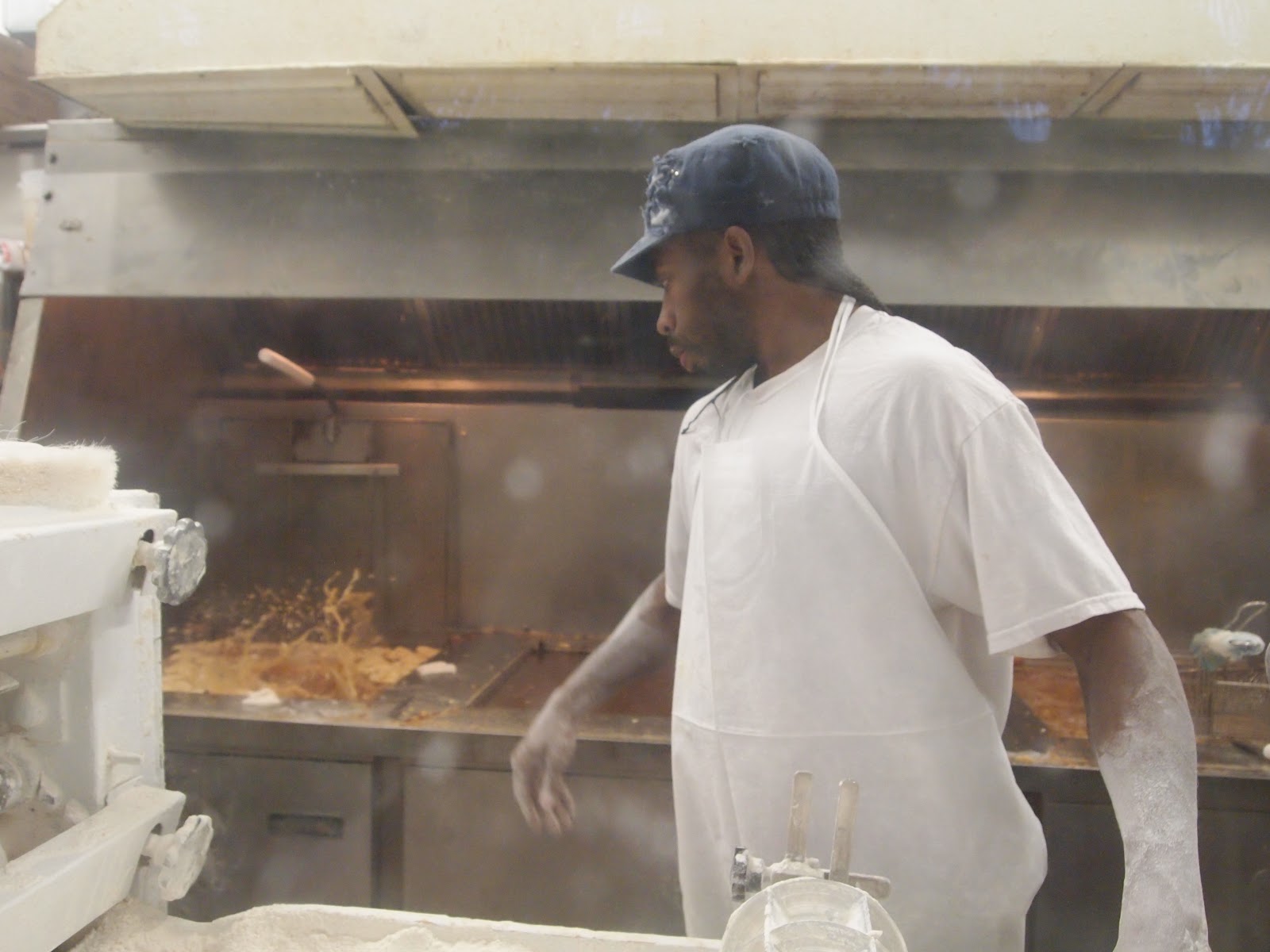
They must get the request a lot. Through huge glass windows that looked out onto a walkway at the back of the restaurant, we saw two men working silently and continuously, feeding the dough into a machine that sliced it and took it along a belt.


Starting from one end of the belt, the men would pick up the individual pieces, prime them in their hands and fling them across the air into the huge vats of boiling oil.


Each plate came with three or four beignets. Snowy mountains of powdered sugar rose precariously on top. Towards the end of the meal, that we had paid a visit to Cafe du Monde for the express purpose of devouring beignets was obvious. Our clothes, bags, and even parts of our hair bore the tell tale evidence.

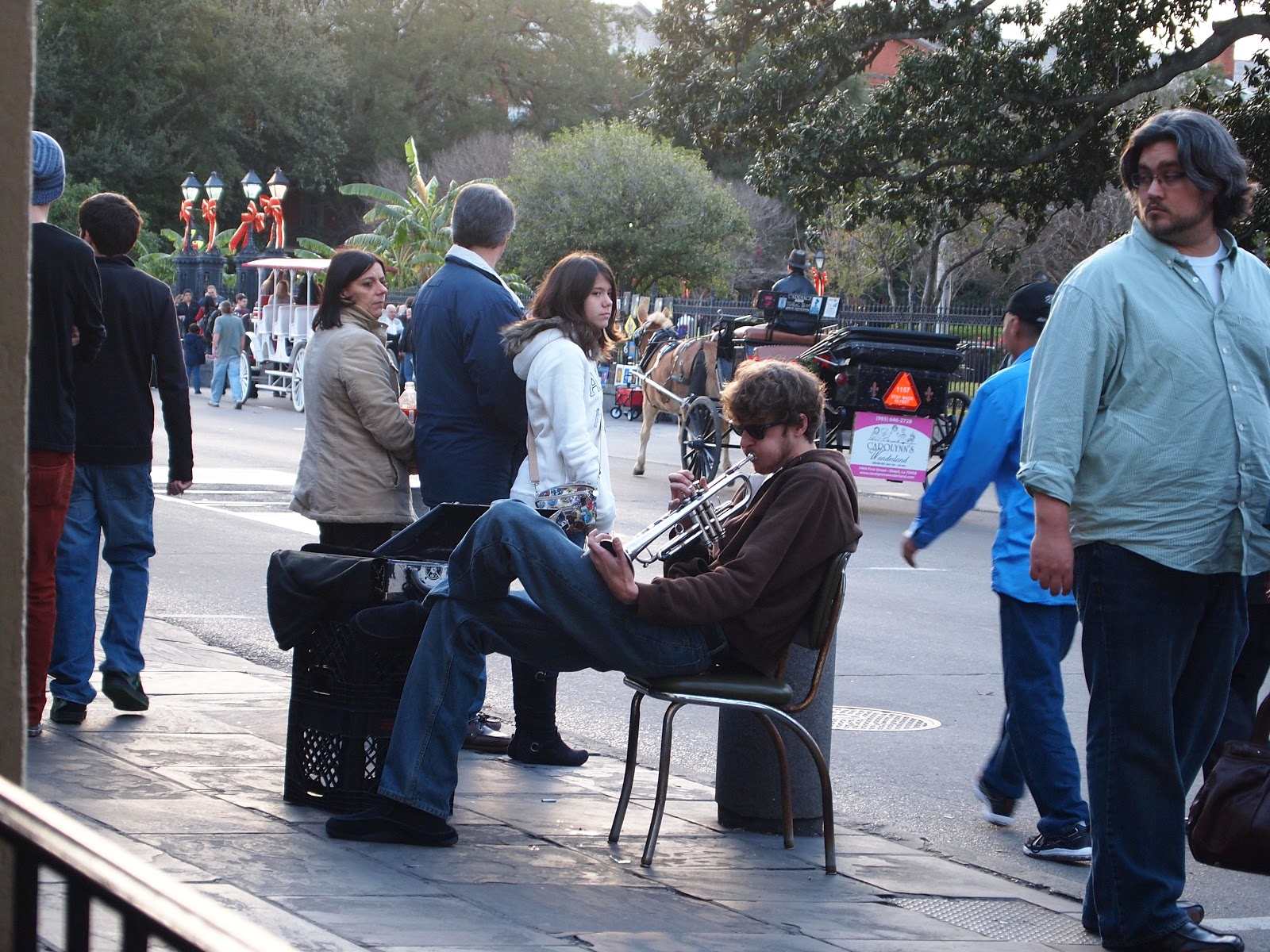
And as always in New Orleans, music was never far away. Just outside the railing the separated the eating area from the sidewalk, this young man played the trumpet.


Wednesday, February 15, 2012

Profiting from Social Media

Sree Sreenivasan, a professor of digital media and dean of student affairs at Columbia Journalism School, has a new blog on CNET. His first post is on profiting from social media.

Sunday, February 12, 2012

Jabberwock's Review of Katherine Boo's Behind the Beautiful Forevers

I recently heard an interview with Katherine Boo on radio and want to get her book, Behind the Beautiful Forevers, about life in Annawadi, a slum in Mumbai. This Jabberwock review seals the deal. And here's an interesting profile of the author in The New York Times.

Tuesday, February 07, 2012

Swimming Lessons in Bangalore at the Nisha Millet Swimming Academy

Olympian Nisha Millet runs the Nisha Millet Swimming Academy at various locations in Bangalore for many age groups and skill levels - from five year-olds to 70 year-olds, from beginners to competitive swimmers. Check out her Facebook page for more details. From first hand experience, I can say that she has a firm but gentle approach with the kids and gets them to love the water, which as many parents will tell you is first biggest hurdle on the road to learning to be a good swimmer. Happy swimming!

Monday, January 23, 2012

Theater Review: Adventure Theatre's A Snowy Day

There are few things more delightful than an afternoon spent surrounded by a gaggle of giggling five and six year-olds. And there was plenty of opportunity for that at a showing of Adventure Theatre's new musical production, The Snowy Day. Based on Ezra Jack Keats' Caldecott Medal winning children's book of the same name, the antics of the four main characters in the play provide plenty of action, adventure and food for thought for audiences young and and not-so-young.

Keats' The Snowy Day is the tale of a young boy, Peter, who wakes up one day to find snow blanketing his neighborhood. As young children are wont to do, he puts on his snow suit and dashes outside to make snowmen and snow angels and snow balls. The plot line is endearing in its simplicity and in the way it evokes the familiar pleasures of staying home from school to have fun in the snow, to stomp through it, to draw lines in it and knock snow off of trees to make your own instant, on-demand snowfall. The book is a stand-out for two reasons - for its art, and for the fact that it was the first children's book in which the main character was black.

In Adventure Theatre's production, Playwright David Emerson Toney and Musician & Lyricist Darius Smith have adapted Keats' book and expanded each occurrence in it to include more characters and sub-plots. We meet Harold the snowman, Roberta the crow, Peter's mother, two neighbors, a fairy, a pirate and a hawker who sells snow flakes in a very warm and sunny place.

Peter has never seen snow before, and he is full of wonder at this white, crunchy stuff that has covered everything as far as he can see. The snowy day is packed with promise as he heads out in his bright red snow suit. There are hills to climb, slopes to slide down and snow pirates to vanquish. He marvels at the possibilities and pretends he's Peter the Great. Peter's mother has nourished his body and soul and Peter has no problem letting his imagination run wild. He wants someone to play with and in Harold and Roberta, he finds playmates but they also need his help to get where they need to go.

Without giving away too much of the plot, suffice to say that the music and lyrics had the children swaying, and the dialogue had them nodding in complete understanding of the boundaries imposed by mothers everywhere.

As a parent, the most revealing aspect of the production was the fact that the children in the audience absorbed the story within the context of a play. The sets, the props, the fact that there was no actual snow on the ground or that Peter's role was portrayed by someone obviously much older than a six year-old - none of these seemed to matter to the little ones. The children seemed to respond to the characters, to their fears and their joys, much as they would in a realistic movie or in a real-life situation.

Adventure Theatre's production of The Snowy Day brings to life a popular children's book (it's a staple in elementary school libraries) and is a marvelous introduction to musical theater for young kids. I have it on good authority: my five year-old declared it was "the best play" she had ever seen.

Children younger than three might find the proximity of the action a bit overwhelming. The stage is intimate and the action is up close (which is fantastic for the older pre-schoolers and the younger elementary school-age children).
~~~~~~

The Snowy Day is playing at the Adventure Theatre in Glen Echo, Maryland from January 20, 2012 through February 12, 2012. Tickets may be purchased at Adventure Theatre's website. More information about the play is available here and about the cast and production crew, here.

~~~~~~~~~~~~~~~~
Updated January 26, 2102 to include a note from Adventure Theatre:

Due to the demand for Snowy Day tickets, Adventure Theatre has added the following performances:

Sunday, January 29th at 4:30pm
Friday, February 3rd at 7:00pm
Sunday, February 5th at 4:30pm
Friday, February 10th at 7:00pm
Sunday, February 12th at 4:30pm


Sunday, January 22, 2012

Forbes Article on D.C. Pedicabs


The nose wheel makes an acute turn and plants itself in the six-foot-wide gap between two cars idling at a traffic light on 14thStreet. Before we have time to analyse just how our driver would steer the rest of the 10-foot-long ‘pedicab’ into that space, we’re straddling another lane line a few feet down the road between a big, red tourist bus and a truck. A few more zigs and zags later, we are in front of a bank of vehicles at least 30 cars deep, clear of all the exhaust. Our driver looks back at us and declares triumphantly, “Like I said, this is not my first day on the job!”

For the past two years, Will Visbeck has been honing his skills as a driver of a pedicab – known to the rest of the world variously as cycle rickshaw, cyclo, becak or trishaw – on the streets of Washington, D.C. It has no roof, doors, seatbelts, airbags, rear-view mirrors or stereo systems (though headlight, taillight and turn signals are in evidence) but we do get to make leisurely circles around statues and monuments as our driver keeps up his commentary of the sights.

Originally published in ForbesLife India. A link to the pdf version is here.