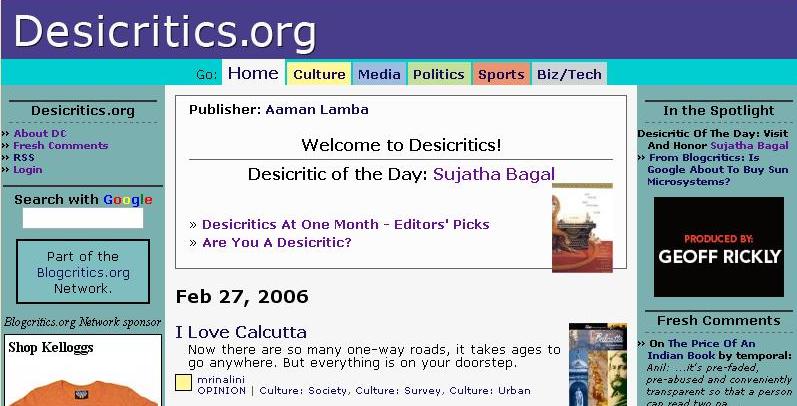
Monday, February 27, 2006

My Fifteen Minutes of Fame

Ok, make that 24 hours of fame!


Check out Desicritics.

Sunday, February 26, 2006

Desicritics Is One Month Old Today

Desicritics, the South Asian offshoot of Blogcritics, is one month old today.

In just a month, Desicritics has made huge strides. There are more than 160 authors on its rolls and the quality and range of articles has been mighty impressive.

Here is a message from the publisher, Aaman Lamba, to mark the occassion:

It's been a pretty good month, far better than one expected when we conceived of Desicritics.org as an online magazine delivering quality news and opinion on all things South Asian with a global focus. Conceived by Eric Berlin as an extension of the successful paradigm established by Blogcritics publisher, Eric Olsen, and technically powered by Phillip Winn, I've been honored to do my part in creating a new reality, closer to the heart.

I do believe Desicritics, Blogcritics, and the ilk are the harbingers of Media 2.0, a citizens' response to big media, embodying the best of blogs as a personal communication medium, and the power of the collaborative, interactive paradigm. The paradigm reflects South Asia, the world's perceptions of the region, and vice versa through the blogosphere's ability to diffract news via opinion, delivering something more than news and opinion.

Eric Olsen commented once on the concept behind Blogcritics,

It's a place to the advantage of both the writers and the readers - they can interact - because we have open comments. You as the reader can participate in the ongoing discussion: you can agree, you can disagree, you can bring in new facts, you can reference materials that you think are important. I think that's something that sets us apart from the traditional media.

The exceedingly fine writers on Desicritics have consistently delivered a delightful variety of news and information on topics ranging from Rang De Basanti to the Cartoon protests. We've covered Arcelor, and joisted on the Indian Army in Kashmir. We've been noticed by the media and the blogosphere as well, and our regular readership continues to grow daily.

One month on, we've got over 160 writers, 100,000+ page views, we added on two more editors (temporal & Sujatha) and we're only just beginning.

Desicritics come from Pakistan and from Australia, from Bangladesh, Toronto, and Bangalore.
If you'd like to be a Desicritic, check this out, and send an e-mail to desicritics@gmail.com. We look forward to adding more quality writers to our rolls.

Thursday, February 23, 2006

The War Against Illiteracy: The View From One Small Corner of the Battlefield

As I turn off of the Jama Masjid Road on to one of the side streets in Ilyasnagar in South Bangalore, I come to a big, colorful shamiana that takes up the entire width of the street. At the head of the shamiana is a dais draped with a thin carpet. On the dais are chairs, a rectangular table with two flower vases (that the photographer promptly removes when the program starts because they're blocking his line of sight) and a microphone on a long stand.

Off to the left of the dais, past the sound system, its snaking wires and the loudspeakers, is the gate that leads to Noor Ayesha's house. The gate opens to a long corridor at the far end of which is the front door that opens to a room about 8 feet by 12 feet that is filled to capacity with people and is buzzing with activity.

Noor Ayesha, petite, reed-thin and bubbling with energy is resplendent in a shimmering green and pink chudidhar. She has a constant stream of guests, some already seated in molded plastic chairs that dot the front room of the house, others still arriving, removing their slippers at the front door before coming in. She is at once in command of the goings on in her house and shies at all the attention she is receiving.

Noor's male relatives are busy lifting low, long school benches lined along one wall of the front room and taking them outside. The women of the house, other than Noor, are busy in the kitchen getting out paper plates, snacks and fruits.

Noor is busy attending to little children, guiding them to a bench in the far corner of the room, getting them to sit. The children are dressed in their best clothes and their faces made up as if for a performance. They sit quietly and patiently and watch the adults.

The room itself has a showcase built into the wall to the left of the front door. The showcase is full of children's notebooks, blocks and puzzles. Number charts, alphabet charts, fruit, vegetable and flower charts hang along the wall facing the front door. A little higher, towards the left of center of the wall, hangs an illustration of Mecca and a chart welcoming everyone. A roll-up black board in the center of the wall proclaims that Noor Ayesha's home is also the Little Lord Pre-Primary English School.

In short, Noor is a foot-soldier in the war against illiteracy in India.

Today, Noor Ayesha and her children are celebrating their school's Annual School Day.

She started out as an Akshara volunteer in their 'Community Outreach' program (of which the pre-school or 'Balwadi' program is one of four components) in November 2004. She went around from house to house with research provided by Akshara (number of children in the household, how many are in school, how many are not and why not) and urged parents to send their pre-school aged children to her house for a few hours everyday so she could school them.

For eight months, she ran her pre-school under Akshara's banner and received all the necessary teaching materials and a monthly stipend from Akshara. Within a few months, she had the experience and a sufficient number of children in her school for her to contemplate going independent. So she took the training offered by Akshara on how to run a self-sustaining Balwadi in April of 2005. From June onwards, she has been running her pre-primary school with the fees she has collected from the families and with some help from her locality's Corporator.

Now Noor has 54 children in the age group of 2 and a half to 6 years old and she's hearing from parents who want to send their children to her even earlier. Initially, her language and math classes were conducted only in Urdu. Following numerous requests from parents, she has now hired an English teacher and offers classes in both Urdu and English.

Enabling Noor to accomplish all this within a span of a few months are her family, her neighborhood and the leadership in her locality. Her in-laws were both school teachers and are fully supportive of their daughter-in-law's efforts to get children in their community on the right track. Her family is investing in building an entire floor above their existing ground-floor house to help her expand her classes. Her local Corporator, known as Mr. Tipu to his constituents, encouraged Noor's efforts by donating books to the school, mementoes for functions, funds to Noor to help her get started when she went independent and fees to families who struggle to send their children to her pre-school.

Although Noor has been on her own for close to eight months now, the Akshara volunteer coordinator looks in on Noor often to check on her progress and help her address operational problems. On the day she celebrated her pre-school's annual day, Mr. Tipu arrived with his entourage to grace the function and exhort the audience to send every child to school and praised Noor's efforts. The Chief Operating Officer of Akshara Foundation, Col. Murthy Rajan attended the annual day celebrations as well, along with Lata Devi, the Balwadi Coordinator for Bangalore and Mamata, a Cluster Resource Person for that part of Bangalore with Akshara. Also in attendance were Balwadi operators from other areas in and around Ilyasnagar who'd gone independent, seeking inspiration from Noor's success and in turn providing support just by being there, sharing her moment of joy.

The success Noor has had not only in starting a Balwadi in her area, but going on to become independent is a sign of the level of demand for education at the pre-primary level. There are no government-run pre-primary schools in Bangalore, so most families who cannot afford private school education end up keeping their children at home until they are old enough to be sent to first grade in the government schools.

Unfortunately, by that time, they are already behind in terms of the things they could have learned in the crucial formative years of their lives. This leads to learning problems in the primary schools and government primary school teachers are overwhelmed by the amount of work necessary to bring the children up to speed. Schools resort to social promotions until the fifth grade with no attention to what the children have actually learned in the intervening years. All these factors collectively result in children dropping out of school altogether somewhere along the road.

This is where Akshara's Balwadi and the government's Anganwadi programs step in. While Anganwadis try to provide health, education, and other essential services that are not accessible to the poorer communities, Balwadis, which became operational in Bangalore in 2000, try to exclusively address this gap in pre-primary education in the slums and day-laborer communities of Bangalore.

Noor's is one of 94 self-sustaining Balwadis in Bangalore. 234 other Balwadis are operating under the Akshara banner. In all, Akshara's Balwadis cover about 4,214 children while the self-sustaining Balwadis serve about 1,915 children.

On this day, Noor, who has not summoned up enough courage to go up on stage, is standing on the ground next to the dais, the microphone pulled low to her height and is welcoming her guests and the parents of her school children. She nervously tugs at her duppatta willing it to stay around her head, her fingers gripping the microphone and adjusting her duppatta by turn. After every sentence, she turns to the English teacher in her school, who has Noor's speech ready in her hands. Together, they make it through the welcome speech.

The audience, mostly women in the front rows, but a sizeable group of men from the community as well in the fringes, many with young children on their laps, are appreciative of Noor. They listen intently when Mr. Tipu speaks, turning to look at Noor every time her name is mentioned.

Noor has moved off to the side now, and is organizing her children. She is already intent on the next stage of the program. This is what the Annual Day is all about. It's about how far her children have come in the span of a year, and it's about showing the parents and the rest of the community why it is important they go to school and stick with it. The children are as excited and nervous as she is. They are about to perform on stage showing off all they've learnt in their Noor teacher's school.


This article was published in Deccan Herald. The published version is available here.

Sunday, February 12, 2006

Say that Again?

"Don't just do something, sit there! "

It took me a couple of readings to understand that simple sentence.

The first time I read it, my mind was only able to register, "Don't just sit there, do something!", the version we are all familiar with.

"With all this socially engaged work, first you must learn what the Buddha learned, to still the mind. Then you don't take action; action takes you."

This, according to the Buddhist monk Thich Nhat Hanh who was 'exiled from Vietnam in the 1960s for his nonviolent antiwar activities' and who now runs the Plum Village meditation center in southwestern France where 'he regularly hosts, among others, Palestinians and Israelis in workshops on conflict resolution and peace negotiation.'

Intrigued?

Read some more here. The entire article is available only by subscription, unfortunately.

Tuesday, February 07, 2006

Caesarean Deliveries: Scientific Progress Gone Boink

Over the past months, a few of my friends and acquaintances have delivered babies. All of them have gone to private hospitals here in Bangalore, some large, some small. Nothing out of the ordinary here, right?

Well, what is out of the ordinary is that the fact that almost all of them have delivered their babies by Caesarean Section (C-Section).

The Indian medical academic community (see p. 6 of that article) estimates that the rate of C-Sections in private hospitals in India is as high as 45%. A conversation I had with the labor and delivery department of a reputed private hospital here, however, puts that percentage at a mind-boggling 70%.

This rising trend in the use of C-Sections for delivering babies is not unique to India.

A Time magazine article (Too Posh to Push, April 19, 2004) highlighted some of the countries with higher than recommended rates of C-Sections (the World Health Organization recommends that C-Sections make up less than 15% of all births). England has a 22% C-Section rate, while Italy's had climbed from 21% more than a decade ago to 33% at the time the article was published, and Brazil takes the cake with some private clinics in that country reporting C-Section rates as high as 90%.

There are, of course, cases of maternal and fetal distress when C-Sections are warranted. And advances in technology, anasthetology and obstetrics have meant that more C-Sections have been performed in recent years in such cases, and they have resulted in more mothers and fetuses surviving childbirth.

There are a few other reasons, however, for this rising trend in the deployment of C-Sections:
  • women opt for C-Sections as a matter of convenience – they want to avoid going through long and painful labor;
  • doctors, overwhelmed with the number of patients they see, have neither the patience nor the time to allow labor to take its normal course; and
  • doctors push C-Sections (which cost twice as much as normal childbirth) on their patients because their hopitals or clinics recuperate the investments they've made in purchasing expensive machines for conducting C-Sections.
And in India, add at least a couple more reasons to that list.

According to this Hindu article, some families are opting for C-Sections because they want their baby delivered at an "auspicious" time. The normal childbirth process, of course, affords no such control over the time of birth. Secondly, some fathers-to-be are "forcing their wives to undergo caesarean section, believing that normal delivery hampers their sex life."

There are, thus, two main prongs in the list of reasons why C-Sections appear to be the preferred form of childbirth: one is the woman or her family's search for control (over pain, over time of birth, over post-delivery sex life) and the other is the doctor's search for control (over cashflow generated by deliveries and over his/her time).

While C-Sections have generally become safer over the years, doctors warn that certain risks remain. C-Sections are major surgeries and among other risks, although the mother may allay the pain for a few hours, recovery can be long and painful. This is definitely not to say that normal childbirth is a walk in the park. There are risks for both mother and child associated with prolonged labor.

Given this scenario, if you are a woman that prefers normal childbirth, what are your options?

There are quite a few steps you can take to be fully prepared before you enter the birthing room.

The first step is to educate yourself regarding the pregnancy and its various stages and the whole labor and delivery process. The internet is a veritable treasure trove of information on this topic. There are also books such as What to Expect When You're Expecting that take you through the pregnancy in an organized and methodical fashion. The third source is information is, of course, your doctor. Do not hesitate to ask questions during your visits.

In fact, talking to your doctor should be a priority. Talk to her about her thoughts on childbirth. What are the scenarios in which she would resort to a C-Section? Is her staff supportive of normal childbirth? Is the hospital equipped to take you through that process? What happens if you go into labor and she is away that day? What are the policies on letting someone (husband, mother) stay with you during labor? And educating yourself allows you to ask the right questions.

If you can find a natural childbirth class near you (most hospitals offer one these days), take it and take your husband or mother (whoever will be with you during labor) to the classes. So you have two minds thinking the day of the delivery rather than just one (labor is as much in the head as it is in the body). Practice the breathing and relaxation techniques they teach. They really do work.

Finally, establish a rapport with the doctor so you feel comfortable and can trust the doctor to do what is right in the end, because no matter how much you've prepared yourself and how much you want natural childbirth, circumstances may prevent that from happening and your doctor may decide that you will need a C-Section after all.

That brings me to the most important point of all - prepare as much as you can to have the kind of childbirth you want, but also prepare yourself to go with the flow. Because while there are many things you can control, it is also wise to acknowledge that there are many more things you cannot.

And that, from personal experience, is a recipe for smooth labor (if there is such a thing).

Note: This article is not meant to be a substitue for professional medical advice. Please consult your doctor for advice regarding your specific circumstances.

Crossposted on Desicritics.org.

Thursday, February 02, 2006

Would you be worried if...

your dentist had bad breath?

A Lesson in Letting Go

My parents' homeowners' association was having its annual Republic Day celebrations late last month and my parents wanted my son to perform something on stage. He had played his keyboard on the last two occasions and neither my son nor myself was keen on another keyboard recital.

It had to be something new, but what? By the last week before the big day we still hadn't decided. I was dragging my feet, as usual.

A couple of days before the function, I was at my parents' house and my dad said, "He's doing his speeches well, just make sure he practices some more."

"What speeches?" I stared at my dad blankly.

"He said he was doing a speech on Time and another on Temples. He has all the points, he just needs to practice some more."

I was speechless. I said I hadn't prepared him. I did not even know that he had thought about what he was going to do. Now it was my parents' turn to stare at me.

So when we came home, and I asked him to show me how he did the speeches in front of my parents. He reeled off everything he had thought about those two topics - how the clock tells us time, and how time tells us what we need to be doing at particular points during the day, how temples are decorated with elephants, and how people make temples very dirty by dropping things on the floor (that's his pet peeve about temples), etc.

The whole thing was just so cool.

I noticed, however, that everytime he recited his speech, the content changed. He would add stuff, he would omit stuff, he would just go off on a tangent (the prasada is too sweet and eating too many sweet things is not good for you, etc.). This was making me uncomfortable. If he did not learn them by rote, he would forget. What if he tried to make up something and he blanked out?

So I decided to teach him that skit about the hole in the bucket, that staple from school annual day functions. He got the story the first time I recited it and after a few practice sessions, he did it pretty well and was good-natured about learning something new on short notice.

But I could see that he was excited about his speeches. Everytime we talked about the function, it was his speeches he brought up. It was his baby.

I was torn between letting him do what he was excited about and making him perform something I was sure he would get right. So I decided to let go and gave him the choice. He went with the speeches, although, I have to tell you, not before agonizing a little bit about making me unhappy if he chose the speeches over my skit.

On the big day, he went up the the stage when his name was announced, grabbed the mike and started off. And what my parents and I heard that day was completely different than what we had heard before.

But he had fun. And I couldn't be happier. He came up with a plan and he executed it, pretty much all on his own. He wasn't afraid of going up there and goofing up.

And, he's promised me, the next time there's a function, he would do the "hole in the bucket" routine.

P.S. He just doesn't like the prasada, and so that it is sweet is just his excuse. He loves chocolate and ice cream, on the other hand.

Stable vs. Happy Marriages

Uma had this post today in which she quoted from an e-mail she received from a gentleman living in the US. He was making a case for the dowry system:
There are innumerable cases all around us in Indian communities in which relatively ineligible (say not good looking) girls have found highly eligible boys by the weight of the other factors, often dowry, and most marriages have been stable, if not successful.
And, by coincidence, R, the lady who helps me with the chores around the house recounted this story about an elderly couple in whose house she's also employed in our apartment complex.

It was the husband's birthday. He had wanted a battery-operated wrist watch as a gift. The wife gave him the battery-operated watch all right.

Minus the batteries.

She had removed the batteries before she gave the watch to her husband. The husband demanded the batteries, the wife pretended that the watch did not come with any.

So, there's an example of a stable (I assure you, neither of them has any inclination to go after the next hottie that crosses their diminishing sight), but decidedly unhappy union of two souls.

Tuesday, January 31, 2006

NRI Parents: Empty Nesters, But Lonely No More

Here's a social sub-group that my parents belong to, but it never crossed my mind until I read this article in the Feb 6, 2006 edition of Outlook magazine - NRI Parents.

In other words, parents of Non-Resident Indians.

These parents have a lot more in common than just their children living away from them in foreign lands. They face common issues at home - loneliness, lack of a support system, travel issues, management of funds, etc. So they banded together to form associations. Many such associations are already up and running in almost every major city in India including Mumbai, Pune, Bangalore, Baroda, Ahmedabad and Coimbatore.

How do these associations help? In more ways than you can imagine:
They meet every month; organise excursions, get-togethers and recreational activities; celebrate festivals; bring out newsletters and directories of members; and in times of need provide a rock-solid support network. At a more practical level, they provide lists of recommended vital service providers, hold lectures and workshops on typical concerns like travel, insurance, healthcare, and foreign exchange; teach members to become computer-savvy enough to stay in regular e-mail contact with their children; help those travelling abroad, especially first-timers, with visa and passport modalities, ticketing, medical insurance and the like; and stand guard over each other's personal and material well-being. Some associations even advise their members' NRI children on investment, property ownership, taxation, repatriation of funds, inheritance, and dual citizenship, and help returnees relocate and resume careers and children's education.
One aspect of this banding together that I love is the fact that these parents watch out for each others' well-being, especially in times of medical crises. The article tells the stories of aged parents having to go through medical procedures, but not having to have their children catch the first flight back home. Because this time around they had their buddies accompanying them on doctors' visits, staying with them at the hospital and taking them back home with them to recuperate after the procedures.

What a sense of comfort this must be, not just for the parents but for the children as well.

So if you're living abroad and have parents living in India, directing them to these associations may not be a bad idea.

Crossposted on Desicritics.org.

Monday, January 30, 2006

How the Other Half Lives

How the Other Half Lives - A Reality Called India is a group blog started by a few of the excellent bloggers in the Indian blogosphere - Uma, Dilip, Vikrum, Shivam and Anand. This is how they describe their blog and their efforts:
We know that India still remains deeply divided between its elites and its have-nots; a divide so great that much of the elite does not even see it, happily believing that the nation as a whole is on its way to superpower status. There is no doubt at all that economic liberalisation has helped a section of the economy, yet there is equally no doubt that there are faultlines in economic growth and equitability. Rifts across the lines of caste and communalism intersect in complex ways with the changing economic landscape.

This blog will attempt to explore that uncertain terrain. It will focus on the “other half” that is often ignored by the mainstream media. It will attempt to present a fuller picture of India and a fuller examination of issues of concern than what we normally see around us.

To this end, we hope to ask questions and suggest answers. Some of the questions we ask include:

  • Fundamentally, what are the aims of liberalization; what should they be; and what else defines India in the 21st century, apart from the growth of our economy or the successes and failures of liberalization?
  • Which sections of Indian society and the economy have benefited from liberalization, and which ones have not? And which ones have been adversely affected because of liberalization?
  • Is poverty decreasing? If so how much and how fast?
  • What are we doing to push growth and opportunity in rural areas, where over two-thirds of Indians still live?
  • What about issues of caste, class, gender? What about food, housing, water, sanitation, education? What about corruption, crime, social justice, rights and responsibilities?
[...]

Because India is changing, in many ways and dramatically. Yet in many ways India is also much the same. This blog is a fruit of the tension between those two thoughts, an attempt to examine the ground in between.

Surely it is time for us to pay attention to how the other half lives.
Check it out. I expect it to be well worth your time and thought.

Friday, January 27, 2006

Of Babysitting and Stolen Childhoods

At least twice a month, Saturday nights were movie nights. We hired a babysitter to play with our young son for a couple of hours, drove to the nearest movie theater, got tickets to whatever movie still had a few seats open and watched that movie.

The neighborhood where we lived in northern Virginia had three girls in their early teens who were interested in babysitting and earning some money along the way. All three had obtained training in CPR (cardiac pulmonary resuscitation), were Girl Scouts (Girl Guides, as they are known in India) and were very professional in their approach to babysitting. They arrived at the appointed time and never canceled if they had promised they would be there on any given day.

One of them, in particular, took her job very seriously. The first day she was to babysit for us, she whipped out a one page, typed form for us to fill. The form asked for everything from our emergency contact information to our son's bedtime, his medications, if any, allergies, if any, his dinner time and what he liked to eat for dinner.

We were taken aback, to say the least.

She was also very well prepared to handle our son for the two odd hours she expected to play with him. She had brought along with her some crayons and pictures for him to color, and some games.

This Saturday night arrangement worked well for all parties involved. My husband and I got to hang out together and watch a movie or attend work-related events, our son had a fun time with a babysitter who wasn't averse to squealing like a child herself and running around the house after him, and the babysitter got to earn money for whatever she was saving for (one of them financed a trip to Mexico through her earnings).

When we moved to Bangalore about a year ago, I was delighted to find a lot of teens in our neighborhood. I, of course, saw potential babysitters in all of them. Fully expecting to have at least five potential babysitters in my rolodex by the end of the week, I approached two of them who were hanging out in the childrens' park in our apartment complex.

"Hi, I was looking for a babysitter for my son. Do you guys babysit?"

"Whaaa...?" read their expressions. They didn't have a clue as to what I was saying.

They looked at each other and got up and walked away, leaving me with my mouth hanging open.

I thought I had approached the whole thing wrong. May be I should've asked the parents.

So I talked to the mother of one of the girls. Her reaction was not much better than the one I got from the girls. Finally I got something along the lines of "I don't think she'll be interested," from the mother.

I couldn't figure it out. It's not that no one had ever heard of babysitting here. Moreover, what did the other parents do? Most families have both parents working and most families are nuclear units, so the need for a babysitter (as distinct from a full-time nanny) must arise at some point.

A couple of months down the road the picture became somewhat clearer. Most of the families with young children had someone staying with them. In some cases it was a grand-parent, but more often than not, a young girl, practically a child herself, transplanted from some village to live at the house and take care of children not much younger than herself.

I saw them everywhere. I saw them at the park with the kids (I saw more such young girls than the childrens' mothers in the park), I saw them at the grocery store handling the cart and the children while the mother piled the cart with groceries, I saw them at the school gates waiting patiently to pick up their wards.

You don't have to look very hard to find the irony in this picture. We hesitate to have our own children "work" while apparently having no objection to young children working long hours to care for our children.

And children don't just work in homes. They work in extremely hazardous conditions in factories and construction sites, in the cities as rag pickers and in the fields. Here is a heart-breaking story from a Human Rights Watch report from a few years ago about a girl forced to work in a beedi-rolling factory:
My sister is ten years old. Every morning at seven she goes to the bonded labor man, and every night at nine she comes home. He treats her badly, he hits her if he thinks she is working slowly or if she talks to the other children, he yells at her, he comes looking for her if she is sick and cannot go to work. I feel this is very difficult for her.

I don't care about school or playing. I don't care about any of that. All I want is to bring my sister home from the bonded labor man. For 600 rupees I can bring her home - that is our only chance to get her back.

We don't have 600 rupees. We will never have 600 rupees.
The entire report is here.

More recently, Outlook (January 23, 2006 issue) carried some horrifying stats on the state of child labor in India.
Nearly 17 million children have to work for a living, many of them in hazardous environments. Close to 30% of the 2 million sex workers are underage. Less than half of India's 430 million children go to schools.
And in any given month, there are at least two stories such as these about the discovery of child labor and the rescue of the children.

And there is something we can all do about it.

Next time you see a child working somewhere he or she should not be working, please report it to the authorities. Organizations such as Akshara Foundation will work with the families of such children and will give them lessons at least for a few hours everyday so that the endless cycle of lack of education and financial indebtedness is not repeated.

This post began on a somewhat facetious note about babysitters, but the point, really, is about children and their right to their childhood, to an education, and to at least the opportunity to get out of whatever financial morass their families have gotten into.

Crossposted on Desicritics.org.

Saturday, January 21, 2006

3 Knights in India and Chinese Take-Out

John Steventon is a cartoonist who's working on his second publication, 3 Knights in India. After seeing my post about the Jayanagar IV Block Shopping Complex, he sent me an e-mail with an interesting question.

He wanted to know what kind of containers are used by Chinese restaurants for packing take-out food so he could depict it appropriately in his illustrations.

In Bangalore, Chinese food comes in round, white, plastic containers with plastic tops. Some restaurants have their name on the containers and some don't.

Has anyone seen any another kinds of containers for Chinese take-out food? Do they pack some food in aluminium foil?

John has visited Bangalore twice to research the series and has some lovely photographs of those visits. Check out the one captioned "Why spelling really does count". It's hilarious.

But even better than the photographs are his cartoons that were inspired by his visits. He's uploaded them as well right alongside the photographs.

Here is his depiction of the Jayanagar market.
Cartoon by John Steventon (www.happyglyphs.com)

Thursday, January 19, 2006

Did a Double Take, Anyone?

Woke up at 4 this morning (jet lag has been unusually severe this time around) and had a hankering for less color. So started tinkering around and came up with this.

Now that I'm looking at it, just too bland. But will stick with it for a while. May be it'll grow on me.

Whaaa...? Come again?

I was at a wedding yesterday.

Towards the end of the marriage ceremony, but while the rituals were still going on, the band switched from traditional carnatic music to that song from Dilwale Dulhaniya Le Jayenge, "Tujhe Dekha To Ye Jaana Sanam"!

I know I sound like a stodgy old woman, but it was a little weird at first. A while later, it was quite enjoyable.

Friday, January 13, 2006

Clash of the Worlds

N and I were at the DMV (Department of Motor Vehicles) a couple of days after we got to the US to get our car license tags reissued.

We took a number to get in line, I filled out the application form and we sat in the row of chairs facing the 17-odd customer service counters. Christmas decorations were everywhere - green imitation pine streamers hung from the doors, windows and ceiling, red bows punctuating them every two feet or so, and red stockings hung from every counter with the name of each employee written in shiny colorful markers across the white furry borders.

As we sat waiting, we read the names on each of the stockings. When we came to the one with lettering in gold-colored marker, I blinked. The name looked like it had been written in Kannada. I blinked again, but it wouldn't go away.

I asked N to go up closer to the stocking and see if it was written in Kannada. He looked at me like I was nuts ("You've got to be kidding, mom"), but he went to the stocking and looked. It said Safiana. In English, of course.

Snippets of conversations I could not catch in crowded places seemed like they were spoken in Kannada. I looked around and there was not a single Indian face to be seen. It's not just me. On this trip, N sometimes thought he heard Kannada too.

This was not the first time my two worlds have clashed in my head. When we're driving around in the US on a stretch of road empty of other vehicles, with relatives or our Indian friends in the car, listening to a Hindi CD, it comes as a complete shock to me when we come to a traffic signal and there are cars with non-Indian faces in them.

We're not in Kansas anymore, Toto.

And my brain doesn't just transplant India into the US. The reverse works very well too.

A few months ago I was at my uncle's house in Bangalore for a pre-wedding family get-together (my cousin was getting married). I was dressed up in Indian clothes, of course, with bindis going a mile up on my forehead and bangles clanging on my wrists. On the way back home I needed to stop at the grocery store for something.

As I was leaving my uncle's house, an image flitted across my head. I was going to show up at the grocery store in all my Indian finery. Just a thought. And an awareness that I would get a lot of stares and smiles and perhaps some questions.

A second later it struck me.

Duh! I'm in India! I'm not going to the local Safeway, I'm going to Monday to Sunday!